
This post contains affiliate links. If you buy through them, we may earn a commission at no extra cost to you.
Short answer: inverter generators run at 48 to 62 decibels at quarter load, about the level of a normal conversation, while conventional open-frame generators run at 68 to 80 decibels, the level of a vacuum cleaner or a lawn mower. The decibel scale is logarithmic, so a 72 dBA generator sounds roughly four times louder than a 52 dBA one, not 40 percent louder. Manufacturer noise ratings are measured at 23 feet (7 meters) at 25 percent load; at full load, add 5 to 10 dB. If you live in a neighborhood, a 60 dBA-or-quieter inverter is the difference between neighbors who tolerate an outage and neighbors who call the police.
Decibels in Context
| dBA | Comparable Sound | Generator Class |
|---|---|---|
| 40 | Quiet library | None |
| 48-52 | Quiet conversation, refrigerator hum up close | Small inverter (2,000-2,500W) in eco mode |
| 55-62 | Normal conversation, dishwasher | Mid inverter (3,000-4,500W); large inverter (7,000-9,500W) at low load |
| 65-70 | Vacuum cleaner, busy restaurant | Quiet conventional units; large inverters at full load |
| 72-78 | Lawn mower, garbage disposal | Typical open-frame conventional (4,000-9,500W) |
| 80+ | Leaf blower, heavy traffic | Large open-frame units at full load |
Every 10 dB increase is perceived as roughly twice as loud. A 74 dBA conventional generator is not “a bit louder” than a 54 dBA inverter; it is about four times as loud to the ear and carries far further at night.
Noise Ratings of Popular Models
Manufacturer figures, measured at 7 meters at 25 percent load unless noted:
| Model | Type | Rated Watts | Noise at 25% Load | Noise at Full Load (approx.) |
|---|---|---|---|---|
| Honda EU2200i | Inverter | 1,800W | 48 dBA | 57 dBA |
| Generac GP3300i | Inverter | 2,500W | 52 dBA | ~60 dBA |
| Champion 2500W dual fuel | Inverter | 1,850W | 53 dBA | ~61 dBA |
| Champion 4500W dual fuel | Inverter | 3,500W | 61 dBA | ~68 dBA |
| Westinghouse iGen9500DF class | Inverter | 7,500W | 52 dBA | ~65 dBA |
| Westinghouse WGen3600 | Conventional | 3,600W | ~69 dBA | ~74 dBA |
| Champion 4375W open frame | Conventional | 3,500W | 68 dBA | ~74 dBA |
| Westinghouse WGen9500DF | Conventional | 9,500W | 74 dBA | ~80 dBA |
| Generac GP8000E | Conventional | 8,000W | ~74 dBA | ~80 dBA |
Notice the large inverter row. A 9,500-watt inverter unit at light load is quieter than a 2,500-watt conventional unit, because the engine slows down when the load is small. That is the whole argument for inverter technology in one line. For the other differences, see inverter vs conventional generators.
Why Inverter Generators Are Quieter
- Variable engine speed. A conventional generator runs at 3,600 RPM constantly to make 60Hz. An inverter generator makes DC and converts it, so at a 300-watt load the engine idles at a fraction of full speed.
- Enclosed housing. Inverter units are fully enclosed in sound-absorbing plastic. Open-frame units have nothing between the engine and your ears.
- Better mufflers. Because the housing traps heat, inverter units are designed with more effective exhaust systems.
How to Make Any Generator Quieter
| Method | Typical Reduction | Cost | Notes |
|---|---|---|---|
| Distance | 6 dB per doubling of distance | Free | Moving from 10 to 40 feet cuts perceived loudness by three quarters |
| Exhaust pointed away from the house | 3-5 dB at the house | Free | Also required for CO safety |
| Rubber or foam pad underneath | 2-4 dB | $15-$40 | Stops vibration transferring to a deck or concrete |
| Eco mode on | 5-10 dB at light loads | Free | Inverter units only |
| Running at lower load | 5-10 dB | Free | Right-size the generator; a 9,500W unit running 800W is loud for nothing |
| Sound-deflecting baffle (plywood or acoustic panels, open top) | 5-10 dB in one direction | $50-$150 | Must leave 3+ feet of clearance on every side and be open above; never a closed box |
| Purpose-built generator enclosure with ventilation | 10-15 dB | $200-$600 | Only designs with forced ventilation; a sealed box overheats the unit and concentrates CO |
| Aftermarket muffler | 3-8 dB | $40-$150 | Motorcycle-style mufflers adapted to generators; check exhaust back-pressure limits |
Distance is the free, guaranteed win. Every doubling of distance drops the sound level by 6 dB. A 74 dBA generator at 23 feet is about 68 dBA at 46 feet and 62 dBA at 92 feet. The 20-foot minimum for carbon monoxide safety is also the first step in noise control; our guide to generator carbon monoxide safety explains why closer is never an option, and any noise enclosure has to respect those same airflow rules.
Check the current price of generator anti-vibration pads on Amazon
Neighborhood Rules and Noise Ordinances
Most U.S. cities have a residential noise ordinance in the range of 55 to 65 dBA at the property line during the day and 45 to 55 dBA at night. Many carve out an exception for emergency generators during an outage; many do not. HOAs often have their own rules. In practice, a neighbor’s complaint during a real outage rarely goes anywhere, but a 78 dBA open-frame unit running all night 15 feet from a bedroom window will test that goodwill. If you live close to neighbors, an inverter unit under 60 dBA and a run-in-shifts schedule (off from 10 pm to 6 am, letting the fridge coast) keep the peace. Our roundup of the best inverter generators for home backup is sorted with noise in mind.
The Silent Option: Battery Power Stations
A lithium power station makes no engine noise at all; the only sound is a small cooling fan during fast charging, around 35 to 45 dBA. For overnight power in a neighborhood, a 2kWh station running the fridge, lights, and a CPAP while the generator is shut off is the setup that keeps everyone asleep. Recharge the battery from the generator during the day. See power station vs generator for how the two work together, and the best portable power stations for home backup for sizes.
Check the current price of quiet inverter generators on Amazon
Reading a Noise Spec Correctly
Manufacturer decibel ratings are not lies, but they are chosen to look good. Three things to check before comparing two numbers:
- Distance. The industry standard is 7 meters (23 feet). Some brands quote 10 meters or even 15 meters, which lowers the number by 3 to 7 dB for the same machine. Two ratings at different distances cannot be compared directly.
- Load. Most ratings are at 25 percent load. A generator you will run at 75 percent load during an outage will be 5 to 10 dB louder than its spec. If the brand publishes a full-load figure, use that one.
- dB vs dBA. dBA is weighted to match human hearing and is the standard. A plain “dB” figure without the A is either sloppy or measured differently. Treat it with suspicion.
Independent measurements from owners with a meter are worth more than the box. When two units are within 3 dB of each other on paper, they are effectively the same; when one is 10 dB quieter, it is about half as loud and you will notice it every hour of the outage.
Measuring It Yourself
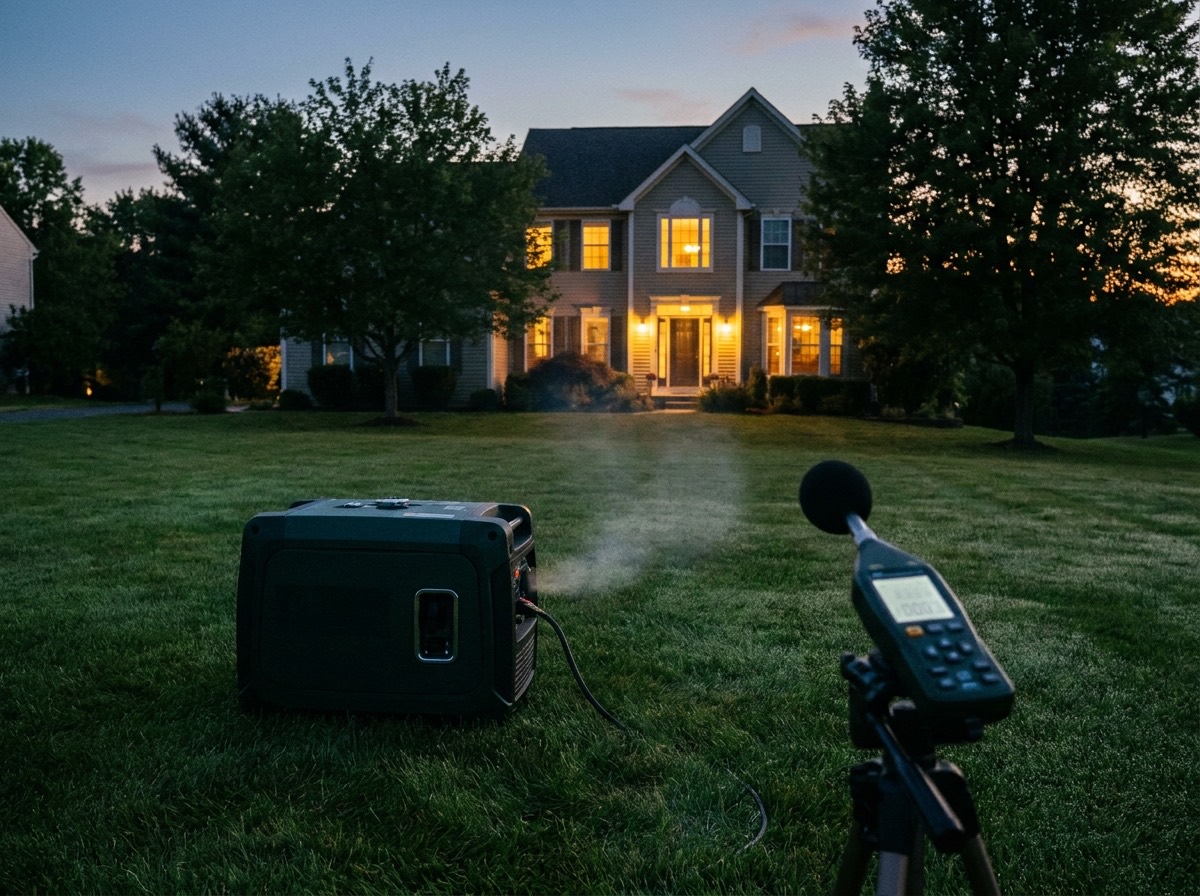
A phone decibel meter app gives a rough reading; a $20 to $40 handheld sound level meter gives a repeatable one. Measure at 23 feet with the generator at the load you actually use, and again at your bedroom window and at the property line. Numbers beat arguments, with the neighbors and with yourself when deciding whether the old open-frame unit is worth replacing.
Frequently Asked Questions
How loud is a portable generator?
Inverter generators run 48 to 62 dBA at quarter load, about a conversation. Conventional open-frame units run 68 to 80 dBA, like a lawn mower.
What is the quietest portable generator?
Small inverter units like the Honda EU2200i (48 dBA) and Yamaha EF2200iS (57 dBA at rated load) are the quietest. Among larger units, enclosed inverter models in the 7,000 to 9,500-watt class run around 52 dBA at low load.
Can I put my generator in a box to make it quiet?
Only a purpose-built enclosure with forced ventilation and an exhaust path. A closed box overheats the generator, and concentrating exhaust is a carbon monoxide hazard. An open-topped baffle with 3 feet of clearance on every side is the safe DIY version.
Is 60 dB loud for a generator?
No. 60 dBA is normal conversation level and is quiet for a generator. Most neighborhood noise ordinances allow it during the day.
How far away should a generator be to reduce noise?
Every doubling of distance cuts about 6 dB. Forty to fifty feet from the house makes most generators tolerable, and the 20-foot minimum for CO safety is the floor.