
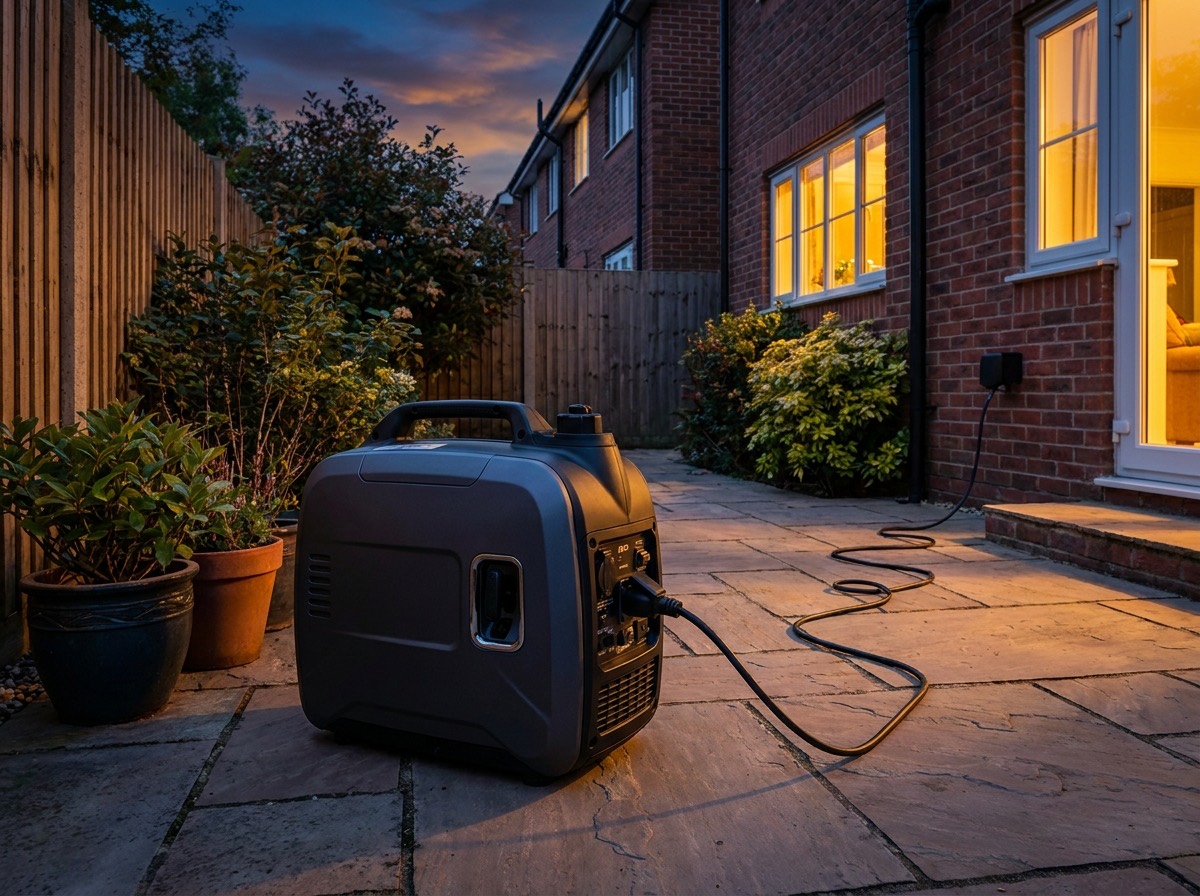
This post contains affiliate links. If you buy through them, we may earn a commission at no extra cost to you.
Short answer: for most homes, the best inverter generator for backup is a 3,500 to 4,500-watt dual-fuel unit with a 30-amp outlet. That size runs a refrigerator, furnace blower, lights, a microwave, and a sump or well pump in rotation, stays quiet enough for a neighborhood, and can feed the house through an inlet box. If you only need the fridge and phones, a 2,200-watt unit is lighter, cheaper, and sips fuel. If you want a window air conditioner or a 240-volt well pump on top of everything else, step up to the 7,000 to 9,500-watt inverter class.
Quick Picks at a Glance
| Category | Pick | Rated / Peak Watts | Fuel | Noise at 25% Load | Why |
|---|---|---|---|---|---|
| Best overall for home backup | Champion 4500W Dual Fuel Inverter | 3,500W / 4,500W (gas) | Gas or propane | ~61 dBA | 30A outlet, dual fuel, electric start, price |
| Best small and quiet | Honda EU2200i | 1,800W / 2,200W | Gas | ~48 dBA | Reliability benchmark, 47 pounds |
| Best for whole-house loads | Westinghouse iGen9500DF or equivalent 9,500W inverter | 7,500W / 9,500W | Gas or propane | ~52 dBA | 240V, 50A outlet, CO shutoff |
| Best mid-size value | Generac GP3300i | 2,500W / 3,300W | Gas | ~52 dBA | Light, PowerRush surge, USB ports |
| Best paired pair | Two 2,200W units with a parallel kit | 3,600W / 4,400W combined | Gas | ~50 dBA | Run one for light loads, both for heavy |
Why Inverter Generators Are Better for Home Backup
A conventional open-frame generator spins its engine at a constant 3,600 RPM to make 60Hz power, no matter the load. An inverter generator produces raw power, converts it to DC, and inverts it back to clean AC electronically, which lets the engine slow down when the load is light. Three things follow from that:
- Clean power. Total harmonic distortion under 3 to 5 percent, which is safe for laptops, TVs, furnace control boards, CPAP machines, and EV chargers. Conventional units can exceed 15 percent.
- Quiet. Roughly 50 to 60 dBA at 25 percent load, about the level of a conversation, versus 70 to 80 dBA for open-frame units. Over a three-day outage, your neighbors and your own sleep will notice.
- Fuel efficiency. At light loads, an inverter unit can use half the fuel of a conventional generator of the same size. Our guide to how long a generator runs on a tank of gas shows the numbers by class.
The trade-off is price per watt. An inverter generator costs 1.5 to 2 times as much as a conventional unit of the same output. For a full breakdown, see inverter vs conventional generators.
The Best Inverter Generators for Home Backup in 2026
1. Champion 4500W Dual Fuel Inverter: Best Overall
The Champion 4500 hits the sweet spot for home backup. It runs 3,500 watts continuously on gasoline (3,150 on propane), has a 30-amp RV-style outlet that connects to a home inlet with a single adapter cord, starts with a button, and switches to propane when the gas cans run dry. Fuel economy mode brings noise down to around 61 dBA at light loads. At 97 pounds with wheels, it moves like a suitcase. We go through runtime by load and our reservations about the wheel kit in the Champion 4500W dual-fuel review.
Weak spots: louder than the Honda class, and 3,500 watts will not run a 240-volt well pump.
Check the current price of the Champion 4500W dual-fuel inverter generator on Amazon
2. Honda EU2200i: Best Small and Quiet
The EU2200i is the unit every other small inverter is compared to. 1,800 watts continuous, 2,200 peak, 47 pounds, roughly 48 dBA in eco mode, and a track record of starting on the first or second pull after years in a garage. It runs a refrigerator, lights, a router, and phone chargers for about eight hours on its 0.95-gallon tank at light load. A parallel kit joins two of them for 3,600 watts, which is how many owners grow into a bigger setup without replacing anything. Full details in the Honda EU2200i review.
Weak spots: no 30-amp outlet on a single unit, gas only, and the price is high for 1,800 watts.
Check the current price of the Honda EU2200i on Amazon
3. 9,500W Dual-Fuel Inverter (Westinghouse iGen9500DF class): Best for Whole-House Loads
This is where inverter technology meets whole-house power. Units in this class deliver 7,500 watts continuous at 120/240V, with a 50-amp outlet for a transfer switch, remote start, CO shutoff, and dual fuel. That runs a 240-volt well pump, a window or small central AC unit, a furnace, and the kitchen at the same time. Noise stays around 52 dBA at quarter load thanks to the enclosed design. The trade-off is weight (200 pounds or more) and a price approaching a small standby generator. If you are choosing between this class and a permanent unit, read is a whole house generator worth it.
Check the current price of 9,500W dual-fuel inverter generators on Amazon
4. Generac GP3300i: Best Mid-Size Value
Generac’s GP3300i gives 2,500 watts continuous and 3,300 peak with a PowerRush feature that briefly delivers extra surge for motor starts, in a 60-pound package with a carry handle. It has two 120V outlets, USB-A and USB-C, and a fuel gauge, which the Honda lacks. Noise is a touch higher than the Honda but still neighbor-friendly. We compared the two directly in Generac GP3300i vs Honda EU2200i.
Check the current price of the Generac GP3300i on Amazon
5. Two 2,200W Units in Parallel: Best Flexible Setup
Instead of one 4,000-watt generator, some households buy two 2,200-watt inverters and a parallel kit. On a mild outage, run one at 48 dBA and 0.1 gallons per hour. On a heavy day, join them for 3,600 watts. If one fails, you still have power. The math works out close to the price of a single 4,000-watt inverter, and the redundancy is worth a lot in a multi-day outage. Look for a parallel kit with a 30-amp outlet so the pair can feed a home inlet.
Check the current price of inverter generator parallel kits on Amazon
How to Size an Inverter Generator for Your Home
Add up the running watts of everything you want on at the same time, then add the largest single surge. A typical essentials list:
| Appliance | Running Watts | Starting Surge |
|---|---|---|
| Refrigerator | 150-200W | 1,000-1,500W |
| Gas furnace blower | 400-800W | 1,200-2,000W |
| Sump pump (1/3 HP) | 800W | 1,300-2,000W |
| Well pump (1/2 HP, 240V) | 1,000W | 2,000-3,000W |
| Microwave | 1,000-1,200W | 0 |
| LED lights (10) | 100W | 0 |
| Wi-Fi and phone charging | 50W | 0 |
| Window AC (8,000 BTU) | 700W | 2,000W |
Fridge, furnace, lights, Wi-Fi, and a microwave in rotation: about 2,000 watts running with a 1,500-watt surge on top, which fits a 3,500-watt unit comfortably. Add a well pump and you need 240-volt output and the 7,000-watt-plus class. The generator size calculator does this math for your specific list, and the appliance wattage guide has figures for everything else.
Connecting It to the House
A 2,200-watt unit powers things through extension cords. Anything with a 30-amp outlet can feed a power inlet box and an interlock kit or transfer switch, which puts the furnace, well pump, and lighting circuits on generator power without a single cord through a window. That installation is the best money most homeowners spend on backup; our guide to connecting a portable generator to your house covers cost and options.
Features That Matter (and Ones That Do Not)
- CO shutoff sensor: non-negotiable in 2026. See generator carbon monoxide safety.
- Dual fuel: worth it. Propane stores forever, and after a hurricane the gas stations are closed.
- Electric start: worth it on anything over 3,000 watts; keep the battery on a float charger.
- 30-amp outlet: essential if you will ever connect to the house.
- Eco mode: standard on all inverters; use it.
- Bluetooth app: nice for checking fuel from the couch, not a reason to pay more.
- Wheel kits: mandatory above 80 pounds, and usually sold separately.
Frequently Asked Questions
What size inverter generator do I need to run a house?
For essentials (fridge, furnace, lights, Wi-Fi, microwave in rotation), 3,500 to 4,500 watts. For a well pump or air conditioning on top, 7,000 watts or more with 240-volt output.
Are inverter generators worth the extra cost?
For home backup, usually yes. The fuel savings over a multi-day outage, the quiet, and the safe power for electronics and furnace boards justify the premium for most households.
Can an inverter generator run a furnace?
Yes. A gas furnace draws 400 to 800 watts running with a surge under 2,000 watts. Even a 2,200-watt inverter can run one, though a 3,500-watt unit gives room for the fridge as well.
Which is more reliable, Honda or Champion?
Honda has the longest track record of starting after years of storage. Champion units are well regarded at their price and offer dual fuel, which Honda does not. Both will serve a household for a decade if maintained.
How long will an inverter generator run on a tank?
A 2,200-watt unit runs about 8 hours at light load on a gallon. A 4,500-watt dual-fuel unit runs 10 to 14 hours on its tank at quarter load, or about 7 hours on a 20-pound propane cylinder at half load.