
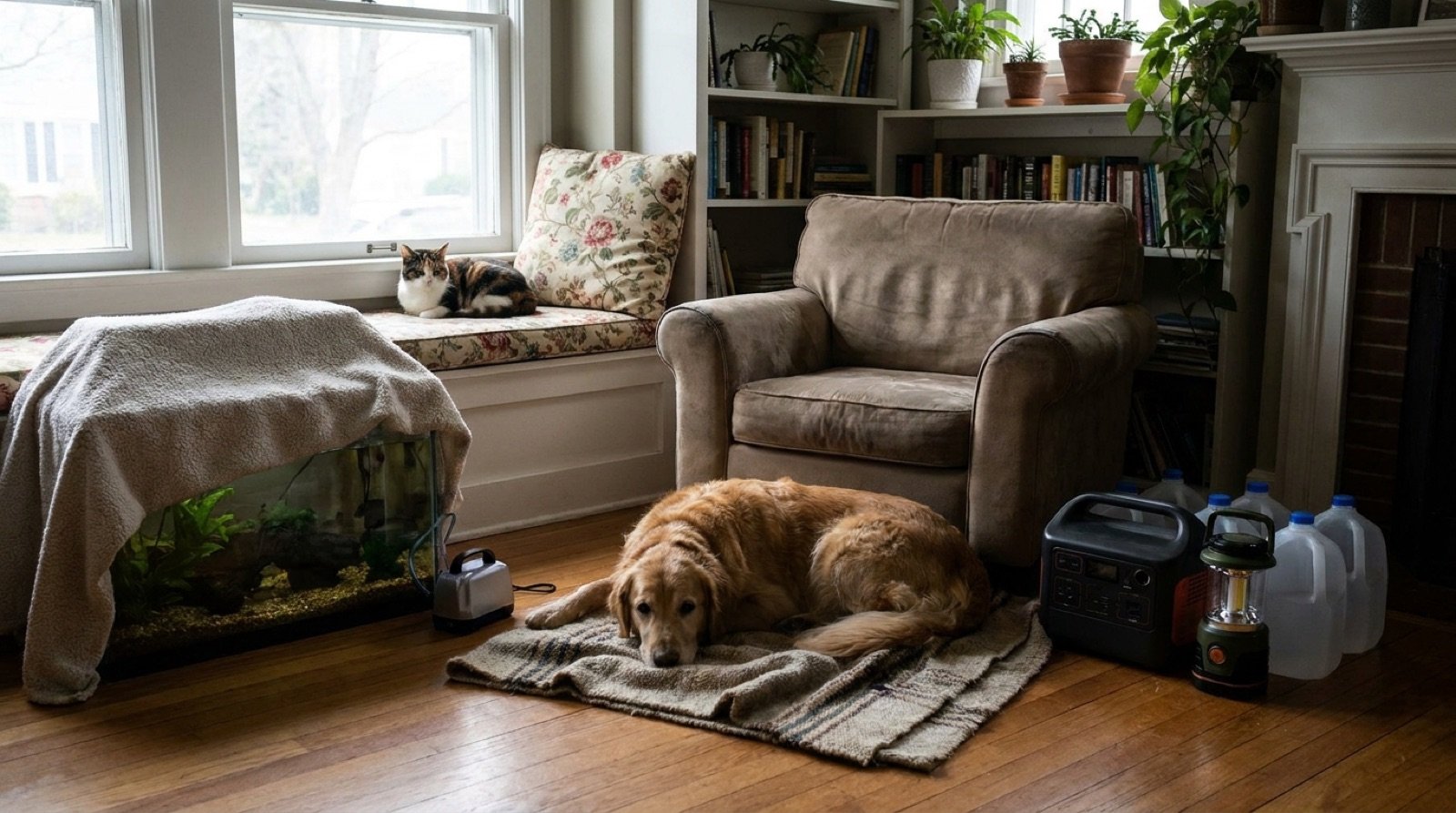
Short answer: Most dogs and cats handle a power outage well if you control the temperature, store about 1 gallon of water per pet per day, and keep them calm and contained. Aquarium fish are the most fragile: a battery air pump (2 to 5 watts) keeps oxygen in the water, and wrapping the tank in blankets slows heat loss. Even a 300 Wh power station can run a 3 watt air pump for about 3 days (300 Wh x 0.85 usable / 3 W = 85 hours).
Why Pets Need Their Own Outage Plan
Your outage plan probably covers food, phones and the fridge. Pets add four problems that people often miss until the lights go out: temperature, water, oxygen for fish, and stress.
Dogs and cats cool themselves mostly by panting, not sweating, so a hot, closed house is harder on them than on you. Fish depend on electric pumps for oxygen and heaters for stable temperature. Birds, reptiles and small mammals like rabbits and guinea pigs are sensitive to temperature swings too. And nearly every pet reacts to storms, darkness, strange noises and a household that suddenly behaves differently.
The good news: most of what pets need uses very little electricity. A fan, an air pump and a heated pad add up to a few hundred watt-hours a day, which a modest battery can handle.
Heat: The Biggest Summer Risk
Summer outages are often the dangerous ones for dogs and cats. Without air conditioning, an indoor room can climb fast on a sunny afternoon, especially upstairs or in rooms with west-facing windows.
Pets at higher risk include flat-faced breeds (bulldogs, pugs, Persian cats), seniors, puppies and kittens, overweight pets, and animals with heart or breathing problems. Watch for heavy panting, thick drool, bright red or pale gums, stumbling, vomiting or unusual lethargy. Those are signs of heat stress or heatstroke, and they need a veterinarian quickly.
How to keep pets cool without grid power
- Pick the coolest room. Usually a ground-floor or basement room on the north or east side. Close blinds on sunny windows early in the day.
- Run a fan on battery. A box fan or pedestal fan typically draws 30 to 60 watts. Aim it near, not directly at, the pet so they can move away.
- Offer cool surfaces. Tile, a damp towel, or a cooling mat that needs no power.
- Add water stations. Put out two bowls so one spill does not leave the pet dry. Drop a few ice cubes in while the freezer is still cold.
- Skip exercise. Walk dogs at dawn or after dark, and keep it short.
If you have a generator or a large power station, cooling one room with a small window unit is realistic. See the guide on how to run a window air conditioner on a generator or power station for the wattage and runtime math.
If a pet does overheat, move them somewhere cooler, wet their body with cool (not ice cold) water, offer small sips of water, and call your vet or an emergency animal hospital on the way.
Cold: Winter Outages and Small Animals
Healthy adult dogs and cats with normal coats tolerate a cool house better than people do. The concern is when indoor temperatures keep falling for days. Short-haired breeds, small dogs, seniors, and pets with arthritis or thyroid problems feel cold first.
- Bring outdoor pets inside. A garage or shed is not a safe shelter in a hard freeze, and a garage is never a place to run a generator.
- Gather everyone into one room. Close doors to unused rooms so body heat and any safe heat source warm a smaller space.
- Raise beds off the floor and add extra blankets. Covered crates with a blanket over three sides hold warmth well.
- Use a low-watt heated pad instead of a space heater where possible. Pet heating pads often draw roughly 10 to 40 watts, a tiny fraction of a 1,500 watt space heater.
- Avoid open flames. Wagging tails and curious cats knock over candles. Use LED lanterns instead.
Reptiles, birds and small mammals are more cold-sensitive than dogs and cats. A reptile basking lamp or ceramic heater can draw 50 to 150 watts, so plan for it the same way you plan for an aquarium heater. For whole-house strategies, see how to keep your home warm during a winter storm outage.
Aquariums: Oxygen First, Then Temperature
Fish are the pets most likely to be lost in an outage, and the cause is usually oxygen, not hunger. When the filter and air pump stop, water circulation stops, and oxygen at the surface stops mixing into the tank. Heavily stocked tanks and warm water (which holds less oxygen) run into trouble fastest.
The aquarium outage routine
- Start aeration within the first hour or two. A battery-operated air pump with an airstone is the simplest fix. Many run on D-cell batteries for a day or more. If you have nothing, gently scoop and pour water back into the tank a few times an hour to agitate the surface.
- Stop feeding. Healthy fish can go several days without food. Uneaten food and waste raise ammonia, and with no filter running, that builds up quickly.
- Insulate the tank. Wrap the sides and back in blankets, towels or foam board, leaving the top partly open for air exchange. A large tank changes temperature slowly, and insulation slows it further.
- Manage temperature gently. If the room is getting cold, float sealed bottles of warm (not hot) water in the tank. If it is getting hot, float sealed bottles of cool water. Change temperature gradually.
- Keep the filter media wet. The beneficial bacteria in a canister or hang-on filter start dying when water stops flowing. If the outage stretches beyond several hours, consider moving the sponge or media into the tank water itself so the bacteria stay alive.
- Restart carefully. When power returns, rinse a canister filter that sat still for many hours in tank water (never tap water) before restarting it, so stagnant water does not flush into the tank.
Saltwater reef tanks are more demanding: circulation pumps matter as much as air. Reef keepers often keep a battery-powered return or powerhead pump just for outages.
Pet Power Loads and Runtime Math
Here is what typical pet equipment draws and how much battery energy it uses per day. Figures are rounded, conservative typical values. Check the label on your own equipment. Runtime assumes about 85% of a power station’s rated capacity is usable after inverter losses.
| Device | Typical watts | Daily use | Energy per day | Days on 1,000 Wh (850 Wh usable) |
|---|---|---|---|---|
| Aquarium air pump | 3 W | 24 h | 3 x 24 = 72 Wh | About 11.8 days |
| Aquarium filter (small to mid tank) | 10 W | 24 h | 10 x 24 = 240 Wh | About 3.5 days |
| Aquarium heater, 100 W (about 50% duty cycle in a cool room) | 100 W | 12 h effective | 100 x 12 = 1,200 Wh | About 0.7 days |
| Box fan for a pet room | 45 W | 12 h | 45 x 12 = 540 Wh | About 1.6 days |
| Heated pet pad | 20 W | 12 h | 20 x 12 = 240 Wh | About 3.5 days |
| Reptile basking lamp | 75 W | 10 h | 75 x 10 = 750 Wh | About 1.1 days |
| LED lantern (charging) | 5 W | 4 h | 5 x 4 = 20 Wh | Weeks |
The pattern is clear: anything that only moves air or water is cheap, and anything that makes heat is expensive. An air pump plus a filter costs about 312 Wh a day (72 + 240), which a mid-size power station covers for close to 3 days. Add a heater and the same battery lasts well under a day.
That is why insulation matters more than heater wattage. A blanket-wrapped tank in a closed room may need the heater far less often, stretching the battery. For more device estimates, the power station runtime chart covers sizes from 300 Wh to 3,600 Wh, and the guide to the best portable power stations for home backup sizes options by outage length.
Water: How Much to Store
A common veterinary rule of thumb is that dogs and cats drink roughly 1 ounce of water per pound of body weight per day, more in heat or after activity. A 50 pound dog needs about 50 ounces, or around 0.4 gallon. A 10 pound cat needs about 10 ounces.
Store more than the minimum, because bowls get spilled and hot weather raises intake. A simple target is 1 gallon per dog per day and half a gallon per cat per day, plus extra for cleaning. For a 3 day outage with one large dog and two cats, that is (1 x 3) + (0.5 x 2 x 3) = 6 gallons.
Aquarium owners should also store dechlorinated water or a bottle of water conditioner. If you are on a well, remember the pump stops with the power, so tank top-offs come from stored water only.
Anxiety, Noise and Escape Risk
Storms, sirens, darkness and the sound of a generator can all trigger anxiety. Stressed pets pace, hide, chew, refuse food, or bolt through an open door. Outages are when a lot of pets go missing.
- Keep a familiar routine. Feed and walk at the usual times when it is safe.
- Create a safe den. A crate or small room with their bed, a worn shirt with your scent, and a covered side.
- Use a battery speaker or phone for low background sound to mask thunder or engine noise.
- Manage doors. Leash dogs before opening exterior doors, and use a baby gate as a second barrier.
- Check ID. Collars with current tags, and microchip registration with your current phone number.
Generator noise bothers some animals more than the storm. Place the generator where it is legal and safe, and if you are shopping, quieter inverter models are easier on pets and neighbors. The generator noise levels guide explains what decibel ratings mean in practice.
Generator Safety Around Pets
Pets are exposed to the same carbon monoxide risk as people, and smaller animals can be affected sooner. The CDC says to run a portable generator at least 20 feet from the home, with the exhaust pointed away from windows, doors and vents. Never run a generator indoors, in a garage, or in a basement, even with the door open. Install battery CO alarms on each level and near sleeping areas, including where pets sleep.
Keep dogs away from a running generator: the muffler is hot, and a chewed extension cord is a shock hazard. Do not tie a dog near the generator area. If you want to power pet equipment through home circuits, a licensed electrician must install a transfer switch or interlock. Never backfeed power through a dryer outlet or any other wall receptacle. The generator carbon monoxide safety guide covers placement in detail.
The Pet Outage Kit
| Item | How much | Why it matters |
|---|---|---|
| Water | 1 gal per dog, 0.5 gal per cat, per day, for 3 to 7 days | Drinking, spills, and tank top-offs |
| Food | At least 1 week, in a sealed container | Stores may close and deliveries stop |
| Medications | 2 weeks if possible, plus a written dose list | Pharmacies may be closed; some meds need a cooler |
| Battery air pump, airstone, tubing, spare batteries | 1 per tank | Keeps fish alive in the first critical hours |
| Water conditioner | 1 bottle | Treats stored water for aquariums |
| Leash, harness, carrier | 1 per pet | Safe exits and evacuation |
| Litter, bags, pads | 1 week | Sanitation when going outside is unsafe |
| Blankets and towels | Several | Warmth, tank insulation, cooling when damp |
| LED lanterns | 2 or more | Safe light without flames |
| Vet records and a recent photo | Paper copy plus phone | Shelters, boarding, and lost pet reports |
If a pet uses refrigerated medication such as insulin, ask your vet in advance how long it stays effective at room temperature and keep a small cooler and ice packs ready.
When to Leave
If indoor temperatures become unsafe and you cannot fix it, relocate with your pets rather than wait it out. Decide ahead of time where you would go: a friend or relative outside the outage area, a pet-friendly hotel, or a boarding facility. The federal PETS Act of 2006 requires state and local emergency plans that receive FEMA funding to account for household pets, but individual shelter policies still vary, so call ahead. Never leave pets behind in a house that is getting dangerously hot or cold.
Bottom line: Pets need very little power but a lot of planning. Store water and food for a week, keep a battery air pump for every tank, insulate before you heat, choose the coolest or warmest room early, and keep generators far from the house and the dog. A modest power station covers fans, air pumps and heated pads for days.
Frequently Asked Questions
How long can aquarium fish survive without power?
It depends on tank size, stocking and water temperature. Lightly stocked, large tanks can go many hours without aeration, while crowded or warm tanks can run low on oxygen much sooner. Start a battery air pump or manual water agitation within the first hour or two rather than waiting to see.
Can I leave my dog home alone during a power outage?
For a few hours in mild weather, usually yes, as long as they have water and a secure, comfortable space. In heat or deep cold, avoid leaving them alone for long, because an indoor room can become unsafe quickly. Never leave a running generator unattended near a pet area.
Is a space heater safe to use around pets during an outage?
Only an electric heater with tip-over and overheat protection, supervised, and kept away from bedding and tails. A 1,500 watt heater drains most power stations in under an hour, so a heated pet pad and blankets are usually a better use of battery energy. Never use fuel-burning heaters or grills indoors.
What size power station do I need just for my pets?
For an air pump, a small filter, a fan and a heated pad, a 500 to 1,000 Wh unit covers 1 to 3 days. Aquarium heaters and reptile heat lamps are the big loads, so add up their wattage times hours, then divide your usable capacity by that daily total. Solar panels can extend runtime on longer outages.