
This post contains affiliate links. If you buy through them, we may earn a commission at no extra cost to you.
Short answer: in a winter outage, your gas furnace is the best heater you own, and it only needs 400 to 800 watts of electricity to run its blower and controls. A 2kWh power station or a small inverter generator keeps a furnace running for a night or more. If you have no gas furnace, an indoor-rated propane heater plus a generator or battery for one space heater lets you keep one room in the 60s while the rest of the house drifts down. The most important preparation happens before the storm: seal one “warm room,” store water, and know how to keep your pipes from freezing.
The Math of Heating Without Grid Power
Heat is expensive in watts. A single electric space heater on high draws 1,500 watts, which drains a 2kWh battery in a little over an hour and pushes a 2,000-watt inverter generator to its limit. That is why the strategy for a winter outage is never “power the electric heat.” It is “power the thing that moves the heat you already have.”
| Heat Source | Electric Draw | Heat Delivered | Runtime on 2kWh Battery | Runtime on 2,200W Generator (1 gal gas) |
|---|---|---|---|---|
| Gas furnace (blower + controls) | 400-800W | 60,000-100,000 BTU/hr | 2.5-4 hours of blower run time, which is 8-14 hours of cycling | 4-6 hours of continuous blower time |
| Gas boiler (circulator pump + controls) | 100-300W | 60,000-150,000 BTU/hr | 6-17 hours of pump time, 20+ hours cycling | 10+ hours |
| Pellet stove | 100-400W | 30,000-50,000 BTU/hr | 4-17 hours | 8+ hours |
| Indoor-rated propane heater | 0W | 4,000-18,000 BTU/hr | Unlimited (fuel-limited) | Unlimited |
| Electric space heater | 1,500W | 5,100 BTU/hr | ~1.1 hours | ~2 hours |
| Heat pump (typical) | 3,000-5,000W | 24,000-48,000 BTU/hr | Not practical | Needs 7,000W+ generator |
Look at the first row. A furnace turns 600 watts into 80,000 BTU per hour of heat. A space heater turns 1,500 watts into 5,100 BTU. The furnace delivers roughly 40 times more heat per watt. Keep the furnace running and you keep the whole house above freezing.
Powering the Furnace: The One Modification Most Homes Need
Furnaces are hardwired. To run one from a generator or power station you need one of three things:
- A furnace cord and outlet. An electrician replaces the hardwired connection with a plug and a dedicated outlet on the wall beside the furnace. During an outage you unplug the furnace from the wall and plug it into a heavy-duty extension cord from the generator or battery. Cost: $150 to $300. This is the cheapest option and it is fully code-compliant when done by an electrician with the proper strain relief.
- A transfer switch or interlock. Feeds the furnace circuit through the breaker panel along with the fridge, lights, and well pump. Covered in detail in our guide to connecting a portable generator to your house.
- A whole-home battery. Automatic, silent, and no work during the outage. See is a home battery worth it without solar.
Get this done in the fall. Electricians are booked solid during and after the storm.
Choosing the Right Backup for Winter Specifically
Cold changes the equipment math in three ways.
Batteries lose capacity and cannot charge below freezing. LiFePO4 cells deliver about 80 percent of rated capacity at 14°F and will refuse to charge below 32°F to protect themselves. Keep the power station inside the warm room and it is fine, which is easy because it produces no exhaust. Our roundup of the best portable power stations for home backup notes which units have built-in battery heaters for cold charging.
Generators are harder to start and drink more fuel. A carbureted engine at 0°F needs fresh gas, a full choke, and patience. Electric start with a healthy battery is worth the extra cost in the North. Synthetic 5W-30 oil instead of conventional 10W-30 makes a real difference on the pull cord. Dual-fuel units running on propane start easier in the cold and the fuel never goes stale; see our best dual-fuel generators guide.
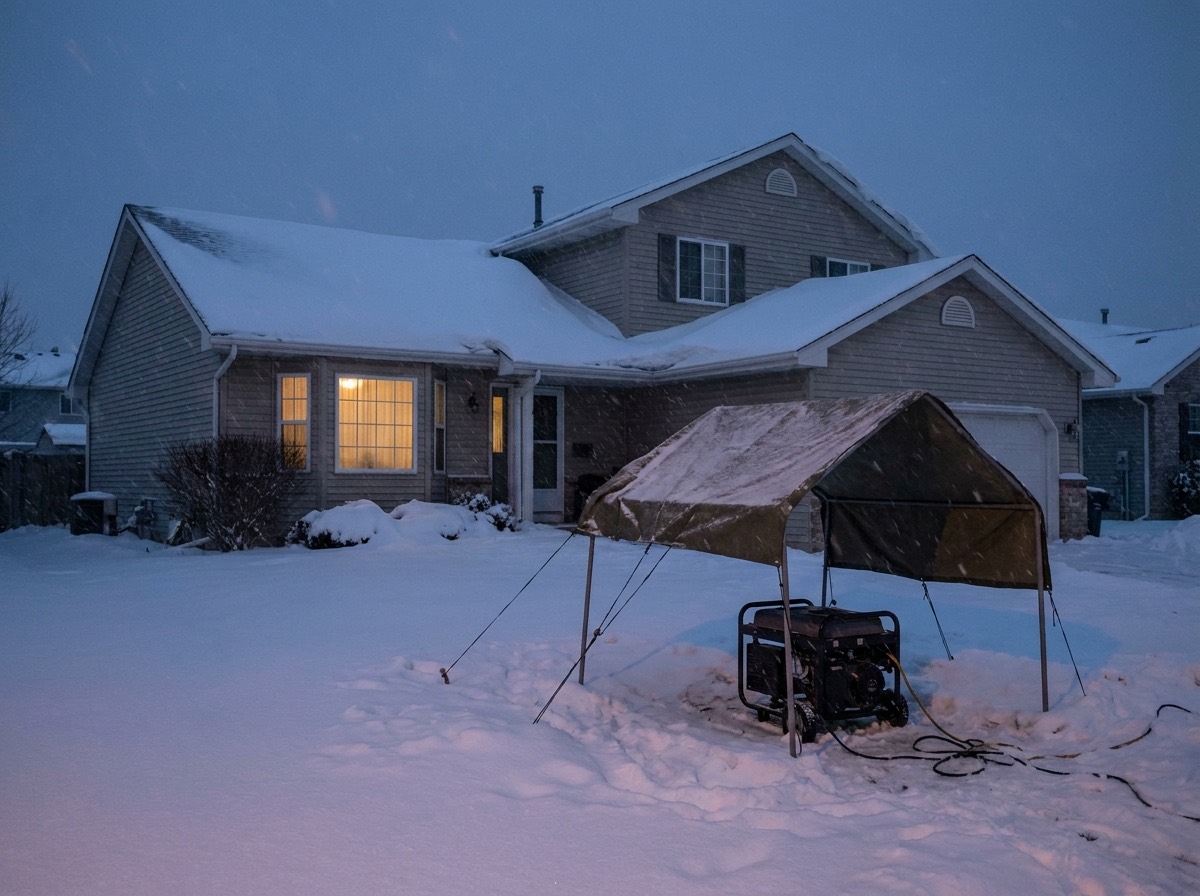
Snow blocks exhaust and intake. A generator buried in a drift can overheat or, worse, push exhaust back toward the house. Keep it on a raised platform, under a generator tent that leaves the sides open, and clear snow around it every couple of hours. The full rules are in generator carbon monoxide safety; they matter even more when every window is shut tight.
Check the current price of a generator running cover for snow and rain on Amazon
Heating Without Any Electricity: Indoor-Rated Propane Heaters
An indoor-safe propane heater is the most cost-effective winter backup that exists. Models with an oxygen depletion sensor and tip-over shutoff are rated for indoor use in the United States. A 9,000 BTU unit on a single 1-pound cylinder runs about 3 hours on high; connected to a 20-pound grill tank with a hose and filter, it runs 40 to 50 hours. That is enough to keep a closed 300-square-foot room in the 60s through a multi-day storm.
Rules that are not optional:
- Crack a window an inch in the room where it runs. Propane combustion consumes oxygen and produces water vapor and a small amount of CO.
- A working CO alarm in the same room.
- Never use a patio heater, a camp stove, a charcoal grill, or a kerosene heater not rated for indoor use. These kill people every winter.
- Keep the 20-pound tank outside or in the garage; only the hose comes in.
Check the current price of indoor-safe propane heaters on Amazon
The Warm Room Strategy
Do not try to heat the whole house. Pick one room, ideally on the south side, with the fewest exterior walls and a door that closes. Then:
- Hang blankets or a shower curtain over the doorway and windows. A room loses most of its heat through glass.
- Bring mattresses in. Body heat from a family in one room adds 300 to 400 BTU per person per hour.
- Put the power station, the propane heater, and the CO alarm in that room.
- Close the doors of every other room and stuff towels under them to slow air exchange.
A closed 12-by-14 room with a 9,000 BTU heater and four people will sit around 62 to 68°F when it is 10°F outside. The rest of the house will drift down toward the 40s over two days, which is why the next section matters.
Protecting the Pipes
Burst pipes cause more dollars of damage in winter outages than anything else. If the furnace cannot run:
- Open every faucet to a pencil-thin stream, hot and cold. Moving water is far harder to freeze.
- Open cabinet doors under sinks on exterior walls so room air reaches the pipes.
- If the house will drop below 40°F for more than a day, drain the system. Shut the main valve, open every faucet from the top floor down, flush toilets, and pour RV antifreeze into toilet bowls and drain traps.
- Know where the main shutoff is before the storm, and make sure it turns.
Water, Food, and Light
If you have a well, the pump stops with the grid. Store at least one gallon per person per day for three days, and fill bathtubs before the storm for flushing. A well pump needs 1,000 to 2,000 watts running with a surge of 2 to 3 times that; a 3,500-watt or larger generator runs it, a 4kWh-class power station runs it for short cycles. Our generator size calculator will tell you what your pump needs.
Refrigerators are the one place winter helps. An unheated garage or a sealed cooler on the porch keeps food cold for free. Our guide to keeping food safe during a power outage covers the time limits.
For light, LED lanterns and headlamps beat candles on every measure: safer, brighter, and a set of AA batteries runs a lantern for days. Skip the candles entirely; house fires spike during every winter outage.
Pre-Storm Checklist (Do This in October)
- Furnace outlet installed, or transfer switch tested under load
- Generator started and run for 20 minutes under load, oil changed, fresh gas with stabilizer or full propane tanks
- Power station charged to 100 percent and stored inside
- Indoor propane heater tested, two 20-pound tanks full, hose and filter on hand
- CO alarms tested, batteries replaced
- Blankets, sleeping bags, and a plan for which room is the warm room
- Water stored, main shutoff located and exercised
- Phone power banks charged, LED lanterns and spare batteries staged
The full general-purpose list lives in our power outage checklist, and if your region sees outages that stretch past three days, read how to prepare for extended power outages.
Frequently Asked Questions
Can a portable power station run a furnace?
Yes. A gas furnace draws 400 to 800 watts while the blower runs, and it cycles on and off. A 2kWh power station typically keeps a furnace going for 8 to 14 hours of real-world cycling. You need a furnace outlet or transfer switch to connect it.
What size generator do I need to run my furnace in winter?
A 2,000 to 2,200-watt inverter generator runs a gas furnace with margin for lights and phones. If you also want the refrigerator, a well pump, and a microwave, step up to 3,500 to 5,000 watts.
Is it safe to use a propane heater indoors?
Only a heater specifically rated for indoor use, with an oxygen depletion sensor and tip-over switch, with a window cracked and a CO alarm in the room. Patio heaters, camp stoves, and grills are never safe indoors.
Will my generator start when it is below zero?
Usually, with fresh fuel, synthetic oil, a healthy starter battery, and full choke. Propane starts easier than gasoline in deep cold. Store the generator in the garage and roll it out to start, but never run it there.
How cold can my house get before pipes freeze?
Pipes on exterior walls can freeze once indoor temperatures drop into the low 40s for more than a few hours. If you cannot keep the house above 45°F, drip the faucets and consider draining the system.