
This post contains affiliate links. If you buy through them, we may earn a commission at no extra cost to you.
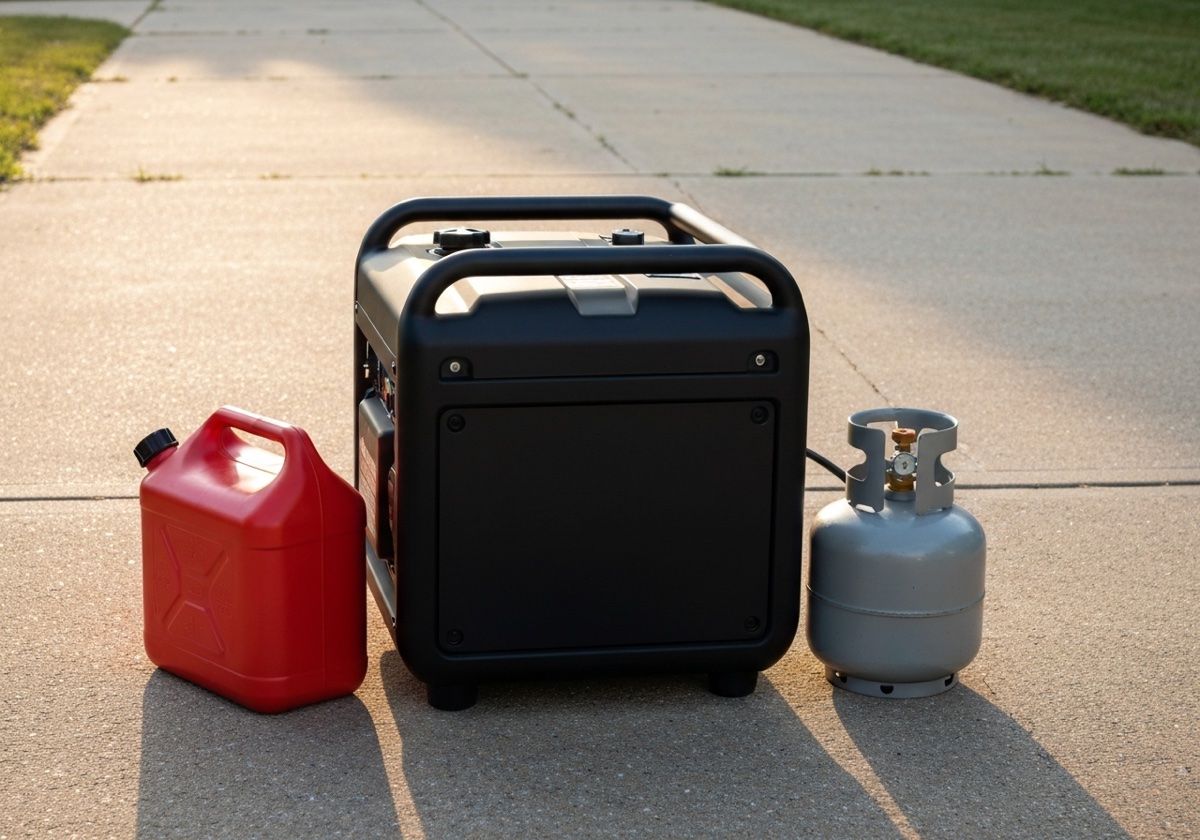
When a storm knocks out your power, the last thing you want is a generator with an empty tank and no gas station open for miles. That is the quiet argument for dual-fuel: gasoline is everywhere on a normal day, and propane is the fuel that waits patiently in a tank for years without going bad. A generator that runs on both gives you two ways to keep the lights on when one supply chain fails.
Dual-fuel generators have matured from a niche feature into the default recommendation for home backup. The switching valves are reliable, the price premium over gas-only models has shrunk to roughly $50 to $150, and every major budget-friendly brand now offers one.
This guide covers the best dual-fuel generators for home backup in 2026, from a quiet inverter that can live on a patio to a 13,000-watt monster that will run central air. All picks are based on published specifications, owner feedback patterns, and long-standing brand track records, with honest trade-offs for each.
Quick Answer: Best Dual-Fuel Generators for Home Backup
- Best overall: Westinghouse WGen9500DF. Around 9,500 running watts on gasoline, remote start, and enough muscle for most of a typical home, usually for roughly $1,100 to $1,300.
- Best budget: Pulsar PG10000B16. Roughly 8,000 running watts for around $700 to $800, one of the cheapest paths to whole-panel essentials.
- Best quiet/inverter: Champion 4500-watt dual-fuel inverter. Clean power for electronics, around 61 dB, ideal for essentials-only backup and small homes.
- Best high output: DuroMax XP13000EH. Roughly 10,500 running watts on gasoline with a 50-amp outlet, for homes that want to run nearly everything, including an AC unit.
- Best big-portable alternative: Champion 12,000-watt dual-fuel with electric start, a strong pick where dealer support and warranty service matter.
Why Dual-Fuel Matters for Home Backup
For emergency backup specifically, dual-fuel is less about saving money and more about resilience.
Propane stores essentially forever. Gasoline starts degrading in about three to six months, gums up carburetors, and is genuinely risky to store in quantity. Propane in a sealed cylinder is stable for decades. Two or three 20-pound grill tanks in the garage are a backup fuel supply that is always ready, with no stabilizer, no rotation schedule, and no smell.
Gasoline is everywhere when you need volume. During a long outage, once stations reopen, gasoline is the easiest fuel to buy in bulk and delivers more watts per gallon. Propane gets you through night one; gasoline carries you through week one.
Carburetor health. Many owners run dual-fuel generators on propane almost exclusively because it burns clean and leaves no residue. A generator that sat for a year on propane duty usually starts far more willingly than one with stale gas in the bowl.
The Propane Derating: Expect Roughly 10% Less Power
Propane contains less energy per unit than gasoline, so every dual-fuel generator produces less power on propane, typically around 10% less. A generator rated 9,500 running watts on gasoline delivers roughly 8,500 on propane.
This matters for sizing. If you plan to lean on propane during outages, which is what most people should do, size against the propane rating, not the headline gasoline number. A generator that barely starts your AC on gasoline may fail to start it on propane.
Runtime on propane is also worth understanding: a standard 20-pound grill cylinder holds about 4.7 gallons of propane and typically runs a mid-size generator for roughly 6 to 10 hours at moderate load. For multi-day outages, a 100-pound cylinder or a connection to a home propane tank changes the game entirely.
How to Size a Dual-Fuel Generator for Your Home
- Essentials only (roughly 4,000–6,000 watts): refrigerator, freezer, furnace fan, internet, lights, phone charging, a window AC or space heater. This is where the Champion inverter shines.
- Most of the home (roughly 9,000–13,000 watts): everything above plus a well pump, sump pump, and a central AC unit (ideally with a soft-start kit). This is WGen9500DF and XP13000EH territory.
- Watch starting watts. Motors (AC compressors, well pumps, sump pumps) briefly draw two to three times their running wattage at startup. The surge rating on the box exists for exactly this.
A quick worked example: a home with a refrigerator (700 starting watts), chest freezer (500), furnace blower (1,200 starting), sump pump (1,500 starting), internet and lights (300), and a 12,000 BTU window AC (1,800 starting) needs roughly 4,500 to 5,500 watts available, assuming not everything starts at the same instant. On propane, that means buying a generator rated at least 6,000 to 6,500 running watts on gasoline to keep comfortable headroom.
Best Overall: Westinghouse WGen9500DF
Check the current price of the Westinghouse WGen9500DF on Amazon.
Who it’s for: homeowners who want one generator that runs most of the house, including a central AC unit, without stepping up to standby-generator prices.
- Power: roughly 12,500 peak / 9,500 running watts on gasoline; around 11,200 / 8,500 on propane
- Runtime: roughly 12 hours at half load on its 6.6-gallon gas tank
- Noise: around 74 dB at 23 feet, typical for an open-frame unit this size
- Weight: roughly 210 pounds (wheel kit included)
- Street price: roughly $1,100–$1,300
Strengths: remote start from a key fob plus electric and recoil backup, a 30-amp and a 50-amp 120/240V outlet for transfer switch hookups, strong owner satisfaction over many years, and a long runtime per tank. It hits the sweet spot of price, power, and features better than anything else in the class.
Trade-offs: it is loud, heavy, and drinks fuel at high load like every big open-frame generator. Its power is not inverter-clean, which is fine for appliances and fine for most electronics in practice, but sensitive equipment is happier behind a UPS.
Best Budget: Pulsar PG10000B16
Check the current price of the Pulsar PG10000B16 on Amazon.
Who it’s for: households that want serious wattage on a strict budget and can accept a lesser-known brand and thinner support network.
- Power: roughly 10,000 peak / 8,000 running watts on gasoline; around 9,000 / 7,000 on propane
- Runtime: roughly 12 hours at half load on a 6.6-gallon tank
- Noise: low-to-mid 70s dB, comparable to other open-frame units
- Weight: roughly 200 pounds with wheels
- Street price: roughly $650–$800
Strengths: the watts-per-dollar ratio is hard to beat. Electric start, a 30-amp 120/240V outlet for a transfer switch, and the same switch-on-the-fly dual-fuel valve found on pricier machines. For a generator that runs a few days per year, it is a rational buy.
Trade-offs: Pulsar’s dealer and parts network is thinner than Champion’s or Westinghouse’s, fit and finish are a step down, and long-term durability reports are more mixed. No 50-amp outlet, which limits some transfer switch setups.
Best Quiet/Inverter: Champion 4500-Watt Dual-Fuel Inverter
Check the current price of the Champion 4500W dual-fuel inverter on Amazon.
Who it’s for: smaller homes, townhomes, and anyone whose backup plan is “fridge, internet, lights, and sanity” rather than the whole panel. Also the pick if you have close neighbors.
- Power: roughly 4,500 peak / 3,500 running watts on gasoline; around 4,050 / 3,150 on propane
- Runtime: up to roughly 14 hours on 2.3 gallons of gasoline at 25% load; roughly 21 hours on a 20-pound propane tank
- Noise: around 61 dB at 23 feet, quiet enough for a normal conversation nearby
- Weight: roughly 100 pounds with built-in wheels and handle
- Street price: roughly $650–$800
Strengths: true inverter output that is safe for laptops, TVs, and CPAP machines, dramatically lower noise than open-frame units, excellent fuel sipping at partial load, and an economy mode that idles down when demand drops. Champion’s support network is one of the best in the budget space.
Trade-offs: 3,500 running watts will not touch central AC or a large well pump, and there is no 240V output on the standard model, so whole-panel transfer switches are out. This is an extension-cord or interlock-with-limits machine, sized for essentials.
Best High Output: DuroMax XP13000EH
Check the current price of the DuroMax XP13000EH on Amazon.
Who it’s for: large homes, homes with central AC plus a well pump, and anyone who wants portable power that behaves like a small standby unit.
- Power: roughly 13,000 peak / 10,500 running watts on gasoline; around 12,350 / 9,975 on propane
- Runtime: roughly 8 hours at half load on its 8.3-gallon gas tank
- Noise: around 74 dB, with a big-engine growl to match
- Weight: roughly 235 pounds; this is a two-person or wheel-it-everywhere machine
- Street price: roughly $1,300–$1,600
Strengths: a 500cc-class V-twin style engine with power to spare, a 50-amp 120/240V outlet, and the ability to start large AC compressors that stall smaller generators. On propane it still delivers nearly 10,000 running watts, which is rare in a portable.
Trade-offs: heavy fuel consumption (figure roughly 15+ gallons of gasoline per day of steady use), serious weight, and more generator than most homes actually need. If your load calculation says 6,000 watts, buying 13,000 mostly buys you fuel bills.
Best Big-Portable Alternative: Champion 12,000-Watt Dual-Fuel
Check the current price of the Champion 12,000W dual-fuel on Amazon.
Who it’s for: buyers who want WGen9500DF-class power but prefer Champion’s warranty service and parts availability, which many owners rate among the best in the industry.
- Power: roughly 15,000 peak / 12,000 running watts on gasoline; around 13,500 / 10,800 on propane
- Runtime: roughly 9 hours at half load on gasoline
- Noise: around 74 dB at 23 feet
- Weight: roughly 225 pounds
- Street price: roughly $1,600–$2,000
Strengths: the most running watts on this list, electric start, 50-amp outlet, and Champion’s three-year warranty with responsive support. On propane it out-powers most competitors’ gasoline ratings.
Trade-offs: price creeps toward budget standby-generator territory, and the fuel appetite is substantial. Like all units here, it is a manual solution: someone has to roll it out, connect it, and start it.
The Transfer Switch: The Upgrade That Makes It “Home Backup”
Extension cords through a window work for a fridge and a lamp. Real home backup means a transfer switch or interlock kit, installed by an electrician for roughly $400 to $1,000, that lets the generator feed your panel safely. It powers hardwired loads like the furnace and well pump, and it prevents backfeeding, which can kill utility line workers and is illegal everywhere.
Match the switch to your generator’s outlet: a 30-amp inlet handles up to about 7,200 watts, and a 50-amp inlet up to about 12,000 watts. If you buy a 9,500-watt-plus generator, get the 50-amp setup so you are not leaving capacity stranded.
What It Costs to Run
Rough operating math for a mid-size unit at moderate load: gasoline consumption around 0.5 to 0.75 gallons per hour means roughly $40 to $60 per day of daytime-only running. On propane, figure two to three 20-pound tanks per day of similar use, roughly $40 to $75 depending on refill prices. Running only during waking hours and letting the fridge coast overnight cuts those numbers substantially, and a well-insulated fridge handles 8 hours off without drama if the doors stay closed.
How to Choose: A 60-Second Decision Path
- Outages are short and your needs are modest: Champion 4500 inverter. Quiet, clean power, easy to live with.
- You want the whole-home experience on a budget: Pulsar PG10000B16 plus a 30-amp interlock.
- You want the best all-around package: Westinghouse WGen9500DF plus a 50-amp transfer switch. This is the default recommendation for most homes.
- You have central AC plus a well pump, or a big house: DuroMax XP13000EH or the Champion 12,000-watt.
- Whatever you buy: keep two or three full propane tanks stored, run the generator for 15 minutes every couple of months, and store it with the gas tank empty or treated with stabilizer.
Frequently Asked Questions
Can I switch fuels while the generator is running?
Most modern dual-fuel models, including the Westinghouse and DuroMax units here, let you switch between gasoline and propane on the fly or with only a brief pause, using a selector dial. Check your manual, since a few models require a shutdown between fuels. Never feed both fuels simultaneously.
How long will a 20-pound propane tank run a generator?
Roughly 6 to 10 hours for a mid-size generator at moderate load, and around 3 to 5 hours for the 12,000 to 13,000-watt class working hard. A 100-pound cylinder multiplies that by five and is the better companion for a serious backup plan.
Is propane or gasoline better for home backup?
Propane for storage and readiness, gasoline for output and long events. The practical pattern most owners settle into: store propane, start on propane, and switch to gasoline only if the outage stretches long enough that you are making fuel runs anyway.
Can a dual-fuel generator run on natural gas too?
Not out of the box; dual-fuel means gasoline plus propane. Tri-fuel models (such as some Champion and Westinghouse variants) add a natural gas connection, and aftermarket conversion kits exist, though they can affect the warranty. If your home has natural gas service, a tri-fuel model is worth the roughly $100 to $200 premium for effectively unlimited runtime.
Specifications and prices are approximate manufacturer figures and typical U.S. street prices as of 2026; verify current details before purchasing. Always run generators outdoors, at least 20 feet from the home, with the exhaust pointed away from doors and windows.