
This post contains affiliate links. If you buy through them, we may earn a commission at no extra cost to you.
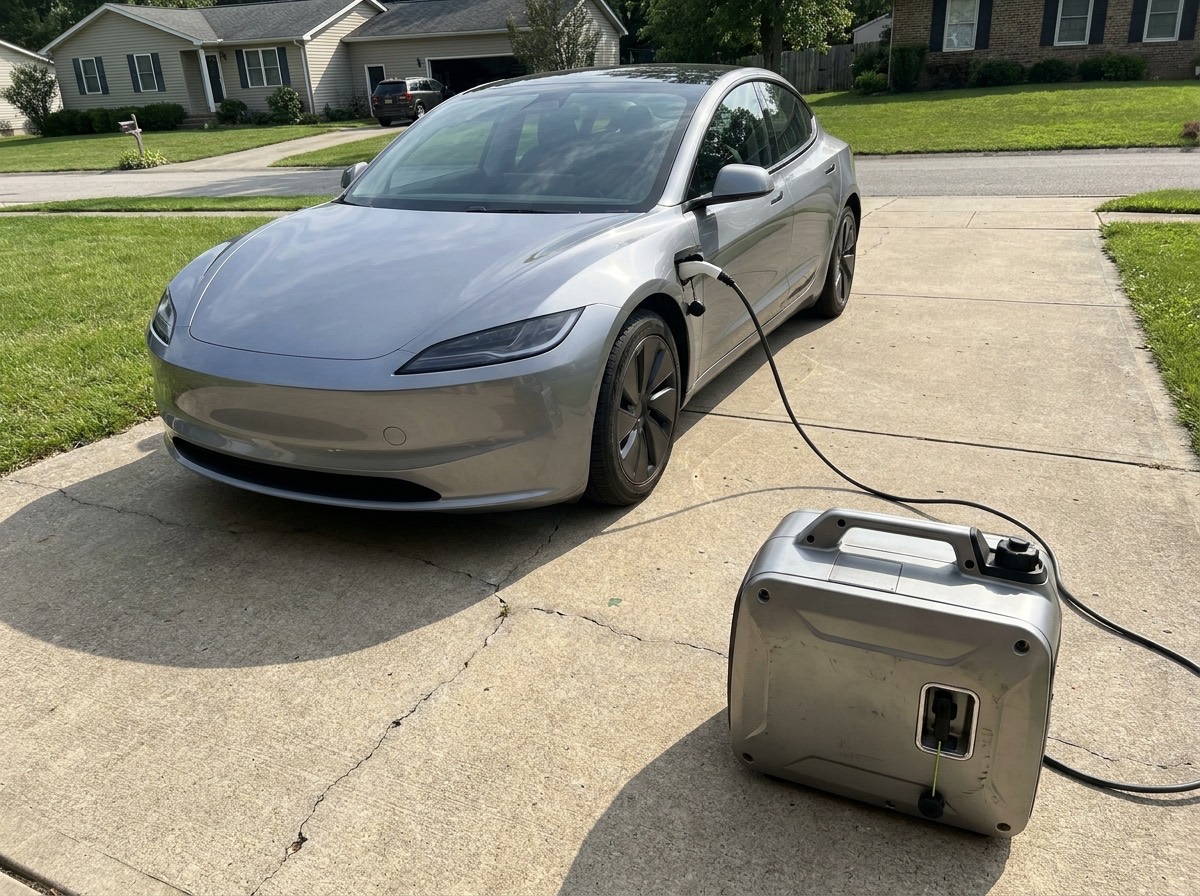
Short answer: yes, you can charge an electric vehicle from a portable generator or a large power station, but it is slow and only makes sense as an emergency measure. A 2,000-watt inverter generator or power station adds roughly 5 to 7 miles of range per hour through a Level 1 (120V) charger. A 7,000-watt or larger generator with a 240-volt outlet and a portable Level 2 charger adds 15 to 25 miles per hour. Two rules are non-negotiable: the source must produce clean sine-wave power, and the generator must be grounded properly or the EV’s charger will refuse to start.
Why This Matters More Every Year
Nearly one in ten new cars sold in the United States is now fully electric. When a hurricane or ice storm takes the grid down for days, an EV with 30 percent charge becomes a real problem. Unlike a gas car, you cannot pour range into it from a can. What you can do is bring your own electricity, which is what generators and large battery power stations do. The trick is knowing how much range you will actually get, and what will make the car refuse to charge.
How Much Range You Get From Each Source
EVs consume roughly 250 to 350 watt-hours per mile depending on size. Charging losses eat another 10 to 15 percent. Here is what that math produces for common sources:
| Power Source | Charging Method | Charge Rate to Car | Range Added per Hour | Range Added in 8 Hours |
|---|---|---|---|---|
| 2,000W inverter generator or 2kWh power station | Level 1, 120V at 12A | ~1.4kW | 4-6 miles | 35-45 miles |
| 3,500-4,000W generator or 4kWh power station | Level 1, 120V at 16A | ~1.9kW | 6-8 miles | 50-60 miles |
| 7,000-9,500W generator with L14-30 outlet | Level 2, 240V at 24A | ~5.7kW | 17-23 miles | 140-180 miles |
| 12,000W+ generator with 50A outlet | Level 2, 240V at 40A | ~9.6kW | 28-38 miles | 220-300 miles |
A 4kWh power station, then, delivers about 10 to 12 miles of range from a full charge before the battery is empty. That is enough to reach an operating charging station on the next grid over. A generator, as long as you have fuel, keeps going. For the fuel side of that equation, see our guide to storing generator fuel at home.
Rule 1: The Power Must Be Clean (Pure Sine Wave)
An EV’s onboard charger monitors the incoming waveform. Conventional open-frame generators produce a rough approximation of a sine wave with total harmonic distortion often above 15 percent. Many EVs, Teslas in particular, will detect it and abort with a charging error. Some will charge for a few minutes and stop.
Inverter generators produce power with distortion under 3 to 5 percent, which the car accepts. Every lithium power station from a major brand outputs a pure sine wave as well. If you are shopping specifically for EV emergency charging, the difference between inverter and conventional generators decides the purchase before anything else does.
Rule 2: The Generator Must Be Grounded (Neutral Bonded)
This is the problem that surprises most people. EV chargers (EVSEs) perform a ground fault check before delivering power. They look for a proper connection between neutral and ground at the source. Most portable inverter generators ship with a “floating neutral,” meaning neutral and ground are not connected inside the unit. The EVSE sees an open ground and refuses to charge, usually with a fault light and no explanation.
Solutions, from safest to most common:
- Buy a generator with a bonded neutral or a switchable bond. Some larger units offer this.
- Use a neutral-ground bonding plug. A small plug that connects neutral to ground in one of the generator’s unused 120V outlets. It costs a few dollars and solves the problem for most inverter generators. Remove it if the generator is later connected to a house through a transfer switch, because the house panel already has its own bond and two bonds create a hazard.
- Drive a ground rod and connect it to the generator’s frame lug. This is what the generator manual describes for standalone use, and it is required by some EVSEs in addition to the bond.
Check the current price of a generator neutral-ground bonding plug on Amazon
Power stations behave differently. Most have their neutral bonded to ground internally or have an app setting for it, and their EPS/UPS circuitry is designed to satisfy EVSE checks. Check the manufacturer’s documentation; EcoFlow and Bluetti both publish EV charging guidance for their larger units.
Rule 3: Lower the Charging Current
Almost every EV lets you set the maximum charging amperage from the dashboard or app. Do it. A Level 1 charger defaults to 12 amps, which is 1,440 watts, right at the continuous limit of a 2,000-watt inverter generator once you add losses. Dropping to 8 or 10 amps keeps the generator in its efficient band, avoids overload trips, and reduces fuel consumption per mile more than you would expect.
For Level 2 charging from a 7,000-watt generator, set the car to 16 to 24 amps. The L14-30 outlet is rated for 30 amps, but running a generator at 80 percent of rated output for hours is hard on it; 60 to 70 percent is the sweet spot for engine life. Our generator wattage guide explains rated versus peak output if those numbers are unfamiliar.
Step-by-Step: Emergency EV Charge From a Portable Generator
- Place the generator outdoors, at least 20 feet from the house and from the car’s cabin, exhaust pointed away. Carbon monoxide does not care that the car is electric.
- Install the bonding plug (or confirm bonded neutral) and connect the ground rod if your EVSE requires it.
- Start the generator and let it stabilize for two minutes. Turn off eco mode until charging is established, then turn it on.
- Set the car’s charging current to 8 to 10 amps for Level 1, or 16 to 24 amps for Level 2.
- Plug the EVSE into the generator first, wait for its ready light, then plug into the car.
- Watch the first two minutes. If the car reports a fault, the cause is almost always grounding or waveform, in that order.
- Refuel only with the generator off and cool. A generator running at 1,500 watts burns about 0.1 to 0.15 gallons per hour; at 6,000 watts, closer to 0.6 to 0.8 gallons per hour.
Which Generators and Power Stations Work Best
For Level 1 only: a 2,000 to 2,200-watt inverter generator is the lightest, quietest option. The Honda EU2200i is the benchmark in this class; our Honda EU2200i review covers its output and fuel numbers.
For Level 2: you need a 240-volt outlet, which starts at roughly 7,000 watts on dual-fuel and conventional units. Inverter models with 240V output exist in the 7,000 to 9,500-watt range and are the cleanest choice. See our roundup of the best dual-fuel generators for models with L14-30 outlets.
For a battery option: only 3.6kWh-class and larger power stations are worth using, and only for a top-up. The EcoFlow Delta Pro 3 outputs 240V and can feed a Level 2 charger at reduced amperage, delivering about 12 miles per full battery. Add expansion packs and solar, and it becomes a slow but fuel-free option.
Check the current price of a portable Level 2 EV charger with a NEMA 14-50 plug on Amazon
Can You Do the Reverse: Power the House From the EV?
Increasingly, yes. The Ford F-150 Lightning, Kia EV6, Hyundai Ioniq 5, and several others offer vehicle-to-load (V2L) with 1,500 to 9,600 watts of output from an onboard outlet or an adapter. An EV with a 75kWh pack holds more than eighteen 4kWh power stations. If your vehicle supports V2L, it may be a better backup plan than the generator you were about to buy. The connection rules are the same as any other source: a transfer switch or interlock, never a backfeed cord. We cover those options in manual vs automatic transfer switches.
Frequently Asked Questions
Will charging from a generator damage my EV battery?
No, as long as the power is a clean sine wave. The car’s onboard charger conditions the power before it reaches the battery. Dirty power from a conventional generator will make the car refuse to charge rather than damage it.
How much gas does it take to charge an EV with a generator?
Roughly 0.4 to 0.6 gallons of gasoline per 10 miles of range on a small inverter generator, and 0.35 to 0.5 gallons per 10 miles on a larger unit at Level 2. That is worse than most gas cars, which is why this is an emergency tactic, not a daily habit.
Why does my Tesla say “unable to charge” on a generator?
Nearly always a ground fault from a floating-neutral generator, or excessive harmonic distortion from a non-inverter unit. Add a bonding plug first; if the error persists, the generator’s waveform is the problem.
Can a solar generator charge an EV?
A large power station with solar panels can, slowly. A 400-watt panel array produces roughly 2kWh per sunny day, which is 6 to 8 miles of range. It is a survival trickle, not a commute.
Is it safe to charge in the garage with the generator outside?
Yes, with the generator at least 20 feet from the garage door and any windows, and the cord routed so the door cannot pinch it. Never run the generator in the garage, even with the door open.