
This post contains affiliate links. If you buy through them, we may earn a commission at no extra cost to you.
Short answer: a portable generator that will not start in a storm almost always failed for one of three reasons: stale gasoline gummed up the carburetor, the oil was never changed, or the battery on an electric-start model died from sitting. A 30-minute monthly run under load, an oil change every 50 to 100 hours or once a year, and either fuel stabilizer or an empty carburetor between uses prevents nearly all of it. Below is the full checklist by interval, with the few tools you actually need.
The Maintenance Schedule at a Glance
| Interval | Task | Time |
|---|---|---|
| Every use | Check oil level, check for fuel leaks, inspect cords and outlets | 2 minutes |
| Monthly | Start and run 20-30 minutes under at least 50 percent load; charge starter battery | 30 minutes |
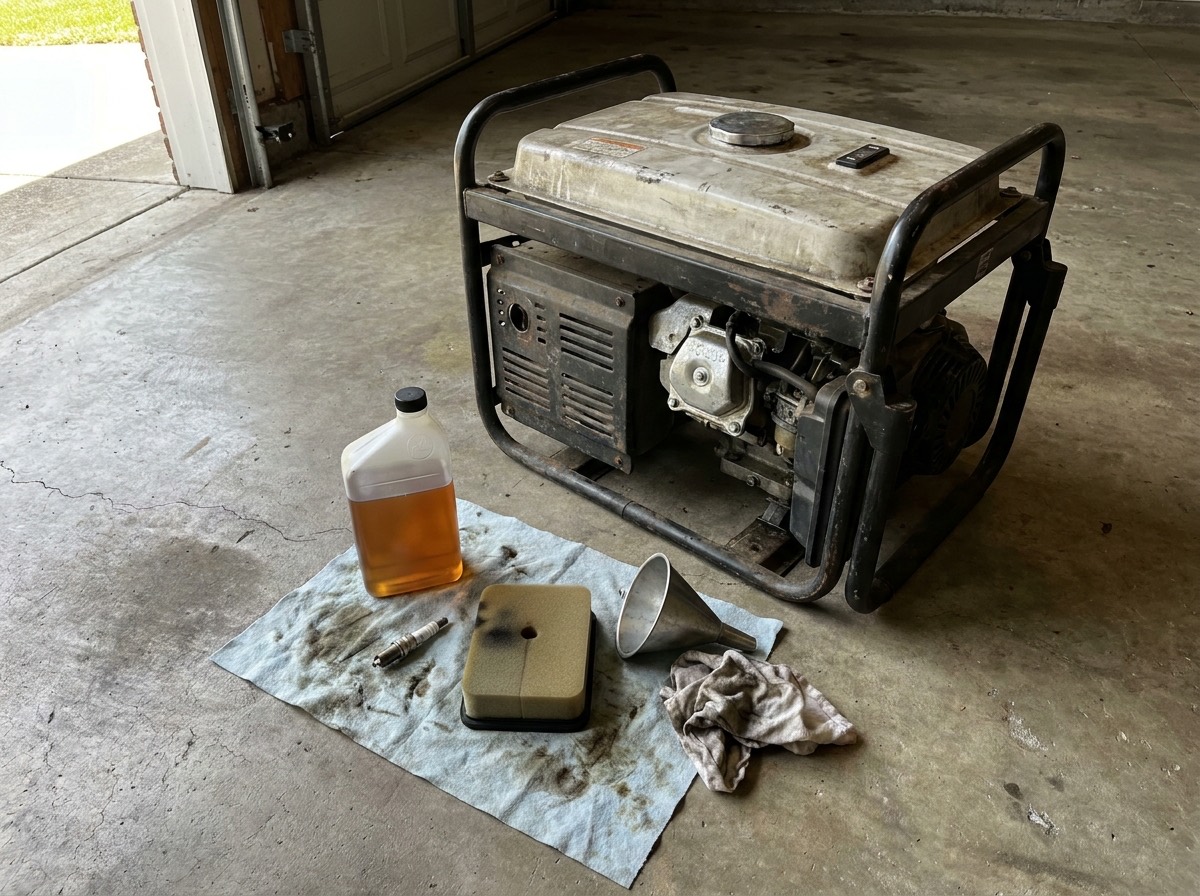
| Every 50 hours or annually | Change oil; clean or replace air filter | 20 minutes |
| Every 100 hours or annually | Inspect and gap spark plug; clean spark arrestor; check valve clearance on OHV engines if the manual calls for it | 30 minutes |
| Every 300 hours or 2 years | Replace spark plug; replace fuel filter if equipped; inspect fuel lines for cracking | 30 minutes |
| Before storage over 30 days | Add fuel stabilizer and run 10 minutes, or drain the tank and run the carburetor dry | 15 minutes |
| Seasonally (fall and spring) | Full function test: every outlet, the transfer switch or inlet, the CO shutoff (if testable), fresh fuel | 1 hour |
Fuel: The Problem That Causes Most No-Starts
Gasoline starts to degrade in about 30 days. Ethanol-blended gas absorbs water from the air, separates, and leaves a varnish inside the carburetor’s tiny jets. A generator that ran perfectly in October and would not start in February almost certainly has a gummed carburetor from the gas that sat in it.
Three ways to prevent it, in order of effort:
- Fuel stabilizer in every tank. Add it to the gas can when you fill it, not just to the generator. Stabilized fuel stays usable for 12 to 24 months depending on the product. Run the generator 10 minutes after adding stabilizer so treated fuel reaches the carburetor.
- Run the carburetor dry before storage. Shut the fuel valve while the engine is running and let it stall. The bowl empties and there is nothing left to varnish. Many manuals recommend this; it takes three minutes.
- Use ethanol-free gasoline. Sold at many marinas, farm stores, and some gas stations. It costs more, stores far longer, and is kinder to small-engine carburetors. Worth it for a machine that sits 11 months a year.
Dual-fuel generators running on propane sidestep the whole issue; propane does not go stale and the carburetor never sees liquid fuel. Our guide to storing generator fuel at home covers safe quantities and rotation.
Check the current price of small-engine fuel stabilizer on Amazon
Oil: Cheap Insurance for the Engine
Most portable generators hold less than a quart of oil and have no oil filter. That small volume gets dirty fast, and running low on oil is the most common cause of a seized engine. Every generator sold in the last decade has a low-oil shutoff, which protects the engine but also causes a confusing symptom: the unit starts, runs 10 seconds, and dies. Check the oil first.
- Break-in change: after the first 5 to 20 hours on a new unit. This removes metal particles from initial wear. Our guide on how to break in a new generator walks through it.
- Regular change: every 50 to 100 hours, or once a year, whichever comes first. Check the manual; inverter generators often specify 100 hours, open-frame units 50.
- Oil type: SAE 10W-30 for most climates. Synthetic 5W-30 for winter starting in the North. Do not use automotive oil with friction modifiers in a generator with a wet clutch, which is rare but exists on some models.
- Drain warm, not hot. Run it five minutes so the oil flows, shut down, then drain. Tilt the unit toward the drain plug to get the last of it out.
Air Filter and Spark Plug
A foam air filter should be washed in soapy water, dried, and lightly oiled once a year or every 50 hours, sooner in dusty conditions. Paper elements get tapped clean or replaced. A clogged filter causes rich running, black smoke, fouled plugs, and lost power under load.
Pull the spark plug annually. A light tan electrode is healthy. Black and sooty means a rich mixture or a dirty air filter. White and blistered means it is running hot or lean, often from a partially clogged carburetor jet. Set the gap to the manual’s spec, usually 0.028 to 0.031 inches, and replace the plug every two years regardless. Keep a spare plug and the correct socket in the generator’s storage bin; a fouled plug during a storm is a five-minute fix if you have the parts.
Check the current price of generator maintenance kits on Amazon
The Monthly Run: Why “Under Load” Matters
Starting the generator monthly and letting it idle for five minutes is better than nothing, but it does not do the job. Idling does not bring the engine to full temperature, which means moisture never boils out of the oil and the crankcase. It also does not exercise the alternator, the breakers, or the voltage regulator.
Do this instead: run it 20 to 30 minutes with at least half its rated load connected. A 1,500-watt space heater plus a work light is an easy load for a 3,000-watt unit. Two heaters for a 6,000-watt unit. This burns off moisture, keeps seals pliable, cycles fuel through the carburetor, and confirms the unit actually produces power. If it cannot hold the load without the voltage sagging or the engine surging, you have found a problem in your driveway instead of in a blackout.
Electric-start models: the small starter battery self-discharges and will be flat in two to three months of sitting. The monthly run charges it, or put it on a float charger permanently. A dead starter battery is the number-two cause of “it will not start.”
Check the current price of a 12V battery float charger on Amazon
Inverter Generators: A Few Differences
Inverter units, like the ones in our Honda EU2200i review, are fully enclosed, which keeps them quiet and also traps heat and dust. Their maintenance differs in three ways:
- The air filter and spark plug are behind access panels. Learn where they are before you need them in the dark.
- Economy mode idles the engine at low RPM when the load is light. Run the monthly test with eco mode off for the first 10 minutes so the engine comes up to temperature.
- Cooling vents on the housing must be kept clear. A mud dauber nest in the intake will overheat the unit in 20 minutes.
Open-frame conventional units are simpler and easier to service, which is one of the trade-offs we cover in inverter vs conventional generators.
Storage Between Seasons
- Fuel treated with stabilizer or carburetor run dry (see above).
- Oil changed so the engine sits in clean oil, not acidic used oil.
- Spark plug hole given a teaspoon of oil and the engine turned over by hand a few times if storing more than six months. This coats the cylinder wall.
- Stored dry, covered, off a concrete floor, with rodent deterrent nearby. Mice chew wiring and build nests in the muffler.
- Battery on a float charger or removed and charged monthly.
- Manual, spare plug, spare oil, funnel, and a flashlight kept in a bin with the unit.
Troubleshooting: The Five-Minute Diagnosis
| Symptom | Most Likely Cause | Fix |
|---|---|---|
| Cranks, will not start | Stale fuel or gummed carburetor; fuel valve closed; choke not set | Fresh fuel, check valve and choke, carburetor cleaner or bowl cleaning |
| Starts, dies in 10 seconds | Low oil shutoff | Top up oil; check that the unit is level |
| Runs but no power at outlets | Tripped breaker; GFCI outlet tripped; blown fuse; lost residual magnetism after long storage | Reset breakers and GFCI; check fuse; “flash” the field per manual |
| Surging RPM | Partially clogged carburetor jet; wrong fuel; governor issue | Carburetor clean; fresh fuel |
| Black smoke, low power | Clogged air filter; choke stuck on | Clean or replace filter; check choke linkage |
| Will not crank (electric start) | Dead starter battery | Charge or replace; use the pull cord |
Tools and Supplies to Keep With the Generator
- Correct oil, two changes’ worth, plus a funnel and drain pan
- Spare spark plug and plug socket
- Spare air filter
- Fuel stabilizer and a can of carburetor cleaner
- A 12V float charger for electric-start models
- A basic tool roll: screwdrivers, pliers, a small socket set
- Heavy-duty outdoor extension cords, checked for cuts and loose plugs
- The manual, in a zip bag
If the unit you are maintaining is a larger open-frame model, our Westinghouse WGen9500DF review and Champion 4500W dual-fuel review both cover the specific service points on those engines.
Frequently Asked Questions
How often should I run my generator if I am not using it?
Once a month, for 20 to 30 minutes, under at least half load. This is the single most effective maintenance habit.
Can I leave gas in my generator?
Only with fuel stabilizer added, and even then, for no more than a year. Without stabilizer, drain the tank and run the carburetor dry if the unit will sit more than 30 days.
How often should generator oil be changed?
Every 50 to 100 hours of use, or once a year, whichever comes first. Do the first change after 5 to 20 hours on a new unit.
Why does my generator run but produce no power?
Check the breakers and GFCI outlets first. If those are fine and the unit has sat for a long time, the alternator may have lost its residual magnetism; the manual will describe how to restore it with a drill or a 12V battery.
Does a generator need to be serviced by a professional?
Oil, filters, plugs, and fuel are all owner-level tasks. Carburetor rebuilds, valve adjustments, and electrical faults are worth a shop visit if you are not comfortable with small engines.