
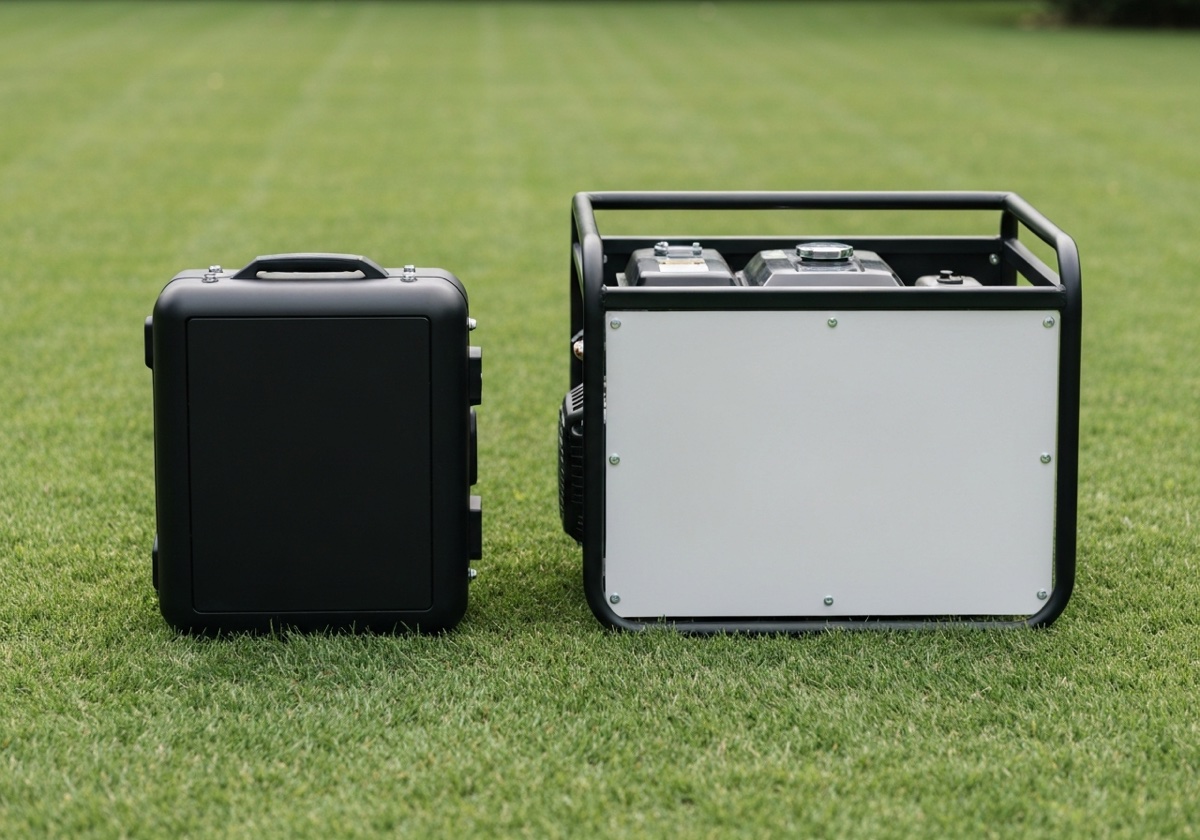
Stand in the generator aisle of any home improvement store and you will see two machines that look like cousins but are priced like strangers. A 4,000-watt conventional generator for around $400 sits next to a 4,000-watt inverter generator for around $1,000. Same watts, more than double the price, and a salesperson mumbling something about “clean power.”
The difference between these two machines is real, it is bigger than most buyers realize, and for a lot of households the expensive one is actually the better deal. This guide explains exactly what separates them, in plain language, and tells you which one to buy for each situation.
Quick Answer: Inverter vs Conventional Generator
- Inverter generators produce clean, stable power (under 3% distortion) that is safe for laptops, TVs, and modern appliances. They are dramatically quieter (roughly 50-60 dB vs 70-80 dB), far more fuel efficient, lighter, and many can be paired for double the output. They cost roughly 1.5 to 2 times more per watt.
- Conventional generators win on raw watts per dollar. They are the right tool for job sites, well pumps, and big motor loads where power quality and noise matter less than muscle and price.
- For home backup with any electronics involved (which is almost every modern home), an inverter generator is the better buy for most people, even at the higher price.
- The exception: if you need 7,500+ watts on a tight budget to run a whole panel including a well pump or central AC, a conventional open-frame unit still makes financial sense.
How Each One Actually Makes Power
Both machines start the same way: a gasoline (or propane) engine spins an alternator, and the spinning creates alternating current. What happens next is where they part ways. (Fuel flexibility is a separate choice entirely; our roundup of the best dual fuel generators includes both types.)
A conventional generator sends that raw alternator output straight to your outlets. To produce 60Hz power (the US standard), the engine must spin at a fixed 3,600 rpm, all the time, whether you are drawing 200 watts or 4,000 watts. The frequency and voltage of what comes out of the outlet are tied directly to how steadily that engine spins. Every hiccup, every load change, every governor correction shows up in the power itself.
An inverter generator adds two extra steps. The alternator’s raw AC output gets converted to DC, then electronically rebuilt (inverted) back into AC by a microprocessor. Because the final waveform is manufactured digitally rather than mechanically, it comes out as a smooth, stable, pure sine wave, essentially indistinguishable from utility power, and often cleaner. It also means the engine no longer has to spin at a fixed 3,600 rpm, which unlocks most of the other advantages below.
THD: The Spec That Explains the Price Gap
Total Harmonic Distortion (THD) measures how far a generator’s power waveform deviates from a perfect sine wave. Think of it as static in the electricity.
- Inverter generators: typically under 3% THD, often 1-2%. Utility grid power is usually under 5%, so this is genuinely clean.
- Conventional generators: commonly 15-25% THD, and it gets worse as loads switch on and off.
Why should you care? Modern electronics are built with sensitive components that expect smooth power. High THD forces power supplies in laptops, TVs, gaming consoles, CPAP machines, and smart appliance control boards to work harder and run hotter. Sometimes the damage is instant. More often it is slow and invisible: the device works fine during the outage, then dies months early. Even things you would not call “electronics,” like a modern refrigerator or furnace, contain circuit boards that dislike dirty power.
A common rule of thumb: anything with a microprocessor should get power with less than 5-6% THD. That single sentence rules out most conventional generators for backing up a modern home office, unless you add a line-interactive UPS between the generator and your gear.
Fuel Efficiency: The Hidden Cost of 3,600 RPM
Here is where the inverter’s price premium starts paying itself back.
A conventional generator screams along at 3,600 rpm even when your actual load is a phone charger and a lamp. It is like driving on the highway in second gear: the engine burns fuel proportional to its speed, not your demand.
An inverter generator with an eco or economy throttle adjusts engine speed to match the load. Powering 300 watts of laptops and lights, it idles down to a fraction of full speed and sips fuel. Real-world difference: a 2,200-watt inverter can run roughly 8-12 hours on about a gallon of gas at quarter load, while a comparable conventional unit might burn through the same fuel in half the time doing the same light work.
During a multi-day outage, this matters twice. First, gasoline is often the scarcest resource in a regional blackout, with gas station lines stretching around the block. Second, fewer refills means fewer trips outside at 2 a.m. with a fuel can. Over several outages, an inverter can claw back hundreds of dollars of its price premium in fuel alone.
Noise: The Difference Between a Conversation and a Lawn Mower
Decibel numbers on spec sheets undersell how different these machines sound in real life.
- Inverter generators: roughly 50-60 dB at rated distance (usually about 23 feet). That is somewhere between a quiet conversation and a normal one. At low load in eco mode, some models are hard to hear from across the yard.
- Conventional generators: roughly 70-80 dB at the same distance. That is a vacuum cleaner at the low end and close to a lawn mower at the top, running continuously for hours.
Because decibels are logarithmic, a 10 dB difference is perceived as roughly twice as loud, and the typical 20 dB gap between these categories is perceived as around four times louder. In practice this decides where you can use the machine at all. An inverter runs on a suburban patio overnight without a neighbor complaint (many are quieter than an AC condenser). A conventional unit doing the same job will have the whole street awake. Most campgrounds cap generator noise around 60 dB, which is effectively an inverter-only rule. And if even 50 dB is too much, a battery power station makes no noise at all; see our picks for the best power stations under $500.
Weight and Portability
Inverter generators use smaller engines, lighter alternators, and enclosed plastic housings, so a 2,200-watt model typically weighs roughly 40-50 pounds, one-hand luggable, and fits in a car trunk. Conventional generators are steel-frame machines: a 4,000-watt unit runs roughly 100-130 pounds, and 7,500-watt units push past 200 pounds. Wheels help on pavement, but you are not lifting one into an SUV alone.
The one caveat: large “open frame inverter” models in the 4,500-7,000 watt class weigh nearly as much as conventional units. They keep the clean power and efficiency but give back most of the portability advantage.
Price Per Watt: Where Conventional Fights Back
This is the conventional generator’s home turf, and it is not subtle.
- Conventional: roughly $0.10 to $0.15 per watt. A 7,500-watt open-frame unit commonly sells for around $800-$1,100.
- Inverter: roughly $0.20 to $0.35 per watt for quality units. A 7,000-watt class inverter often costs $1,600-$2,500, and premium brands charge more.
If you need a lot of watts and your loads are not fussy (power tools, resistive heaters, incandescent work lights, a sump pump), the conventional unit delivers the same muscle for roughly half the money. That math has kept conventional generators alive on job sites for decades, and it is not wrong.
Parallel Capability: The Inverter’s Secret Weapon
Most inverter generators can be connected to a matching unit with a parallel kit, and their electronics synchronize the output automatically. Two 2,200-watt inverters become a roughly 4,400-watt system that is still light enough to carry one piece at a time.
This changes the buying strategy. Instead of guessing your future needs and buying one big machine today, you can buy one inverter now and add a second later if you need more capacity. It also builds in redundancy: if one unit fails during an outage, you still have half your power. Conventional generators cannot do this; two of them cannot be safely combined onto one circuit.
When a Conventional Generator Still Wins
Despite everything above, there are situations where the old-school machine is the honest recommendation:
- Raw watts on a tight budget. If $900 has to buy you 7,500 starting watts because your backup plan includes a well pump and a freezer chest, conventional is the only way that math works.
- Job sites and outdoor work. Saws, compressors, and drills do not care about THD, nobody expects silence, and a steel frame survives being dropped off a tailgate.
- Big motor loads. Well pumps, sump pumps, and older AC units demand a huge starting surge (often 2-3 times their running watts). Cheap conventional units in the 7,500-9,500 watt range handle these surges for far less money than inverter equivalents.
- Infrequent, short, undemanding use. If the generator runs one afternoon a year to keep a fridge and some lights going, the fuel and noise penalties barely register, and the fridge will survive the dirty power in small doses.
Head to Head Comparison
| Inverter Generator | Conventional Generator | |
|---|---|---|
| Power quality (THD) | Under 3%, pure sine wave | Roughly 15-25% |
| Safe for electronics | Yes | Risky without a UPS or conditioner |
| Engine speed | Variable, matches the load | Fixed 3,600 rpm always |
| Fuel efficiency | Excellent, especially at partial load | Poor at light loads |
| Noise | Roughly 50-60 dB (conversation) | Roughly 70-80 dB (vacuum to mower) |
| Weight (2,000-4,000W class) | Roughly 40-100 lbs | Roughly 100-130 lbs |
| Price per watt | Roughly $0.20-$0.35 | Roughly $0.10-$0.15 |
| Parallel capable | Yes, on most models | No |
| Best for | Home backup, camping, electronics, RVs | Job sites, big budget-driven loads, well pumps |
Worked Example: Powering a Home Office Plus the Fridge
Say an outage hits on a workday and you need to keep working while protecting your food. The load list looks like this:
- Laptop and monitor: roughly 100-150 watts
- Wi-Fi router and modem: roughly 20-30 watts
- Phone chargers and a couple of LED lamps: roughly 40-60 watts
- Refrigerator: roughly 150-200 running watts, with startup surges around 900-1,200 watts each time the compressor kicks on
Total running load: roughly 350-450 watts, with brief spikes to around 1,300-1,500 watts. A 2,200-watt inverter generator handles this with room to spare. In eco mode it idles quietly between compressor cycles at maybe 55 dB, burns roughly a gallon of gas across a full workday, and feeds your laptop and router power cleaner than the grid’s.
Run the same day on a 4,000-watt conventional unit and everything still technically works, but the experience is worse in every direction: the engine hammers at 3,600 rpm and 75 dB outside your window for eight straight hours, it burns roughly twice the fuel to deliver a fraction of its capacity, and your laptop’s power adapter and the fridge’s control board spend the day filtering 20% THD. Same outage, same loads, and the “cheaper” machine costs you fuel, sleep, and electronics lifespan.
This example generalizes: modern home backup loads are mostly small, electronic, and intermittent, which is precisely the profile inverters were designed for.
Verdict: Which Should You Buy?
For home backup, buy the inverter. A 2,200-watt inverter (roughly $500-$700 for a quality unit) covers essentials for most apartments and small homes; a 3,500-4,500 watt inverter or a paired set covers a typical house minus central AC. The quieter operation, the fuel savings during exactly the emergencies you bought it for, and the safety for every microprocessor in your house justify the premium. This is our clear recommendation for most readers. For specific models, see our guide to the best portable generators for home outages.
For job sites and pure muscle per dollar, buy conventional. A 7,500-9,500 watt open-frame unit around $1,000 powers tools, well pumps, and big surges without apology. Just do not plug your laptop into it.
For the whole-house-on-a-budget crowd, consider the hybrid path: a large open-frame inverter in the 7,000-9,000 watt class. It costs more than conventional but delivers clean power at whole-panel scale, and prices in this segment have fallen steadily.
Frequently Asked Questions
Will a conventional generator really damage my electronics?
Not necessarily instantly, but the risk is real and cumulative. High THD stresses power supplies and control boards, which can shorten their lifespan even when everything appears to work. Laptops, CPAP machines, modern TVs, and smart appliances are the most sensitive. If you must use a conventional unit with electronics, put a quality line-interactive UPS between the generator and the device.
Why are inverter generators so much quieter?
Three reasons stack up: the engine slows down to match the load instead of roaring at 3,600 rpm constantly, the housing is a fully enclosed sound-dampening shell rather than an open frame, and the mufflers are typically larger relative to engine size. The variable speed is the biggest factor, which is why the noise gap is widest at light loads, exactly the loads most home backup consists of.
Can I run my furnace or well pump on an inverter generator?
A gas furnace, easily: the blower typically draws roughly 400-800 running watts, well within a 2,200-watt inverter’s range, and the furnace control board actually prefers clean power. A well pump is harder: a 1/2 HP pump can surge to roughly 2,000-3,000 watts at startup, so you need an inverter in the 4,000-watt class or larger, or a conventional unit if budget rules.
Is a cheap inverter generator better than a good conventional one?
For electronics and quiet, yes, because even budget inverters deliver clean sine-wave power; that comes from the architecture, not the price tag. But budget inverters cut corners on engine longevity, outlets, and support. If you are choosing between a no-name inverter and a well-known conventional unit at the same price for running power tools, take the conventional. For anything with a circuit board, take the inverter.
Wattage, noise, and price figures in this article are typical approximations that vary by model and manufacturer. Always check your specific appliances’ rated and surge watts, and run any generator outdoors, well away from windows and doors, to avoid carbon monoxide hazards.