
This post contains affiliate links. If you buy through them, we may earn a commission at no extra cost to you.
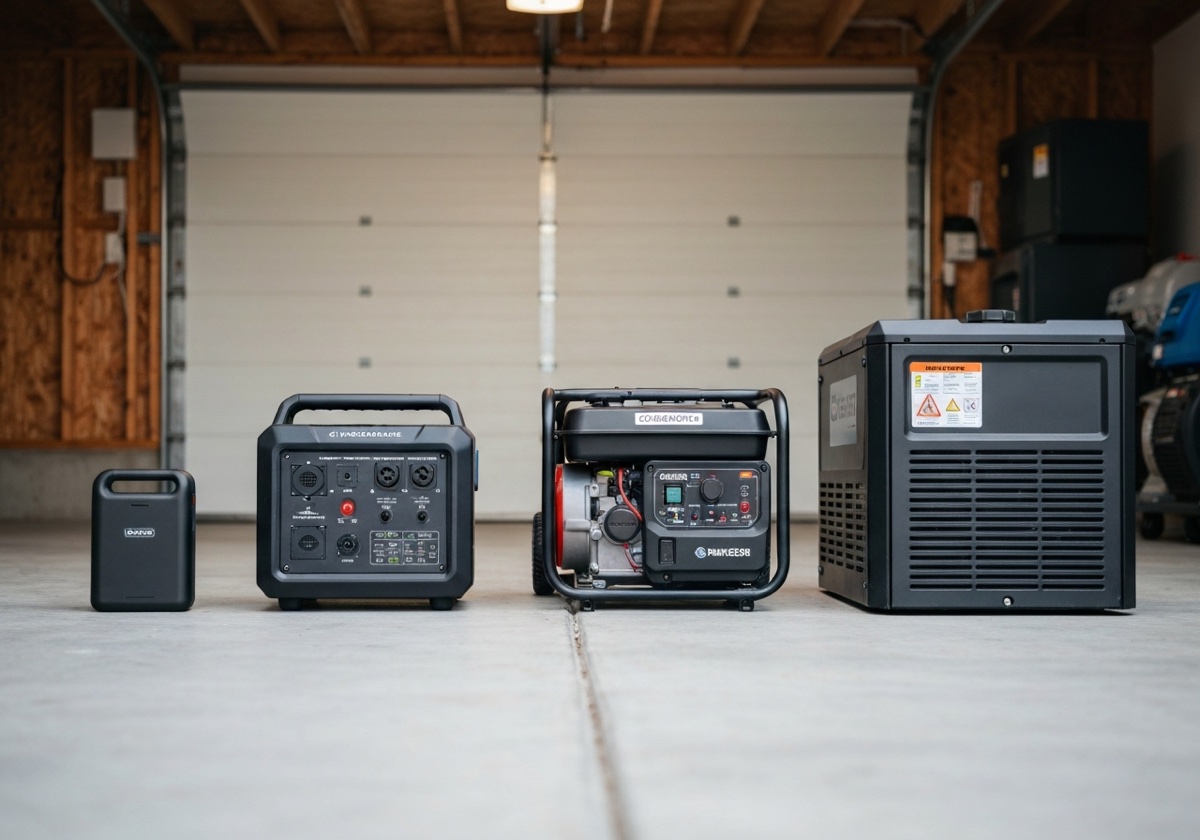
Ask ten neighbors what the best home backup power solution is and you will get ten different answers, because they are solving different problems. The retiree who loses power twice a year for an hour needs something completely different from the family in hurricane country that lost a freezer full of food last season.
The good news is that useful backup power starts at around $200, not $10,000. The bad news is that the market is crowded with options that sound similar but behave very differently when the lights actually go out.
This guide walks through five budget tiers, from a bedside power station to a whole-house standby generator, and explains what each tier covers in a real outage, where it falls short, and how to upgrade later without wasting the money you spent first.
Browse options: portable power stations on Amazon | dual-fuel generators on Amazon.
Quick Answer: Best Home Backup Power by Budget
- Under $300: A small portable power station (250 to 300Wh). Keeps phones, the Wi-Fi router, and a CPAP running for one night. The right first purchase for almost everyone.
- $300 to $800: A mid-size power station (500 to 1,000Wh). Cycles the refrigerator, runs lights and devices for roughly a day.
- $800 to $2,000: Either a large power station with a solar panel, or a quality dual-fuel inverter generator with an interlock kit. This is where multi-day outages become manageable.
- $2,000 to $6,000: An expandable flagship battery system, or a strong portable generator paired with a professionally installed manual transfer switch. Most of the house stays live.
- $6,000 to $20,000: A whole-house standby generator or a home battery system. Automatic, hands-off, covers everything.
Under $300: The Small Power Station
The entry point to real backup power is a compact portable power station in the 250 to 300 watt-hour range, typically priced between $180 and $300. These are lithium batteries about the size of a lunchbox, with AC outlets and USB ports.
What it covers in a real outage: phones and tablets recharged many times over, your Wi-Fi router and modem for roughly 15 to 25 hours, a few LED lamps through the evening, and a CPAP machine (humidifier off) for one full night. That handles the most common American outage, which lasts a few hours, with room to spare.
Representative products: the small models from Jackery, EcoFlow, Anker SOLIX, and Bluetti all compete here. Prioritize LiFePO4 battery chemistry, which typically survives 3,000 or more charge cycles instead of 500 to 800 for older lithium types.
Limitations: the refrigerator is out of reach. A fridge spikes to 700 or more watts at compressor startup, and many small stations either cannot handle the surge or drain within a couple of hours. Anything with a heating element is completely off the table.
Upgrade path: excellent. A small station never becomes obsolete. When you buy a bigger system later, it becomes the bedroom or camping battery while the main system runs the house.
$300 to $800: The Mid-Size Power Station
Between $350 and $800 you move into 500 to 1,000 watt-hour stations with 1,000 to 1,800 watts of output. This is the tier where the refrigerator enters the picture.
What it covers in a real outage: a full-size refrigerator run intermittently (15 to 20 minutes per hour holds safe temperatures if the door stays closed) for roughly 12 to 24 hours, plus lights, phones, laptops, the router, and a fan. A family gets through a full day without losing food or contact with the outside world.
Representative products: the mid-range lines from EcoFlow, Jackery, Bluetti, and Anker, most offering fast AC recharging and solar input around 200 to 500 watts.
Limitations: you are still rationing. Running the fridge continuously instead of intermittently cuts runtime to 4 to 8 hours. Central HVAC, well pumps, and electric ranges remain far beyond this tier. And once the battery is empty during an extended outage, you cannot refill it unless you bought a solar panel.
Upgrade path: add a 200W folding solar panel (roughly $200 to $400) and you can put 800 to 1,000Wh back into the battery on a sunny day, converting a one-day solution into an indefinite one for essential loads.
$800 to $2,000: The Fork in the Road
At this budget, two very different approaches become affordable.
Path A: Large power station plus solar
A 1,500 to 2,000Wh station with 2,000 or more watts of output (roughly $900 to $1,500) plus a 200 to 400W solar panel gives you silent, indoor-safe, self-recharging backup. It runs the refrigerator, a window AC unit in short bursts, the sump pump when it cycles, and every small device in the house. With decent sun, the essentials never go dark, even in a week-long outage.
Path B: Dual-fuel inverter generator plus interlock
A quality dual-fuel inverter generator in the 4,000 to 6,500 watt class (roughly $700 to $1,200 from brands like Champion, Westinghouse, or Generac) produces more sustained power than any battery near this price, for as long as you feed it gasoline or propane. Pair it with a breaker interlock kit installed by an electrician (roughly $300 to $600) and you can backfeed your panel safely and legally, running the furnace blower, well pump, and most 120V circuits through your home’s own wiring.
How to choose: pick the battery path for short but frequent outages, medical equipment in the home, or if noise and fumes are dealbreakers. Pick the generator path if outages run multiple days or you need maximum watts per dollar.
Limitations: the battery path still cannot touch 240V loads like central AC or an electric dryer. The generator path requires outdoor operation at least 20 feet from the house, fuel storage, seasonal maintenance, and someone willing to stand in the weather to start it.
Upgrade path: both paths stack beautifully. The strongest sub-$2,500 setup is arguably a mid-size power station plus a dual-fuel generator: the battery runs the bedroom silently all night, and the generator runs a couple of hours a day to recharge it and cool the fridge.
$2,000 to $6,000: Serious Capacity
This tier buys a flagship expandable battery system or a permanently integrated generator setup.
Path A, the flagship battery ecosystem: systems like the EcoFlow DELTA Pro line, Anker SOLIX F3800 series, or Bluetti’s larger units start around $2,500 to $3,500 and accept expansion batteries that push total storage to 8,000 to 12,000Wh or more. Many output 240V, which brings well pumps into play, and several support a transfer switch connection to feed selected home circuits directly. Paired with 800 or more watts of solar, a system like this can carry a home’s essential loads indefinitely.
Path B, generator plus manual transfer switch: a 7,500 to 9,500 watt dual-fuel generator (roughly $1,000 to $2,000) with a professionally installed 10-circuit manual transfer switch (roughly $800 to $1,500 installed) gives you a semi-permanent solution. When the power fails, you roll out the generator, start it, and flip the switch, and your pre-selected circuits (furnace, fridge, well pump, kitchen outlets) come back to life.
What it covers in a real outage: at this tier, an outage stops being an emergency and becomes an inconvenience. Food is safe, heat works, water flows, and the house functions at 70 to 80 percent of normal for as long as the outage lasts.
Limitations: nothing here is automatic. Someone has to be home and able-bodied to start a generator or reconfigure a battery system. Central air conditioning remains marginal: a 3-ton unit needs roughly 3,500 running watts plus a large startup surge, which strains this tier unless you add a soft-start kit.
Upgrade path: the transfer switch installed for a portable generator can often be reused or credited toward a standby generator installation later. Expandable battery systems grow by adding modules rather than replacing the core unit.
$6,000 to $20,000: Whole-House, Automatic, Done
The top tier is defined by one feature the lower tiers cannot buy: automation. These systems restore power whether you are home, asleep, or on vacation.
Whole-house standby generator: an air-cooled unit in the 18 to 26kW range from Generac, Kohler, or Cummins runs roughly $5,000 to $8,000 for the equipment, and installation (concrete pad, gas plumbing, automatic transfer switch, permits) typically brings the total to $10,000 to $16,000. It starts itself within about 30 seconds and runs on natural gas or propane for days or weeks. Budget roughly $200 to $400 per year for maintenance, and expect noise similar to a central AC condenser while it runs.
Home battery system: a Tesla Powerwall 3, Enphase IQ Battery, or Franklin Home Power installation runs roughly $12,000 to $20,000 for 13 to 27kWh of storage before incentives, and the federal 30 percent tax credit pulls the net cost down substantially. Batteries switch over in milliseconds, run silently, require essentially no maintenance, and recharge from rooftop solar during even a long outage. The tradeoff is finite capacity: without solar, 13.5kWh covers essential loads for roughly one to two days.
How to choose at this tier: pick the standby generator if your area sees week-long outages, if you have cheap natural gas service, and if runtime matters more than silence. Pick the battery if you have (or plan) rooftop solar, if outages run under 48 hours, or if your utility offers time-of-use rates the battery can arbitrage every day, outage or not.
How to Decide: Frequency, Duration, and Critical Loads
Strip away the marketing and the right tier comes down to three questions.
1. How often do you lose power? Once a year or less, and a lower tier plus patience is rational. Monthly, and the higher tiers start paying for themselves.
2. How long do your outages last? This is the most important variable. Under 4 hours, any tier works. Four to 24 hours, you need tier two or three. Multi-day outages effectively require fuel or solar, meaning tier three and up, because a battery without a recharge source is just a countdown timer.
3. What absolutely must stay on? Phones and a router: tier one. Refrigerator: tier two. Furnace, well pump, sump pump: tier three or four. Medical equipment or a home office where downtime costs real money: the automatic switchover of tier five is what you are actually buying.
Multiply the three together. A home with rare, short outages and no critical loads should stop at $500. A home with frequent multi-day outages and a well pump should be shopping between $4,000 and $15,000, and anything less is a stopgap.
Worked Example: The Hendersons Choose a Tier
Consider a family of four in upstate New York: two working parents, a home office, a full freezer, a natural gas furnace, and roughly three outages a year, one of which usually stretches past 24 hours after an ice storm.
They start by listing critical loads: refrigerator plus freezer (roughly 1,800Wh per day combined), the furnace blower (roughly 3,000Wh per day in winter), the router and two laptops (roughly 800Wh per day), and lights and phones (roughly 500Wh per day). Total: around 6,000Wh per day in winter.
Tier one is instantly ruled out, and a $600 mid-size station covers barely a quarter of one day. A $3,000 expandable battery system covers one to two days but would need over $1,500 in solar panels to survive an ice storm, exactly when solar production is worst. A standby generator solves everything but is hard to justify at $12,000 for three outages a year.
They land on the tier-three combination: a 6,500-watt dual-fuel inverter generator ($1,100), an interlock kit installed by an electrician ($450), two propane tanks ($120), and a 1,000Wh power station ($650) so the office runs silently between generator sessions. Total: roughly $2,300. During the next ice storm, the generator runs the furnace and fridge a few hours morning and evening, the power station bridges the quiet hours, and the house stays warm, fed, and online for four days.
Frequently Asked Questions
What is the best backup power option for under $500?
A 500 to 800Wh portable power station from an established brand. It runs a refrigerator intermittently for most of a day, keeps phones and the router alive, requires zero maintenance, and works indoors. A cheap conventional generator at the same price makes more raw power but cannot run indoors, needs fuel and upkeep, and produces electricity too rough for sensitive electronics.
Is a whole-house generator worth the cost?
It depends almost entirely on outage duration in your area. If you regularly see outages longer than two days, or someone in the home depends on powered medical equipment, the installed cost buys genuine security and typically adds some resale value. For homes with a few short outages a year, a $1,500 to $3,000 portable setup delivers 80 percent of the benefit at 20 percent of the price.
Can a portable power station really replace a generator?
For outages under 24 hours, yes, and it is quieter, safer, and maintenance-free. For multi-day outages, only with solar panels and cooperative weather. Once a battery is empty it is done, while a generator keeps going as long as you have fuel. That is why the combination of the two is so effective.
What size backup system do I need for my refrigerator?
A modern full-size refrigerator uses roughly 1,000 to 1,500Wh per day but surges to 700 or more watts at compressor startup. You want at least 1,000 watts of continuous output with surge headroom above 1,500 watts, and roughly 1,000Wh of storage per day of outage you want to cover. Running it 15 to 20 minutes per hour with the doors closed stretches any battery two to three times further.
Prices in this article reflect typical U.S. retail and installation ranges at the time of writing and vary by region, brand, and season. Always have panel-connected equipment such as interlocks and transfer switches installed by a licensed electrician.