
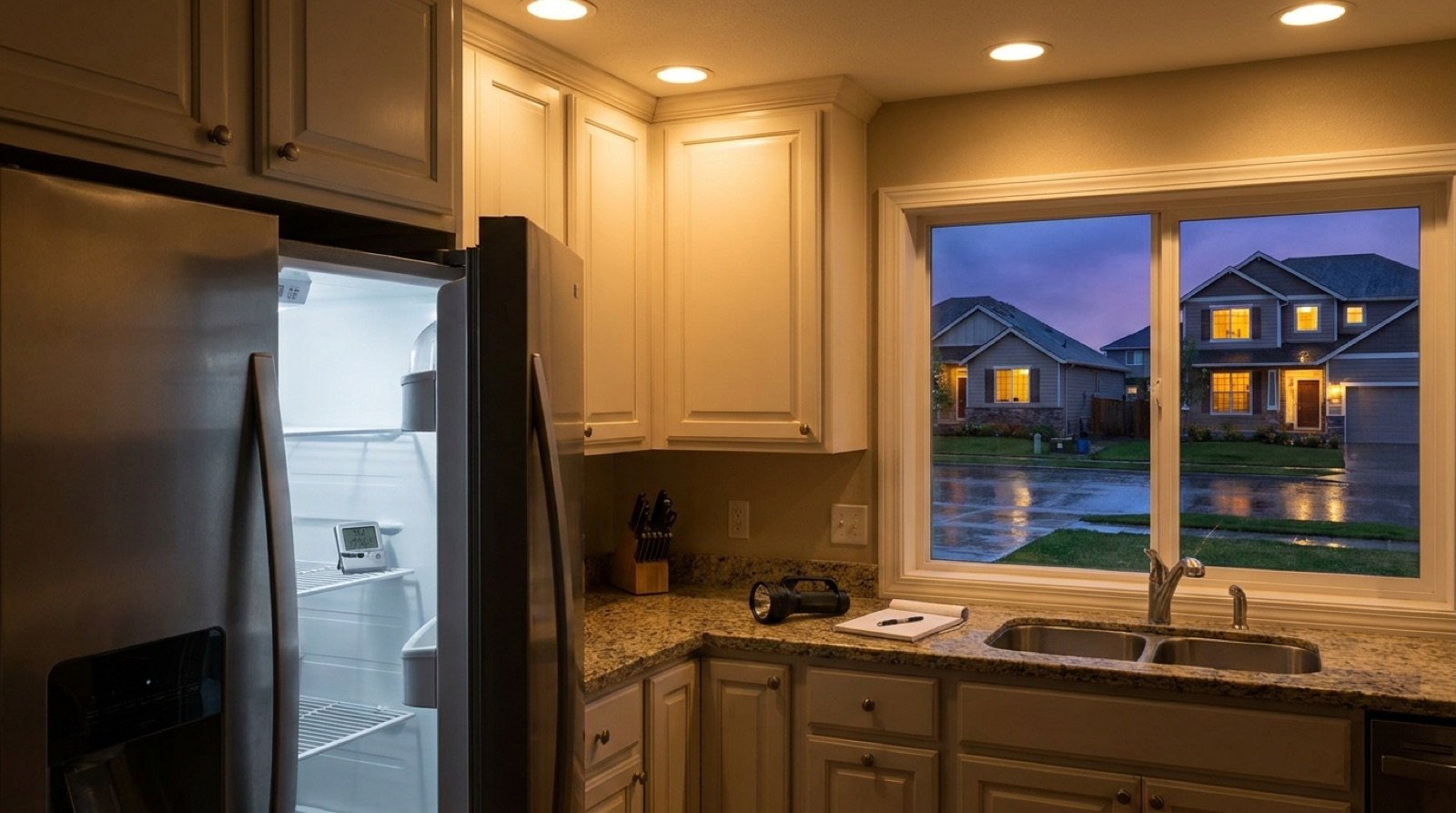
Short answer: when the power comes back on, wait 5 to 15 minutes before turning anything big back on, because the first minutes of restored power can flicker or drop out again. Then restart large loads one at a time, about 2 to 5 minutes apart, starting with the refrigerator and freezer. Check food with a thermometer (anything perishable above 40°F for more than 2 hours goes in the trash), and shut down your generator only after you have moved the house back to utility power and removed its load.
The minutes right after an outage ends are when a lot of avoidable damage happens: fried electronics, tripped breakers, a generator left running into a dead transfer setup, or food that looked fine but was not. This guide gives you the order of operations so you can work through it calmly, with a flashlight still in your pocket.
Step 1: Do Not Rush. Let the Grid Settle First
When a utility restores a circuit, it is common for the power to blink once or twice, or to come back for a few seconds and drop out again while crews switch sections of the line. Each of those cycles is a fresh startup for every motor and power supply still plugged in.
There is also a neighborhood effect that utilities call cold load pickup. After a long outage, every refrigerator, freezer, water heater, furnace and air conditioner on the street wants power at the same moment. Here is a rough illustration of why that matters:
- A central air conditioner might run around 3,500 watts.
- On a normal day, maybe one in three homes on a block has its AC running at any given moment.
- Right after restoration, nearly all of them call at once: 30 homes x 3,500 W = 105,000 W, versus about 35,000 W on a typical afternoon.
That sudden demand can sag voltage and trip the line again. You cannot control your neighbors, but you can keep your house off the pile for the first few minutes.
What to do: leave one lamp or ceiling light switched on during the outage so you know immediately when power returns. When it comes on, note the time and wait 5 to 15 minutes before bringing anything else back. If the lights flicker or dim during that window, wait longer.
Step 2: Protect Electronics From Surge Risk
Ideally you unplugged sensitive electronics when the outage started: TVs, computers, game consoles, printers and anything with a small transformer or circuit board. If you did not, unplug them now or switch off the surge protector strips they sit on, then plug them back in only after the grid has been stable for several minutes.
A few practical notes:
- Surge protectors wear out. Many strips have a protection indicator light. If it is off after a storm, the strip may still pass power but no longer protect anything. Replace it.
- Whole-home surge protection installed at the panel is a real option for homes in storm-heavy areas, but it must be installed by a licensed electrician.
- Battery-backed equipment such as a UPS or a portable power station in pass-through mode will usually ride through flickers on its own. Let it recharge from the wall before you depend on it again.
Step 3: Shut Down the Generator the Right Way
If you ran a portable generator, the order here matters for both safety and equipment life. How you do it depends on how the generator was connected.
If you used a transfer switch or interlock kit
- Confirm utility power is truly back and stable (Step 1).
- Turn off the generator-fed circuits or the generator main breaker so the generator is carrying no load.
- Move the transfer switch or interlock back to the utility position, following the procedure your electrician gave you.
- Let the generator run with no load for 1 to 2 minutes so the engine and alternator cool a little.
- Switch the generator off and close the fuel valve if it has one.
If you are not sure which position is which, or the switch feels wrong, stop and call the licensed electrician who installed it. If you have not set up a proper connection yet, read our guide on how to connect a portable generator to your house safely before the next storm. Never backfeed a house through a dryer outlet or any other receptacle with a homemade cord. It can kill line workers and energize your neighbor’s wiring.
If you used extension cords
- Unplug the appliances from the extension cords.
- Plug those appliances back into wall outlets, but do not switch them on yet (you will restart them in sequence in Step 4).
- Let the generator idle unloaded for 1 to 2 minutes, then shut it off.
- Coil the cords and check them for cuts or melted spots.
After it is off
- Let it cool before refueling or covering it. Hot mufflers and spilled gasoline are a fire risk. Plan on at least 15 to 20 minutes.
- Keep it outdoors while it cools. Never move a running or hot generator into a garage, shed or basement. CDC guidance is to operate generators at least 20 feet from the home, and that rule applies until the engine is fully stopped.
- Deal with the fuel. If you will not use it again within a month or so, either add fuel stabilizer and run it a few minutes to circulate it, or run the carburetor dry per the owner’s manual.
- Check the oil. Long outage runs burn through oil faster than people expect. Our portable generator maintenance checklist covers oil change intervals after heavy use.
Step 4: Bring Appliances Back One at a Time
Motors draw several times their running watts for a second or two when they start. Stacking those startup surges is what trips breakers after an outage. Spacing them out costs you a few minutes and avoids the problem.
Here is a typical example of why the order matters:
- Refrigerator: about 150 W running, often 600 to 1,200 W at startup.
- Chest freezer: about 100 W running, roughly 500 to 800 W at startup.
- Well pump (1/2 to 1 HP): about 1,000 W running, 2,000 to 3,000 W or more at startup.
- Central AC: about 3,500 W running, with a startup surge several times higher.
If the fridge, freezer, well pump and AC all kick on at once, you could see a combined startup draw of 1,200 + 800 + 3,000 + 10,000 = 15,000 W for a moment on a single panel, plus everything else in the house. One at a time, the worst single surge is the AC alone.
| Order | Load | When | Why |
|---|---|---|---|
| 0 | One test light | Already on | Tells you power is back |
| 1 | Refrigerator and freezer | After 5 to 15 minutes of stable power | Food is the most time-sensitive item |
| 2 | Well pump or sump pump | 2 to 5 minutes later | Restores water and flood protection |
| 3 | Furnace or heat pump | 2 to 5 minutes later | Comfort and freeze protection in winter |
| 4 | Central or window AC | 5 or more minutes after the thermostat sees power | Largest surge, and compressors need a pressure rest |
| 5 | Water heater | Any time after the AC is running | Large but steady resistive load |
| 6 | Modem, router, computers, TVs | Last | Most sensitive to flicker |
A few appliance-specific notes:
- Air conditioners and heat pumps: many have a built-in delay, but not all. If yours runs right away and sounds strained, switch it off at the thermostat and wait 5 minutes.
- Sump pump: if water rose in the pit during the outage, make sure the float moves freely and the pump actually empties the pit. If it does not, see our guide to sump pump backup power options before the next storm.
- Gas appliances: most modern furnaces, water heaters and ranges relight on their own. If you smell gas, leave the house and call the gas utility from outside. Relighting pilots or inspecting gas lines is a job for the utility or a licensed plumber.
Step 5: Check Your Food With Real Numbers
Do not judge by smell or appearance. USDA guidance is straightforward: a closed refrigerator keeps food safe for about 4 hours, a full freezer about 48 hours, and a half-full freezer about 24 hours. Perishable food that sat above 40°F for more than 2 hours should be thrown out.
Use an appliance thermometer and work through it like this:
| Situation | Decision |
|---|---|
| Fridge was off under 4 hours, door kept shut | Keep, then confirm it drops back to 40°F or below |
| Fridge was off over 4 hours, thermometer above 40°F | Discard meat, poultry, seafood, milk, soft cheese, leftovers, cut fruit |
| Freezer food still has ice crystals or reads 40°F or below | Safe to refreeze (quality may drop) |
| Freezer food fully thawed and above 40°F for over 2 hours | Discard perishables |
| No thermometer and you do not know the temperature | When in doubt, throw it out |
Quick arithmetic for a common case: the outage lasted 7 hours and the fridge door stayed shut. Subtract the 4 safe hours and you have about 3 hours where the fridge may have been above 40°F. That is more than the 2 hour limit, so dairy, meat and leftovers should go unless your thermometer proves the box stayed cold. Our full fridge and freezer food safety guide lists the gray-area items such as hard cheese, butter, condiments and produce.
Also check medications that need refrigeration, such as insulin. Labels vary, so ask your pharmacist whether a dose that warmed up is still good.
Step 6: Reset Clocks, Devices and Settings
This is the easy part, but it is where small problems hide. Walk the house with this list:
- Clocks: microwave, oven, coffee maker, cars plugged into chargers, and any timer outlets for lights or pool pumps.
- Thermostat: confirm the schedule and the heat or cool mode survived. Some reset to factory settings.
- Internet: power the modem first, wait 2 to 3 minutes until its lights settle, then the router, then mesh nodes.
- Garage door opener: if you used the manual release, pull the cord back toward the door or run the opener once so the trolley re-engages.
- Smart home hubs and cameras: check that they rejoined Wi-Fi and that recording schedules are back on.
- Smoke and CO alarms: hardwired units with battery backup may chirp after a long outage. Replace the backup battery if needed and press test.
- Ice maker: toss the first batch if the outage came with a boil-water notice.
Step 7: Check the Panel and Look for Damage
If anything did not come back, look at the breaker panel. A single tripped breaker can be reset once. If it trips again, leave it off and call a licensed electrician, because a repeat trip usually means a fault, not a fluke.
Call an electrician before restoring power to any area that flooded, any outlet or appliance that got wet, or if you notice burning smells, buzzing, scorched outlets or lights that are much brighter or dimmer than normal. Lights that swing bright and dim can point to a loose neutral, which is dangerous and needs a professional fast. Report it to the utility too.
Step 8: Recharge and Restock for Next Time
The best time to get ready for the next outage is the hour after this one ends, while you still remember what you were missing.
- Recharge power stations, flashlights, power banks and spare phone batteries.
- Refill or stabilize generator fuel, staying within your local storage limits.
- Write down how long the outage lasted and which loads you wished you had powered.
- If your current generator could not handle what you needed, compare options in our best portable generators for home power outages guide.
Bottom line: wait for stable power, shut the generator down only after the house is back on utility power, restart big appliances one by one a few minutes apart, and let a thermometer, not your nose, decide what food stays. Fifteen calm minutes of sequencing can save a compressor, a computer and a trip to the ER.
Frequently Asked Questions
How long should I wait after the power comes back on to turn things on?
Wait about 5 to 15 minutes of stable power before restarting large appliances. If the lights flicker or the power drops again during that time, start the clock over. Then bring loads back one at a time, 2 to 5 minutes apart.
Can a power surge happen when the power is restored?
Yes. Restoration can come with brief flickers, voltage swings and repeated on and off cycles as crews switch the line. Unplugging electronics during the outage, or switching off their surge strips, is the simplest protection.
Should I turn off the generator before or after switching back to utility power?
Remove the generator’s load and move the transfer switch or interlock back to utility first, then let the generator idle unloaded for 1 to 2 minutes and shut it off. If you are unsure how your transfer equipment works, have a licensed electrician walk you through it before the next outage.
Is food in the freezer safe if it partly thawed?
According to USDA guidance, food that still has ice crystals or reads 40°F or below can be safely refrozen, though texture may suffer. A full freezer holds about 48 hours if the door stays shut, a half-full one about 24 hours. Fully thawed perishables that sat above 40°F for more than 2 hours should be thrown out.