
This post contains affiliate links. If you buy through them, we may earn a commission at no extra cost to you.
Ten years ago, home backup power meant one thing: a gasoline generator roaring in the yard. Today, battery-based portable power stations have gotten big enough and cheap enough to run refrigerators, medical devices, and even space heaters, and millions of homeowners are stuck on the same question. Should you buy a power station, a generator, or somehow both?
The honest answer is that neither one wins outright. They are different tools that happen to solve the same problem, and the right choice depends on where you live, how long your outages last, and whether you can safely run an engine outside your home at all.
This guide compares them head to head across the factors that actually matter for home backup: cost per usable watt, runtime, indoor safety, noise, maintenance, power ceilings, lifespan, and weather. Then it maps each option to real household scenarios, because “it depends” is only useful if someone tells you what it depends on.
Quick Answer: Power Station vs Generator
- Buy a portable power station if: you live in an apartment or townhome, your outages are rare and under a day, someone in the house uses medical equipment overnight, or you simply cannot deal with engines, fuel, and maintenance.
- Buy a portable generator if: your outages regularly run multiple days, you need to power heavy loads like a well pump or central AC, and you have outdoor space at least 20 feet from the house to run it safely.
- Buy both (the hybrid strategy) if: you live in the storm belt and want silent overnight power plus unlimited daytime recharging. A small generator plus a mid-size power station beats either one alone.
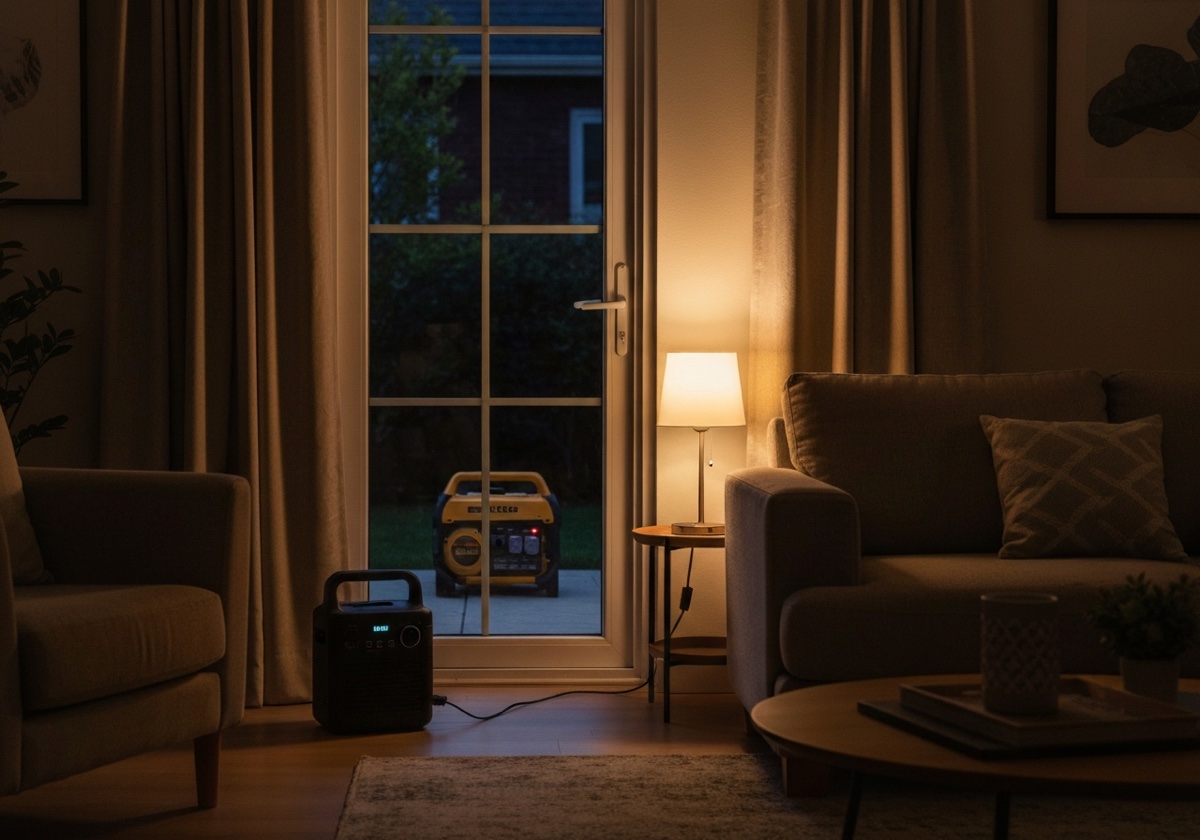
- Rule that overrides everything: a generator can never, under any circumstances, run indoors. If you have nowhere safe outside, the power station is not the better option, it is the only option.
Round 1: Upfront Cost per Usable Watt
Generators win this round, and it is not close. A dual-fuel portable generator delivering roughly 9,500 running watts costs around $1,000-$1,300. A battery system that can output even 7,200 watts with enough storage to matter runs $4,000-$8,000 once you add expansion batteries.
In practical terms, roughly $500 buys you either a 4,000-watt generator or a 1,000Wh power station with around 1,800 watts of output. If your outage plan includes big appliances and long durations, dollars stretch three to five times further on the engine side.
The gap narrows when you count what the sticker price leaves out: the generator needs a fuel supply, oil, stabilizer, and possibly an electrician-installed inlet, while the power station needs nothing except an eventual solar panel if you want one. But even with those adjustments, generators remain the cheapest watts you can buy.
Round 2: Runtime
A generator runs as long as you can feed it. With 15 gallons of stabilized gasoline and a couple of propane tanks, a mid-size unit can carry a house through a week-long outage with sensible load management. That is the generator’s defining superpower: energy on demand, indefinitely, as long as fuel exists.
A power station holds a fixed amount of energy. A 1,000Wh unit runs a typical refrigerator for roughly 10-15 hours. A large 3,600Wh unit stretches that to about two days. When it is empty, it is a very heavy box, unless you can recharge it, which is where solar changes the equation. A 400W panel array in decent sun can put roughly 1,600-2,400Wh back into the battery per day, enough to keep a fridge and electronics running indefinitely in fair weather.
Check the current price of the EcoFlow Delta 2 on Amazon.
Verdict: generators for guaranteed multi-day endurance, power stations only if paired with solar and modest loads.
Round 3: Indoor Safety (The Decisive Factor)
This is the round that decides the whole comparison for millions of households. A power station is a battery. It produces no exhaust, no fumes, and no carbon monoxide. It can sit next to your bed running a CPAP machine all night.
A generator burns fuel and produces carbon monoxide, which is odorless, invisible, and kills people in minutes in enclosed spaces. The safety guidance is absolute: outdoors only, at least 20 feet from the house, exhaust pointed away from openings, never in a garage even with the door open. Carbon monoxide from portable generators kills dozens of Americans every year, most of them during the exact storm emergencies the generator was bought for.
If you live in an apartment, a condo, a rowhouse with no yard, or anywhere you cannot maintain that distance, this round is not a comparison. The generator is disqualified before it starts.
Round 4: Noise
A power station is silent. Not quiet, silent. It can run in a bedroom, during a nighttime noise ordinance, in a campground with rules, anywhere.
Generators range from around 52 dB for the quietest small inverters (a normal conversation) to 75 dB or more for open-frame conventional units (a vacuum cleaner running in the yard, all night). In dense neighborhoods, generator noise is a genuine source of conflict during extended outages, and some HOAs and municipalities restrict nighttime operation.
Round 5: Maintenance
A power station asks you to top up its charge every few months. That is the entire maintenance schedule.
A generator is a small engine, and small engines demand attention: oil changes roughly every 50-100 hours, air filters, spark plugs, fuel stabilizer, carburetor care, and monthly test runs so it actually starts when a storm hits. The most common generator failure is not mechanical, it is neglect. A machine that sat untouched for a year with old gas in the carburetor has a real chance of refusing to start at the worst possible moment.
If you know yourself well enough to admit the maintenance will not happen, that self-knowledge should weigh heavily toward the battery.
Round 6: Power Output Ceilings
Mid-size power stations output roughly 1,800-2,400 watts, with flagship units reaching 3,600-7,200 watts. That covers refrigerators, electronics, furnace blowers, and most 120V appliances, but whole-home 240V loads (well pumps, central AC, electric water heaters) are beyond most battery setups short of installed home battery systems costing five figures.
Portable generators routinely deliver 7,500-12,000 peak watts with 240V outlets, transfer-switch compatibility, and the surge capacity that motor startups demand. If your must-run list includes a well pump or central air, the generator is the practical answer.
Round 7: Lifespan
Modern power stations built on LiFePO4 (lithium iron phosphate) chemistry are rated for 3,000+ charge cycles before dropping to 80 percent capacity. Used for backup and occasional trips, that is roughly a 10-year service life with zero interventions.
A well-maintained generator engine can also last a decade or more, but “well-maintained” is doing heavy lifting in that sentence, and budget units used hard may need carburetor work within a few seasons. Call this round roughly even for disciplined owners, and a clear battery win for everyone else.
Round 8: Weather Dependence
Generators run in any weather that lets you safely refuel them, though they should be sheltered from direct rain by a canopy or generator tent, never by a garage. Cold starts are harder but manageable.
Power stations charge from the wall before the storm regardless of weather, but their solar recharging is hostage to the sky. The cruel irony of storm outages is that they tend to arrive with clouds. Batteries also lose usable capacity in freezing temperatures, and most units refuse to charge below roughly 32°F, so winter storage in an unheated shed is a bad plan.
Side by Side: The Comparison Table
| Factor | Portable Power Station | Portable Generator |
|---|---|---|
| Cost per usable watt | High (roughly 3-5x more) | Low, best value at high wattages |
| Runtime | Fixed capacity; extendable with solar | Unlimited with fuel supply |
| Indoor use | Yes, completely safe | Never, under any circumstances |
| Noise | Silent | Roughly 52-75+ dB |
| Maintenance | Essentially none | Oil, filters, stabilizer, test runs |
| Max practical output | Roughly 1,800-7,200W | Roughly 3,000-12,000W with 240V |
| Lifespan | 3,000+ cycles, roughly 10 years | 10+ years if maintained |
| Ready when needed | Instant, push a button | Depends on fuel and upkeep |
| Weather sensitivity | Solar needs sun; cold hurts charging | Needs rain shelter; runs regardless |
Real Scenarios: What Should You Actually Buy?
The apartment or condo dweller
There is no decision to make. With no safe outdoor space 20 feet from the building, a generator is off the table entirely. A 1,000-2,000Wh power station keeps the fridge cycling, phones charged, and a fan or CPAP running through a typical outage, and it doubles as a very capable device for trips and blackout-proofing the home office.
The suburban home with rare, short outages
If your power fails a couple of times a year for a few hours, a generator spends 99.9 percent of its life as a maintenance obligation. A mid-size power station (around 1,000-2,000Wh) covers the fridge, Wi-Fi, lights, and phones through nearly all of your actual outages, with zero noise, zero fuel storage, and zero pull cords. Add a folding solar panel later if you want insurance against the rare long one.
The storm belt home with multi-day outages
Hurricane country, ice storm territory, wildfire shutoff zones: here the generator earns its keep. Multi-day outages with a freezer full of food, a sump pump, and possibly a well demand more energy than any reasonable battery can store. A dual-fuel unit in the 4,500-9,500 watt range, connected through an interlock or transfer switch installed by an electrician, is the backbone. Whether you add a battery on top brings us to the hybrid strategy below.
The household with medical devices
Power station first, every time. A CPAP, oxygen concentrator, or medication fridge needs power the instant the grid drops, silently, in the bedroom, with no one going outside at 2 a.m. in a storm to pull a starter cord. Size the battery to the device (roughly 500Wh covers 1-2 nights of CPAP with the humidifier off), then add a generator as the long-outage recharging layer if outages in your area run long.
The Hybrid Strategy: The Setup That Beats Both
The strongest home backup plan for most storm-prone households is not choosing between the two. It is a small inverter generator plus a mid-size power station, working in shifts.
Here is how it plays out during a multi-day outage. The power station runs the quiet, critical overnight loads: fridge cycling, CPAP, phones, a lamp. It is silent, so everyone sleeps, and no fuel burns overnight. In the morning, you start the generator outside for two or three hours. It recharges the power station (most mid-size units refill from a generator in roughly 1-2 hours), pulls the refrigerator and freezer back down to temperature, heats water, and handles any heavy chores. Then it shuts down, and the battery carries the house again.
The numbers are compelling. A generator running four hours a day instead of 24 uses roughly one-sixth the fuel, which turns 15 gallons of stored gasoline from a two-day supply into more than a week. Engine wear drops proportionally. Neighbors hear an engine for a few daylight hours instead of all night. And you keep full redundancy: if the generator will not start, the battery still covers essentials; if the battery runs flat, the generator still runs everything directly.
A realistic hybrid budget: around $600 for a 2,000-watt class inverter generator, plus around $700-$1,000 for a 1,500-2,000Wh LiFePO4 power station. For roughly $1,300-$1,600 total, that combination outperforms a $4,000 battery-only setup on endurance and a generator-only setup on safety, silence, and reliability.
See current pricing for the Honda EU2200i inverter generator on Amazon.
The Verdict by Profile
- No outdoor space: power station, full stop.
- Rare short outages, low tolerance for upkeep: power station.
- Medical devices in the house: power station first, generator second if outages run long.
- Multi-day outages, big loads, well pump or central AC: generator, professionally connected.
- Storm belt household that wants it done right: the hybrid, a small generator plus a mid-size battery.
Frequently Asked Questions
Can a power station really run a refrigerator?
Yes. A typical modern refrigerator draws 100-200 watts while cycling with startup surges around 800-1,200 watts, well within the output of any mid-size power station. A 1,000Wh unit runs one for roughly 10-15 hours; keeping the door closed stretches that further because the compressor cycles less.
Is it safe to charge a power station from a generator?
Yes, and it is the core of the hybrid strategy. Inverter generators produce clean power that any power station accepts happily. With conventional (non-inverter) generators, most modern power stations still charge fine because their chargers rectify the input, but an inverter generator is the safer pairing for all your electronics anyway.
How long does a power station hold its charge in storage?
LiFePO4 units typically lose only a few percent per month. Topping up every three months keeps the battery healthy and storm-ready. Store it indoors at room temperature, not in a freezing garage, and at around 50-80 percent charge if it will sit for many months.
Why not just buy a home battery system like a Powerwall?
Installed home batteries are excellent but cost roughly $10,000-$20,000 installed, a different budget class entirely. A portable power station delivers a meaningful slice of that capability for 5-10 percent of the price, and you can take it camping. For whole-home automatic backup, the installed system wins; for practical outage resilience per dollar, portables do.
Related: If a power station wins for you, pick the right brand with our EcoFlow vs Bluetti vs Jackery comparison.
Safety reminder: never run a fuel-burning generator indoors, in a garage, in a basement, or near open windows and vents. Operate it outdoors at least 20 feet from the house with the exhaust facing away, and install battery-powered carbon monoxide detectors on every level of your home. Any connection to your home’s electrical panel must be made through a transfer switch or interlock installed by a licensed electrician. This article is for general information only.