
This post contains affiliate links. If you buy through them, we may earn a commission at no extra cost to you.
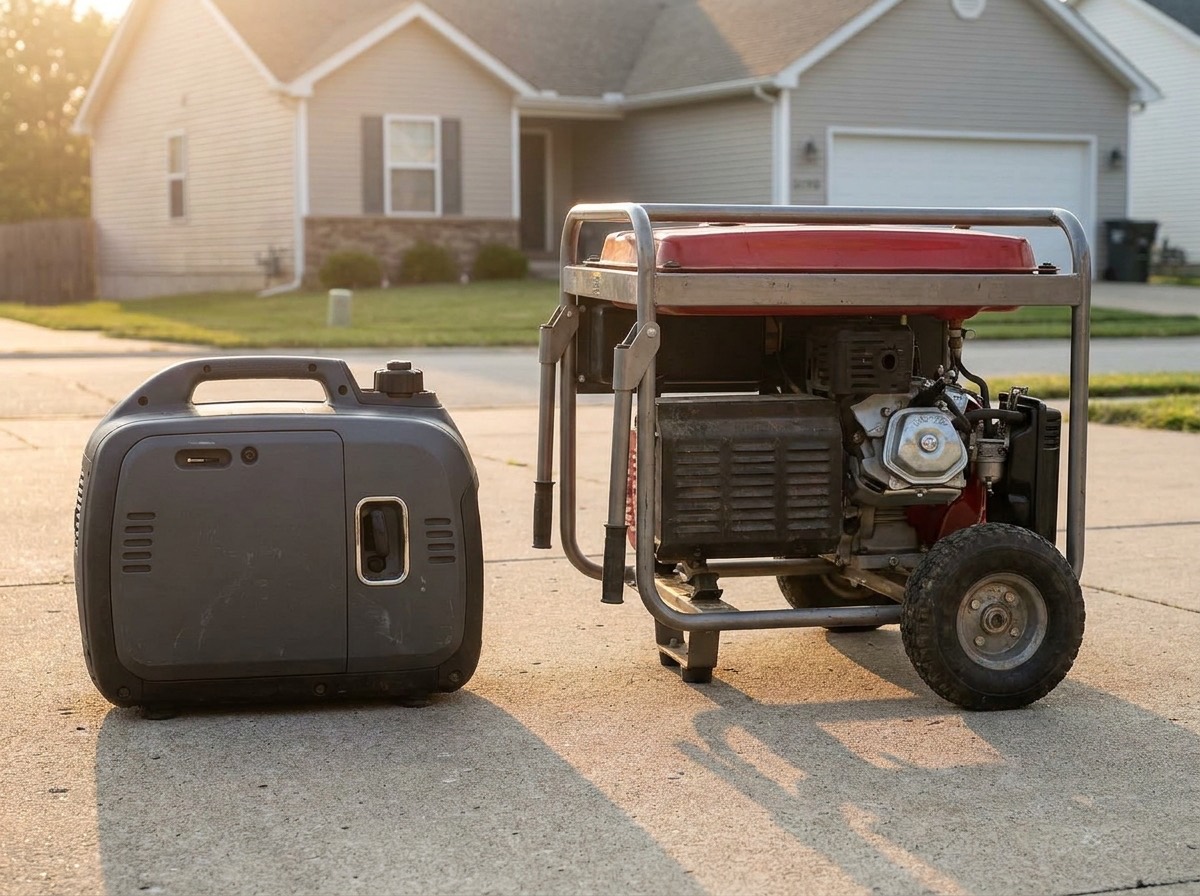
Short answer: under $1,000 buys a lot of generator in 2026. In the $500 to $1,000 range you can get a 3,500 to 4,500-watt dual-fuel inverter unit with electric start and a 30-amp outlet, or a 7,500 to 9,500-watt open-frame conventional generator that runs a well pump and central loads. Under $500, the choice narrows to 2,000 to 2,500-watt inverters and 4,000-watt open-frame units. The right pick depends on whether you value quiet and clean power (inverter) or raw wattage per dollar (conventional).
Quick Picks by Budget
| Budget | Pick | Type | Rated / Peak Watts | Best For |
|---|---|---|---|---|
| Under $500 | Champion 2500W dual-fuel inverter | Inverter | 1,850W / 2,500W | Fridge, lights, phones, CPAP; apartments and small homes |
| Under $500 | Westinghouse WGen3600 class | Conventional | 3,600W / 4,650W | Fridge, freezer, furnace, sump pump on a budget |
| Under $750 | Champion 4500W dual-fuel inverter | Inverter | 3,500W / 4,500W | Best all-round home backup, 30A outlet |
| Under $1,000 | Westinghouse WGen9500DF | Conventional dual fuel | 9,500W / 12,500W (gas) | Well pump, window AC, whole-house essentials via transfer switch |
| Under $1,000 | Generac GP3300i or Honda EU2200i (on sale) | Inverter | 2,500-1,800W | Quietest option; pair two later |
What $500 Buys vs What $1,000 Buys
The price of a generator is driven by three things: watts, inverter technology, and features (electric start, dual fuel, CO shutoff, wheels). At $500 you get two of the three. At $1,000 you get all three.
| Feature | Under $500 | $500-$1,000 |
|---|---|---|
| Inverter generator wattage | 2,000-2,500W | 3,500-4,500W |
| Conventional generator wattage | 3,500-4,500W | 7,500-12,000W |
| Dual fuel | Some models | Standard |
| Electric start | Rare | Standard above 3,500W |
| 30A outlet for home inlet | Only on conventional units | Standard |
| 240V output | No | Yes on 7,000W+ |
| CO shutoff sensor | Most current models | Standard |
| Wheel kit | Usually not needed | Included or $40-$80 extra |
The Best Portable Generators Under $500
Champion 2500W Dual-Fuel Inverter: Best Small Inverter Under $500
Champion’s 2500-watt dual-fuel inverter is the budget answer to the Honda EU2200i. It delivers 1,850 watts continuous on gasoline (1,665 on propane), weighs 39 pounds, runs about 53 dBA, and includes a parallel port and CO shutoff. On a 1.1-gallon tank it runs roughly 11 hours at quarter load. Propane capability is the feature the Honda lacks at any price. Build quality and long-term reliability trail Honda, but for a household that needs a fridge and lights a few days a year, it is the best value in the class.
Check the current price of the Champion 2500W dual-fuel inverter on Amazon
3,600 to 4,500W Open-Frame Conventional: Most Watts Under $500
Units in the Westinghouse WGen3600 and Champion 4375 class deliver 3,500 to 3,600 watts continuous for well under $500, often with a 30-amp outlet, wheels, and CO shutoff. They are loud (68 to 72 dBA), heavy (100-plus pounds), and their power is not clean enough for sensitive electronics without a line conditioner. But they run a refrigerator, freezer, furnace blower, sump pump, and lights all at once, and they can feed a home inlet box. For a rural home on a budget, this class does the job. The trade-offs are explained in inverter vs conventional generators.
Check the current price of 3,600W portable generators on Amazon
The Best Portable Generators from $500 to $1,000
Champion 4500W Dual-Fuel Inverter: Best Overall Under $750
This is the unit we recommend most often for home backup. 3,500 watts continuous, dual fuel, electric start, a 30-amp RV outlet that adapts to a home inlet, and about 61 dBA in eco mode. It runs a fridge, furnace, lights, Wi-Fi, and a microwave in rotation, and at 97 pounds with wheels it moves without a second person. Our Champion 4500W dual-fuel review covers runtime by load and the few things we would change.
Check the current price of the Champion 4500W dual-fuel inverter on Amazon
Westinghouse WGen9500DF: Most Power Under $1,000
At 9,500 rated watts on gasoline (8,500 on propane) with a 50-amp 240-volt outlet, remote electric start, and CO shutoff, the WGen9500DF is the budget route to running a well pump, a window air conditioner, and the rest of the house through a transfer switch. It is a conventional unit, so it is loud (around 74 dBA) and burns 0.75 gallons per hour at half load, and it weighs over 200 pounds. For a home with 240-volt loads and a limited budget, nothing else in the price range comes close. Full details in the Westinghouse WGen9500DF review.
Check the current price of the Westinghouse WGen9500DF on Amazon
Generac GP3300i: Best Mid-Size Inverter Under $1,000
Generac’s 3,300-watt inverter is a step up from the 2,200 class in surge capacity (PowerRush delivers extra starting power for motor loads) while staying at 60 pounds and around 52 dBA. It has USB ports, a fuel gauge, and a clean-power output safe for anything. Compared side by side in Generac GP3300i vs Honda EU2200i, it wins on watts and price; the Honda wins on long-term reputation.
Check the current price of the Generac GP3300i on Amazon
How to Choose Between Inverter and Conventional at the Same Price
At roughly $700, you can have a 3,500-watt inverter or a 7,500-watt conventional generator. The question to ask is what you actually need to run:
- Fridge, furnace, lights, electronics, CPAP, and you live in a neighborhood: inverter. Quiet, clean, half the fuel.
- Well pump, window AC, electric water heater, or anything 240-volt: conventional 7,500W-plus. The inverter cannot do it at this price.
- You want to feed the house through an inlet and run whatever you like: either works with a 30A outlet, but the conventional unit gives more headroom.
The generator size calculator adds up your real loads, and the appliance wattage guide has figures for everything in the house.
What to Budget Beyond the Generator
| Item | Cost | Needed? |
|---|---|---|
| Heavy-duty 12 or 10-gauge outdoor cords | $50-$150 | Yes, unless you install an inlet |
| Power inlet box + interlock kit, installed | $400-$900 | If you want hardwired loads (furnace, well pump) |
| Generator cord for inlet, 25 ft | $60-$120 | With an inlet |
| Fuel cans and stabilizer | $60-$120 | Yes |
| Running cover or generator tent | $50-$150 | If outages come with rain or snow |
| Battery-powered CO alarms | $40-$80 | Yes, non-negotiable |
| Wheel kit (if not included) | $40-$80 | Above 80 pounds |
A $700 generator becomes a $1,200 to $1,800 backup system once it can safely feed the house. Our guide to connecting a portable generator to your house explains the inlet and interlock side, and generator carbon monoxide safety is required reading before the first outage.
Models to Avoid in This Price Range
- Anything without a CO shutoff sensor. New units from every major brand have one. If a listing does not mention CO Shield, CO Sense, CO Guard, or similar, it is old stock or a no-name import.
- No-name inverter generators under $350. Reviews are full of units that lose their inverter board in the first season with no warranty support.
- Open-frame units marketed as “inverter” at open-frame prices. Some “open-frame inverter” designs are legitimate, but check that total harmonic distortion is listed at under 5 percent.
- Anything rated only in peak watts. A “4,000W generator” that is 3,200 rated is a 3,200-watt generator.
For a wider view of the market, see our best portable generators for home outages and best dual-fuel generators roundups.
Frequently Asked Questions
What is the best generator under $500 for home backup?
For a quiet, clean unit, the Champion 2500W dual-fuel inverter. For maximum watts, a 3,600-watt open-frame unit with a 30-amp outlet from Westinghouse or Champion.
Can a $1,000 generator run a whole house?
A 9,500-watt conventional unit in that range runs the essentials of most homes through a transfer switch, including a well pump and a window AC. It will not run central air, an electric range, and a water heater together.
Is a cheap inverter generator worth it?
From an established brand (Champion, Westinghouse, Generac, WEN), yes. From an unknown brand under $350, usually not; inverter boards fail and support is nonexistent.
Should I spend more for dual fuel?
Yes. Propane stores indefinitely, starts easier in cold, and is available when gas stations are closed. The premium is typically $50 to $100.
Do I need a 30-amp outlet?
Only if you plan to connect the generator to the house through an inlet box. For extension cord use, standard 120V outlets are enough.