
This post contains affiliate links. If you buy through them, we may earn a commission at no extra cost to you.
Short answer: a household with an infant or an elderly relative has three power needs that most outage guides skip: safe temperature (babies and older adults lose the ability to regulate body heat quickly), refrigeration for formula, breast milk, insulin, and other medication, and quiet, fume-free power that can run in a bedroom. A 1 to 2kWh portable power station handles all three indoors with no carbon monoxide risk, which a generator cannot do. Pair it with a plan for heat or cooling, a stocked medication list, and a decision rule for when to leave the house.
Why These Households Need a Different Plan
Healthy adults can tolerate a house at 50°F or 90°F for a day with discomfort. Infants under one year and adults over 65 cannot. Babies lose heat through their large heads and thin skin and cannot shiver effectively; older adults often have reduced circulation, medications that impair temperature regulation, and less thirst signal in heat. During the 2021 Texas freeze and in every major summer heat-wave outage since, the deaths were concentrated in exactly these two groups. The goal of this plan is simple: keep one room safe, keep the medicine cold, and keep the medical devices running.
The Three Non-Negotiables
| Need | Infant | Elderly Adult | Power Solution |
|---|---|---|---|
| Safe room temperature | 68-72°F ideal; below 60°F or above 80°F is a risk | Same range; heat above 85°F is dangerous with heart or kidney conditions | Furnace blower (400-800W) in winter; a fan or small window AC (500-700W) in summer |
| Refrigeration | Formula, pumped milk (4 hours at room temp, 4 days refrigerated) | Insulin, many biologics, eye drops, some antibiotics | Refrigerator (100-200W avg) or a dedicated small medical fridge (30-60W) |
| Medical and comfort devices | Bottle warmer, sterilizer, baby monitor, humidifier, nebulizer | CPAP, oxygen concentrator, nebulizer, lift chair, hospital bed, mobility scooter charger | Indoor battery power; see device wattages below |
Device Power Draw: What You Are Actually Running
| Device | Running Watts | Hours per Day | Daily Watt-Hours |
|---|---|---|---|
| Baby monitor (camera + parent unit) | 5-10W | 24 | 150-250Wh |
| Bottle warmer | 300-500W | 0.5 | 150-250Wh |
| Electric breast pump | 10-30W | 2 | 20-60Wh |
| Cool-mist humidifier | 20-40W | 10 | 200-400Wh |
| Nebulizer | 60-100W | 0.5 | 30-50Wh |
| CPAP, humidifier off | 30-60W | 8 | 240-480Wh |
| Oxygen concentrator, 5 L/min | 300-400W | 24 | 7,200-9,600Wh |
| Small medical refrigerator | 30-60W | 24 | 500-800Wh (cycling) |
| Full-size refrigerator | 100-200W avg | 24 | 1,200-2,000Wh |
| Box fan | 50-100W | 12 | 600-1,200Wh |
| Gas furnace blower | 400-800W | 6 (cycling) | 2,400-4,800Wh |
Everything except the oxygen concentrator and the furnace fits comfortably in a 2kWh power station for a day. The oxygen concentrator is the outlier: at 300 to 400 watts around the clock, it needs 7 to 10kWh a day, which means a generator or a very large battery bank. If someone in the house depends on one, read our dedicated guide to backup power for medical devices, and register with your utility’s medical baseline program, which prioritizes restoration and often includes advance outage warnings.
Step 1: Choose Indoor-Safe Power
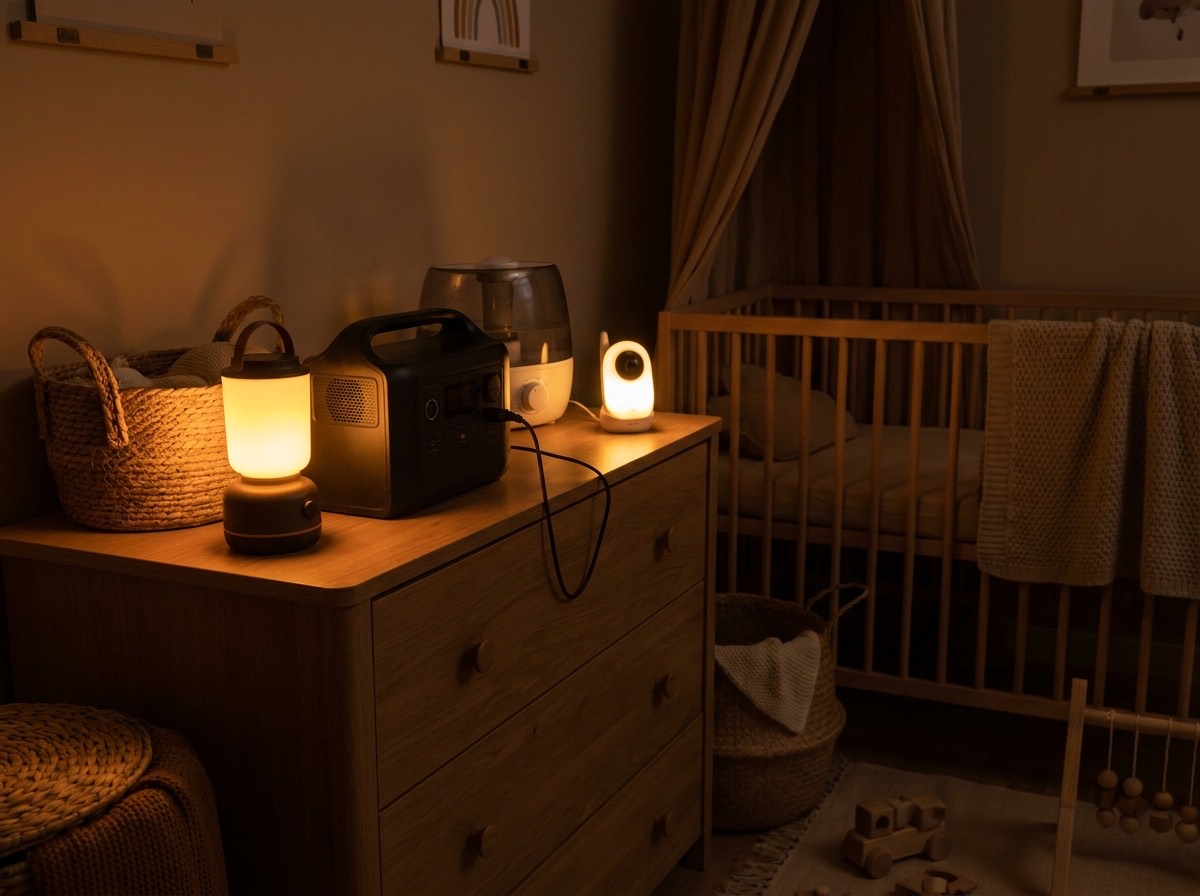
A gasoline generator cannot run in the house, the garage, or under a window, and its exhaust is most dangerous to the smallest lungs and the weakest hearts. The right tool for a nursery or a bedroom is a lithium power station. It is silent, produces no fumes, and can sit on the nightstand.
- 1kWh class: baby monitor, humidifier, bottle warmer, breast pump, phone charging, a lamp, and a CPAP for one to two nights. A good starting point for an infant household in a mild climate.
- 2kWh class: adds the refrigerator for a day or the furnace blower for a night. The practical choice for most families with an elderly parent at home.
- 4kWh class: runs a window AC through a hot night or a furnace through a cold one and still has margin for everything else.
Look for UPS or EPS mode so the CPAP or monitor never blinks, and a surge rating that covers the refrigerator’s compressor. Our roundup of the best portable power stations for home backup lists surge and UPS figures for each unit, and how long a power station runs a CPAP gives runtime by battery size.
Check the current price of 2,000Wh LiFePO4 power stations on Amazon
A generator still has a role: it lives outside, at least 20 feet from the house, and recharges the power station during the day. The CO rules in generator carbon monoxide safety are written for exactly this household; read them twice.
Step 2: Keep One Room at a Safe Temperature
Winter: the furnace is the most efficient heater you own; a 2kWh battery or a small generator runs its blower for a night. If that is not possible, pick a small interior room, close it off, hang blankets over the windows, and bring everyone in. Body heat matters. Dress the baby in layers rather than piling loose blankets, which are a suffocation risk. An indoor-rated propane heater with an oxygen sensor is the fuel-based fallback, with a window cracked and a CO alarm in the room. The complete winter plan is in how to keep your home warm during a winter power outage.
Summer: heat is the more dangerous direction for both groups. Move to the lowest floor, close blinds on the sun side, and run a fan on the power station (50 to 100 watts runs all day on a 1kWh unit). A small window AC unit (500 to 700 watts) on a 2 to 4kWh battery can hold one bedroom in the 70s overnight. Cool cloths on the neck and wrists, and lukewarm baths for an infant, bring body temperature down without electricity. Watch for the signs of heat illness: a baby who stops sweating, is unusually sleepy, or has flushed dry skin; an older adult who is confused, dizzy, or has stopped urinating.
Check the current price of rechargeable battery-powered fans on Amazon
Step 3: Protect the Medicine and the Milk
- Refrigerator rules: keep it closed. Four hours of safe temperature closed; up to 24 hours with a frozen jug inside and the door shut. On a power station, the fridge runs indefinitely at the cost of 1.2 to 2kWh per day. See keeping food safe during a power outage.
- Insulin: unopened vials and pens are stable at room temperature (below 86°F) for up to 28 days. An opened pen is fine at room temperature for its labeled period. The risk is heat, not the lack of a fridge. A small evaporative cooling pouch or an insulated bag with a cold pack (not touching the insulin) covers a multi-day outage.
- Formula and breast milk: ready-to-feed formula needs no water or heat. Keep a few days’ supply. Pumped milk lasts 4 hours at room temperature, 4 days refrigerated, and 6 to 12 months frozen; a full freezer holds 48 hours closed.
- Medication list: print it. Names, doses, times, prescribing doctor, pharmacy phone. Keep a week’s supply in a labeled bag. Pharmacies close in outages too.
- A small medical fridge (30 to 60 watts) runs for days on a 1kWh battery and keeps insulin, eye drops, and biologics at 36 to 46°F without opening the main fridge.
Check the current price of portable medication refrigerators on Amazon
Step 4: Water, Light, and Communication
- One gallon of water per person per day, plus extra for formula and for an elderly relative who needs to take pills. If you are on a well, the pump stops with the power; fill jugs and the tub before the storm.
- LED lanterns and headlamps, never candles. A nursery or an older adult’s room with candles is a fire waiting for a knocked-over table.
- A working phone with a charged power bank, and a written list of numbers: pediatrician, doctor, pharmacy, utility outage line, a relative with power. Our guide to keeping your internet and phone working during an outage covers the equipment side.
- Register in advance with the utility’s medical baseline or critical care program if anyone uses life-sustaining equipment.
Step 5: The Decision Rule for Leaving
Decide before the outage, in writing, when you will leave the house: for example, “if the bedroom is above 85°F or below 55°F and we cannot fix it within two hours,” or “if the oxygen concentrator battery has less than 4 hours left and the generator will not start.” Identify two destinations: a relative’s home in a different utility area, and the nearest emergency shelter or hospital. Pack a go-bag for the baby (formula, diapers, clothes, monitor) and for the elderly relative (medications, list, glasses, hearing aid batteries, walker or cane) and keep it by the door from the moment the forecast turns serious.
Pre-Storm Checklist
- Power station charged to 100 percent, in the bedroom, with the devices you will run already tested on it
- Generator (if any) fueled, tested, 20-foot spot marked, CO alarms tested
- Three days of ready-to-feed formula and diapers; a week of medications; printed medication list
- Frozen water jugs in the fridge and freezer
- Fans or heating plan in place for the safe room
- Water stored; phones and power banks charged
- Go-bags packed; decision rule written; destinations agreed
The general household list lives in our power outage checklist. This page is the layer on top of it for the two people in the house who cannot wait the outage out.
Frequently Asked Questions
What is the safest backup power for a baby’s room?
A lithium portable power station. It is silent, has no exhaust, and can sit in the nursery running the monitor, humidifier, and bottle warmer. Never run a generator indoors or near a window.
How cold is too cold for a baby during a power outage?
Below about 60°F, dress the infant in layers (not loose blankets) and move to a warmer room. Below 50°F, or if the baby’s hands and chest feel cold and the baby is lethargic, leave for somewhere with heat.
How long does insulin last without refrigeration?
Unopened insulin is stable up to 28 days at room temperature below 86°F. Keep it out of direct heat; an insulated bag with a cold pack that does not touch the insulin is enough for most outages.
Can a power station run an oxygen concentrator?
Yes, but a 5 L/min concentrator draws 300 to 400 watts continuously, so a 2kWh unit lasts only 4 to 5 hours. For overnight or multi-day use, plan on a generator to recharge the battery or a portable concentrator with its own batteries.
Should an elderly person stay home during a long power outage?
Only if you can keep the room between roughly 60 and 80°F, keep medications and devices running, and check on them regularly. If any of those fails, relocating to a relative or a shelter is safer than waiting.