
This post contains affiliate links. If you buy through them, we may earn a commission at no extra cost to you.
Short answer: a portable generator that will not start almost always has one of five problems, in this order of likelihood: stale fuel or a gummed carburetor, low oil tripping the shutoff, a fouled or wet spark plug, a closed fuel valve or wrong choke position, or a dead starter battery on electric-start units. Work through them in that order and you will fix 9 out of 10 no-start generators in the driveway in under 30 minutes with a spark plug socket, a can of carburetor cleaner, and fresh gas.
Before You Touch Anything: The 60-Second Checks
- Fuel valve ON. The small lever near the tank or carburetor. It is easy to leave off after storage.
- Fuel in the tank, and is it fresh? If the gas has been in there more than 60 days without stabilizer, assume it is the problem.
- Choke set to CLOSED (start) for a cold engine. Full choke to start, open it after 15 to 30 seconds of running. A warm engine usually needs no choke.
- Engine switch ON. Some units have a separate ignition switch and a low-oil light; both should be checked.
- Oil level. Pull the dipstick. Low oil is the most common cause of “starts and dies in 10 seconds.” Level ground matters; a tilted generator can read low and trip the sensor.
- Nothing plugged in. Some units will not start, or will stall, with a load connected. Unplug everything.
Symptom-Based Diagnosis
| Symptom | Most Likely Cause | Next Most Likely |
|---|---|---|
| Cranks (or pulls) normally, never fires | No fuel reaching the carburetor: stale gas, clogged jet, closed valve | No spark: fouled plug, disconnected plug wire, faulty kill switch |
| Fires briefly, then dies | Choke opened too early; carburetor main jet clogged | Low oil shutoff; fuel cap vent blocked |
| Starts, runs 5-15 seconds, shuts off | Low oil sensor | Generator not level; oil sensor fault |
| Runs rough, surges, backfires | Partially clogged carburetor; water in fuel | Dirty air filter; wrong plug gap |
| Will not crank at all (electric start) | Dead starter battery | Blown fuse; loose battery terminal; faulty start switch |
| Pull cord will not move or is very hard | Hydrolocked cylinder (fuel or oil in the combustion chamber) | Seized engine from running without oil |
| Runs but no power at outlets | Tripped breaker or GFCI | Lost residual magnetism after long storage; failed AVR or capacitor |
Problem 1: Stale Fuel and a Gummed Carburetor
Gasoline with ethanol degrades in about 30 days and leaves varnish inside the carburetor’s tiny passages. This is the number one reason a generator that ran last fall will not start today.
Quick test: spray a one-second burst of starting fluid into the air intake (with the filter removed) and pull the cord. If it fires for a second or two and dies, you have spark and compression; the problem is fuel delivery. That points straight at the carburetor.
Fix, easy version: drain the old fuel from the tank and the carburetor bowl (most bowls have a drain screw at the bottom), add fresh gasoline, and try again. Sometimes fresh fuel alone dissolves enough varnish to get it running. Let it run 15 minutes.
Fix, next level: remove the carburetor bowl (usually one bolt underneath), spray carburetor cleaner up through the main jet and the passages, and clean the jet with a fine wire or a jet-cleaning tool. Reassemble with a new bowl gasket if the old one tears. This takes 20 minutes and fixes most cases.
Fix, last resort: a replacement carburetor for most portable generators costs $15 to $40 and swaps in with two bolts, a fuel line, and a throttle linkage. Search by your generator’s model number.
Check the current price of carburetor cleaner spray on Amazon
Prevention is cheaper than any of this: stabilizer in every tank, or run the carburetor dry before storage. Our portable generator maintenance checklist covers the routine, and storing generator fuel at home explains how to keep gas usable.
Problem 2: Low Oil Shutoff
Every generator built in the last 15 years has a sensor that kills the ignition when oil is low. The symptom is unmistakable: it starts, runs 5 to 15 seconds, and dies, and it does this every time. Check the dipstick with the unit on level ground. Fill to the top mark with the correct grade (usually 10W-30). If the oil is full and it still dies, the unit may be tilted, or the sensor wire may be shorted; the manual will show a sensor connector you can temporarily unplug to test.
Problem 3: Spark Plug
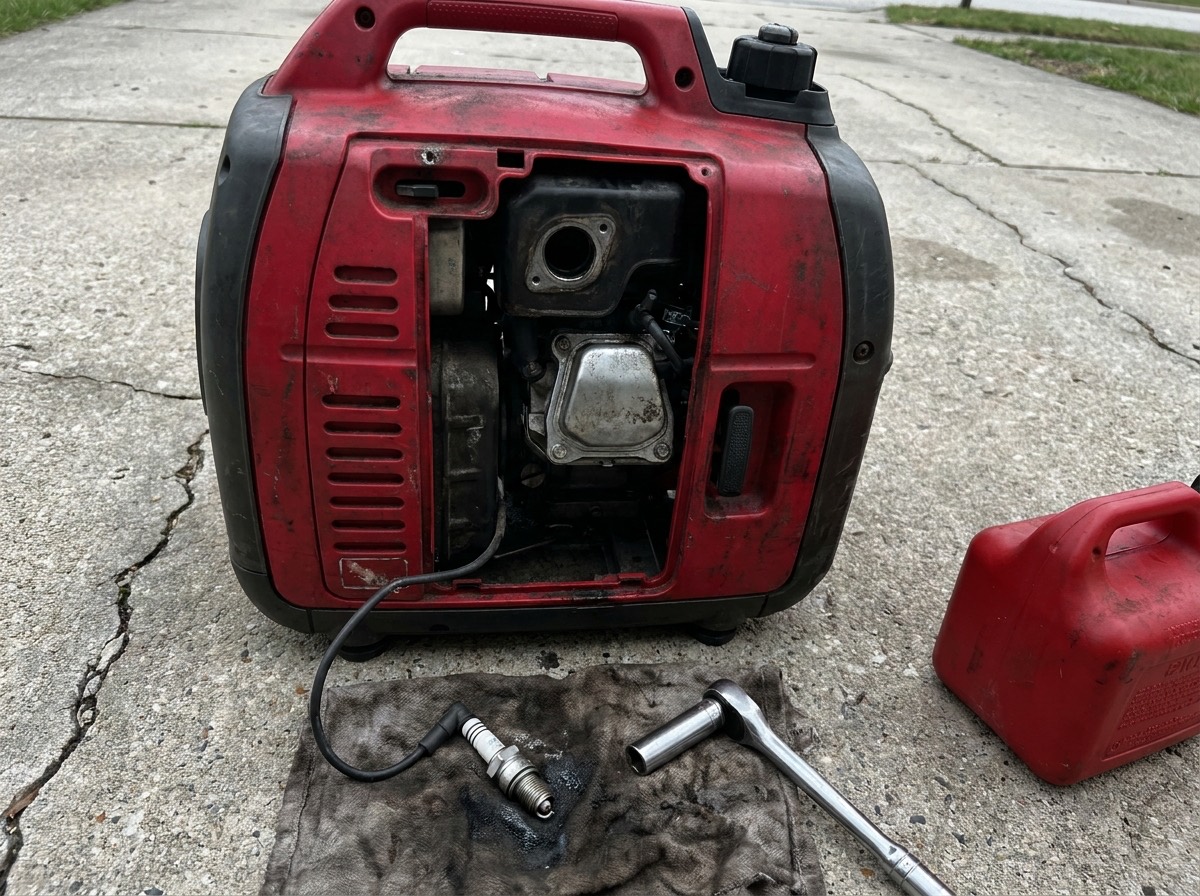
Pull the plug (a 13/16 or 5/8-inch plug socket fits most). Look at it:
- Wet with fuel: the engine is flooded. Dry the plug, pull the cord a few times with the plug out and the choke open, reinstall.
- Black and sooty: fouled from a rich mixture or a dirty air filter. Clean with a wire brush or replace.
- White or blistered: running lean or hot; often a partly clogged jet.
- Cracked porcelain or a worn electrode: replace.
Spark test: reconnect the plug wire to the removed plug, hold the plug’s threads against bare metal on the engine (use insulated pliers), and pull the cord. A visible blue spark means ignition is fine. No spark means a bad plug, a disconnected or damaged plug wire, or the engine switch is off or faulty. Keep a spare plug and the socket in the generator’s storage bin; it is a $5 part that ends a lot of driveway frustration.
Check the current price of a spark plug socket set on Amazon
Problem 4: Choke and Fuel Valve
More no-starts than anyone admits come down to the choke. Cold engine: full choke, pull, and when it fires, move the choke to half, then open, over the next 30 seconds. Warm engine: no choke. If you flood it (strong gas smell, wet plug), open the choke fully, hold the throttle open if it has one, and pull several times.
The fuel valve is the other easy miss. It is usually a lever under the tank. If you ran the carburetor dry for storage, the valve is still closed. Turn it on and wait 30 seconds for the bowl to fill before pulling.
Problem 5: Dead Starter Battery (Electric Start)
The small 12-volt battery on electric-start models self-discharges in two to three months of sitting. If pressing the start button gets a click or nothing, that is the battery. Every electric-start generator also has a recoil pull cord; use it. Afterward, charge the battery on a 12V charger or replace it (most use a small sealed lead-acid or lithium pack for $25 to $60). A float charger left connected between outages prevents this entirely.
Check the current price of generator starter batteries on Amazon
Problem 6: It Runs But Makes No Power
This is a different failure and it has its own short list:
- Reset the outlet breakers and press the reset button on any GFCI outlet.
- Check for a blown fuse near the control panel.
- If the unit has sat unused for a year or more, the alternator may have lost its residual magnetism. The fix, called flashing the field, involves briefly applying 12 volts to the brushes or spinning a corded drill plugged into the outlet while the generator runs. The manual describes the procedure for your unit; do not improvise.
- On inverter units, a dead inverter board produces no output and is a repair-shop or warranty job.
When to Stop and Call a Shop
- The pull cord will not move: a hydrolocked or seized engine. Do not force it.
- A knocking sound, or metal shavings on the dipstick.
- No spark after a new plug and a good plug wire.
- Fuel leaking from the carburetor or tank.
- An inverter unit with a fault code that clears and returns.
A carburetor rebuild or a coil replacement at a small-engine shop typically runs $75 to $150. Compared with the cost of a new generator, it is worth a quote. If the unit is old, loud, and lacks a CO shutoff, this is also the moment to consider replacing it; our guides to the best portable generators under $1,000 and best inverter generators for home backup cover the current market.
Storm-Day Kit to Keep With the Generator
- Fresh, stabilized gasoline (or full propane tanks on a dual-fuel unit)
- Spare spark plug and plug socket
- Can of carburetor cleaner and a small screwdriver set
- Quart of the correct oil and a funnel
- Starting fluid (for diagnosis only)
- 12V charger or a jump pack for electric start
- Flashlight or headlamp, and the manual in a zip bag
Starting the generator once a month under load is the habit that makes this whole article unnecessary; see how to break in a new generator for the first hours and the maintenance checklist above for the rest.
Frequently Asked Questions
Why does my generator start and then die after a few seconds?
Usually the low-oil shutoff. Check the oil on level ground. If oil is full, the carburetor’s main jet is likely clogged and the engine starves as soon as the choke opens.
Why will my generator not start after sitting all winter?
Stale fuel varnished the carburetor. Drain the old gas, clean the carburetor bowl and jet, add fresh fuel. Use stabilizer or run it dry before the next storage period.
Can I use starting fluid on a generator?
A one-second burst for diagnosis is fine. Do not rely on it to run the engine; if it only runs on starting fluid, the carburetor needs cleaning.
How do I know if the spark plug is bad?
Remove it and inspect. Wet, black, or damaged means it needs cleaning or replacement. A spark test against the engine block confirms whether ignition is working.
My generator runs but the outlets are dead. What now?
Reset breakers and GFCI outlets first. If it has been stored for a long time, the alternator may need its field flashed, a procedure described in your manual.