
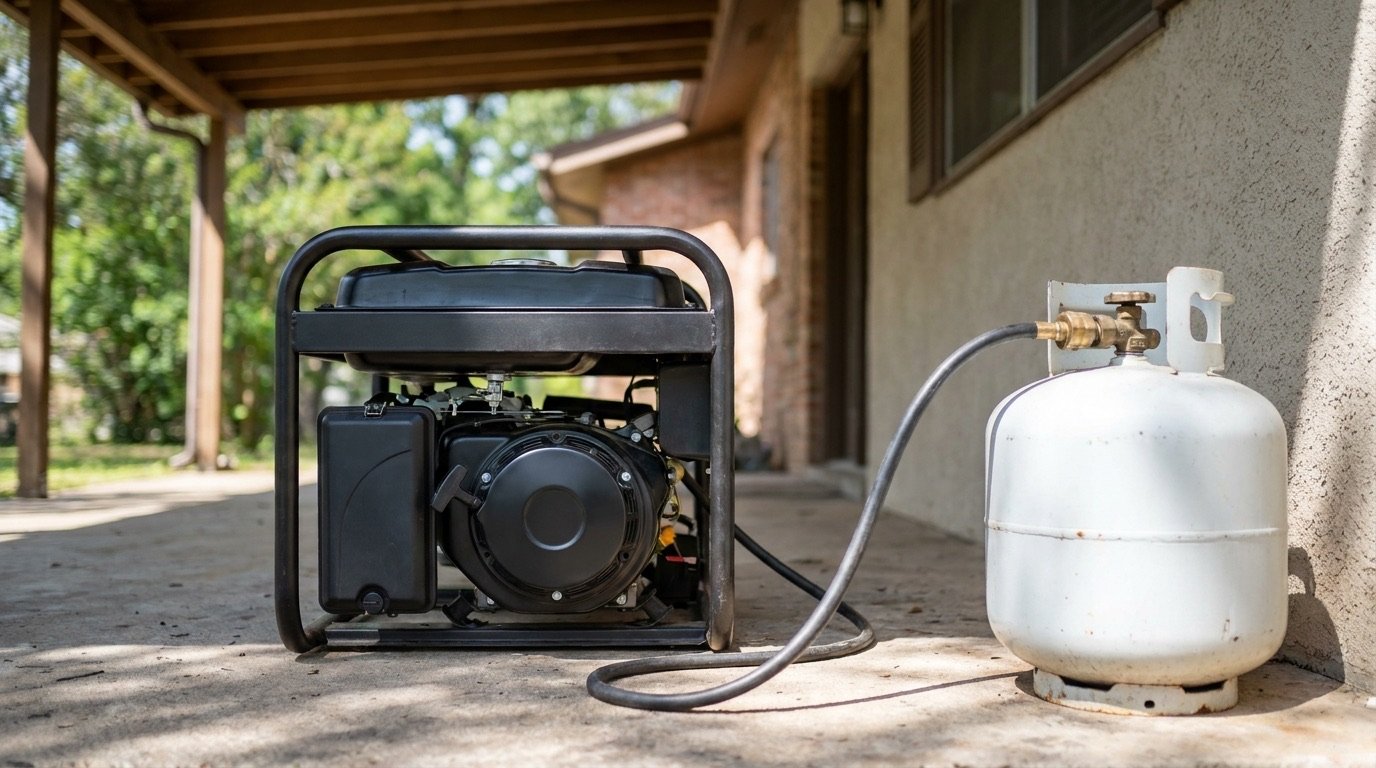
Short answer: switching a dual fuel generator from gasoline to propane costs you about 10 percent of its rated output, and switching to natural gas costs 17 to 27 percent. We pulled the published ratings for nine dual and tri fuel generators and calculated the drop for each one. The result is stranger than expected: six of the nine manufacturers publish a derate of exactly 10.0 percent, to the decimal, which is not what independent measurement of combustion looks like. The tables below show every number, what it means for sizing your generator, and where the published figures deserve skepticism.
The Fuel Derating Table
Running watts on each fuel, as published by the manufacturer, with the percentage drop from gasoline calculated for each.
| Model | Gasoline (W) | Propane (W) | Propane drop | Natural gas (W) | Natural gas drop |
|---|---|---|---|---|---|
| DuroMax XP13000EH | 10,500 | 9,975 | 5.0% | n/a | n/a |
| DuroMax XP9000iH | 7,600 | 7,200 | 5.3% | n/a | n/a |
| Westinghouse WGen11500TFc | 11,500 | 10,500 | 8.7% | 9,500 | 17.4% |
| Champion 200988 | 3,500 | 3,150 | 10.0% | n/a | n/a |
| Champion 100891 | 7,500 | 6,750 | 10.0% | n/a | n/a |
| Champion 201176 | 7,250 | 6,525 | 10.0% | 5,875 | 19.0% |
| Westinghouse iGen4500DF | 3,700 | 3,330 | 10.0% | n/a | n/a |
| Firman T07571 | 7,500 | 6,750 | 10.0% | 5,500 | 26.7% |
| Westinghouse WGen9500DFc | 9,500 | 8,500 | 10.5% | n/a | n/a |
What the Pattern Suggests
Six of the nine propane figures land on exactly 10.0 percent. Champion does it three times across three different engines of 212cc, 420cc and 439cc. Westinghouse does it once at 10.0 and once at 10.5. Firman does it at 10.0.
Combustion does not work that cleanly. Propane carries about 4 percent less energy per unit of air-fuel mixture than gasoline, and the actual power loss on a given engine depends on compression ratio, ignition timing, carburetor or mixer design and how well the conversion is tuned. Independent engine testing typically finds somewhere between 5 and 15 percent, varying by engine. A figure that lands on precisely 10.0 percent across unrelated engine displacements is a rule of thumb applied at the marketing stage, not a measurement of that specific machine.
That does not make the numbers useless. It makes them a conservative planning figure rather than a specification. Treat 10 percent as the industry’s shorthand and assume your particular unit could be a little better or a little worse.
The two DuroMax entries deserve the opposite kind of skepticism. Claiming only 5.0 and 5.3 percent makes DuroMax the best performer in the table by a factor of two, on ordinary air-cooled engines with no unusual technology described. It is possible. It is also the kind of outlier that, in a category where everyone else defaults to a round 10 percent, is worth treating as optimistic until an independent load test says otherwise.
Natural Gas Is the Real Penalty
The propane conversation gets all the attention, and it is the small problem. Natural gas costs 17.4 percent on the Westinghouse, 19.0 percent on the Champion and 26.7 percent on the Firman. The spread between those three is itself notable: 9 percentage points of difference for the same fuel across three tri fuel units.
Natural gas loses more because it is delivered at low pressure from a residential line and carries much less energy per unit volume than propane. The practical effect on sizing is large. A Firman T07571 sold as a 7,500-watt generator delivers 5,500 running watts on natural gas. If you sized it for a 7,000-watt load because the model name said 7500, you are 1,500 watts short on the fuel you intended to use permanently.
That is the single most common sizing error with tri fuel units, and it runs in one direction only. Nobody discovers they have too much generator. Our generator size calculator works from your actual loads, and the rule is to apply the derate before comparing against your total.
How to Size Around the Derate
- Decide the fuel you will actually run. Not the one on the box. If your generator will be connected to a house gas line permanently, natural gas is your real rating and gasoline is irrelevant.
- Apply the published derate, then add margin. Take the manufacturer’s figure for your fuel, then plan to use no more than 80 percent of it continuously. Engines are rated at sea level and moderate temperature, and both altitude and heat take another bite.
- Check the surge separately. Peak watts are also published per fuel, and motor starting is where an undersized unit fails first.
- Add altitude if it applies. Naturally aspirated engines lose roughly 3 percent of output per 1,000 feet of elevation. At 5,000 feet a generator already down 19 percent on natural gas is down about 30 percent from its gasoline nameplate.
Worked example. A Champion 201176 is sold as a 9,000-watt tri fuel unit. Running watts on gasoline are 7,250. On natural gas the published figure is 5,875. At 4,000 feet of elevation, subtract another 12 percent, leaving about 5,170. Apply the 80 percent continuous rule and the honest planning number is roughly 4,100 watts, from a generator whose model name suggested 9,000. That is not a defect. It is how every generator in this category works, and it is why sizing from the model name is the most expensive mistake in the category.
If you are shopping now, our guide to the best dual fuel generators is the place to apply these derated figures to real picks, and the Champion 4500W dual fuel review shows what the propane loss means on one of the most popular models.
Three More Derived Numbers
Watts per pound: what you get for the weight
| Model | Running W (gas) | Weight (lb) | Watts per pound |
|---|---|---|---|
| Westinghouse WGen11500TFc | 11,500 | 230 | 50.0 |
| DuroMax XP13000EH | 10,500 | 234 | 44.9 |
| Westinghouse WGen9500DFc | 9,500 | 212 | 44.8 |
| Champion 201176 | 7,250 | 166 | 43.7 |
| Generac GP3300i | 2,500 | 59.5 | 42.0 |
| Generac GP8000E | 8,000 | 207 | 38.6 |
| Honda EU2200i | 1,800 | 47.4 | 38.0 |
| Westinghouse iGen4500 | 3,700 | 98 | 37.8 |
| Champion 100891 | 7,500 | 205 | 36.6 |
| Firman T07571 | 7,500 | 213 | 35.2 |
| Champion 200988 | 3,500 | 103 | 34.0 |
| DuroMax XP9000iH | 7,600 | 237 | 32.1 |
| Generac iQ3500 | 3,000 | 109 | 27.5 |
| Honda EU7000iS | 5,500 | 263 | 20.9 |
Open-frame conventional generators dominate this column, which is the expected result: inverter units carry an inverter, a heavier enclosure and sound insulation. The Honda EU7000iS finishing last at 20.9 watts per pound is the clearest illustration that this metric measures density, not quality. It is among the quietest and most durable units in the category, and it is heavy partly because of what makes it good.
Watts per cc: how hard the engine works
Dividing running watts by engine displacement shows how much electrical output each manufacturer extracts per unit of engine. The conventional open-frame units cluster at 19 to 21 watts per cc, while the inverter units sit at 14 to 17.
That gap is mostly the inverter conversion loss plus the fact that inverter generators throttle down. It also hints at engine loading: a unit producing 21 watts per cc is working its engine harder at rated output than one producing 14. Honda’s two units are the lowest in the table at 14.9 and 14.1, meaning a physically larger engine for a given output, which is one of the reasons they tend to last. Whether that tradeoff is worth the price is the subject of inverter vs conventional generators.
Surge headroom
Peak divided by running ranges from 1.17x on the Generac iQ3500 to 1.32x on the Generac GP3300i and Westinghouse WGen9500DFc. The range is narrow because engine-driven generators cannot fake surge the way a battery inverter can; the headroom comes from the engine’s ability to absorb a momentary load. For motor starting, more is better, but the difference between 1.2x and 1.3x matters far less than getting the running watts right in the first place.
Where These Numbers Came From, and What Is Missing
Every running watt, peak watt, weight and displacement figure above was read from the manufacturer’s own product page, spec sheet or operator’s manual in September 2026. The derating percentages, watts per pound, watts per cc and surge headroom columns are our calculations from those published figures.
Three honest gaps. Generac does not publish a decibel rating for the GP3300i, GP8000E or iQ3500 on their official spec sheets, so noise is absent for those units rather than filled in from a third party. Honda’s own site blocked automated access, so the Honda figures come from sources that reproduce Honda’s spec sheet rather than from the sheet itself. And two Champion models in the table, the 100891 and 200988, no longer appear in Champion’s current catalog and appear to have been succeeded by newer versions; their specs come from Champion’s still-hosted manuals.
We have left prices out. They move constantly and would date the article within weeks.
Frequently Asked Questions
How much power do you lose running a generator on propane?
About 10 percent of rated output, according to most manufacturers. The real figure for any specific engine varies between roughly 5 and 15 percent depending on tuning and compression. Plan with 10 percent and you will rarely be caught short.
How much do you lose on natural gas?
More than most people expect: 17 to 27 percent across the tri fuel units we checked. Natural gas arrives at low pressure and carries less energy per unit volume. If natural gas is your permanent fuel, size the generator from its natural gas rating, never from the model name.
Is propane worth the power loss?
Often yes, for reasons that have nothing to do with watts. Propane does not go stale, does not gum a carburetor and stores safely for years, which matters for equipment that sits unused between outages. The cost per kWh is higher, and we work that out in what backup power really costs per kWh. The fuel-by-fuel tradeoff is in natural gas vs propane generators.
Does altitude affect the rating too?
Yes, and it stacks with the fuel derate. Naturally aspirated engines lose roughly 3 percent per 1,000 feet of elevation. A generator on natural gas at 5,000 feet can be 30 percent below its gasoline nameplate.
Why do so many manufacturers publish exactly 10 percent?
Because it is the accepted industry approximation for the propane derate, applied as a rule rather than measured per engine. Identical decimal figures across unrelated engine sizes from the same brand indicate a formula, not a dynamometer. Use it as a planning figure and leave margin.