
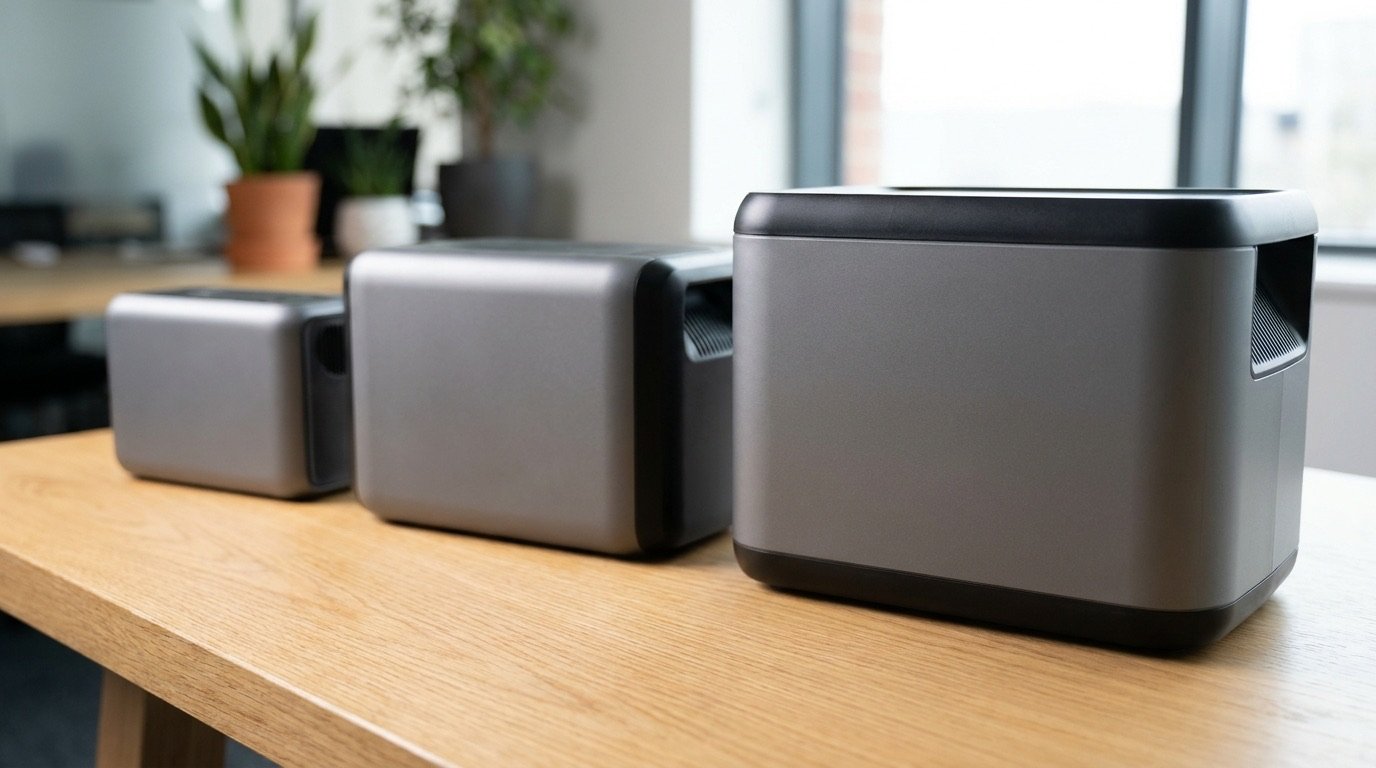
Short answer: two power stations with the same capacity on the box can differ by sixteen times in the total energy they will deliver before they wear out. A Goal Zero Yeti 1500X holds 1,516 Wh and is rated for 500 cycles, which is about 758 kWh over its life. A Bluetti Elite 200 V2 holds 2,074 Wh and is rated for 6,000 cycles, which is about 12,442 kWh. Nobody prints that number, so we calculated it for thirteen current models from published manufacturer specs. The table below is that math, alongside three other derived figures that change which unit is actually the right buy.
Lifetime Energy: The Number Nobody Publishes
Manufacturers advertise capacity in watt-hours and, separately, a cycle rating buried in the spec sheet. Multiply the two and you get lifetime energy: roughly how many kilowatt-hours the unit will deliver before its capacity drops to the stated threshold. It is the closest thing to a durability figure this category has.
| Model | Capacity (Wh) | Chemistry | Rated cycles | To what capacity | Lifetime energy (kWh) |
|---|---|---|---|---|---|
| Bluetti Elite 200 V2 | 2,074 | LiFePO4 | 6,000 | not stated | 12,442 |
| Anker SOLIX F3800 | 3,840 | LFP | 3,000 | not stated | 11,520 |
| Jackery Explorer 2000 Plus | 2,043 | LiFePO4 | 4,000 | 70% | 8,171 |
| EcoFlow DELTA 2 Max | 2,048 | LFP | 3,000 | 80% | 6,144 |
| Bluetti AC200L | 2,048 | LiFePO4 | 3,000 | 80% | 6,144 |
| Jackery Explorer 1000 v2 | 1,070 | LiFePO4 | 4,000 | 70% | 4,280 |
| EcoFlow DELTA 3 Plus | 1,024 | LiFePO4 | 4,000 | 80% | 4,096 |
| DJI Power 1000 | 1,024 | LFP | 4,000 | 70% | 4,096 |
| Bluetti AC180 | 1,152 | LiFePO4 | 3,500 | 80% | 4,032 |
| Anker SOLIX C1000 | 1,056 | LiFePO4 | 3,000 | 80% | 3,168 |
| Jackery Explorer 300 Plus | 288 | LiFePO4 | 3,000 | 80% | 864 |
| EcoFlow RIVER 3 Plus | 286 | LiFePO4 | 3,000 | 80% | 858 |
| Goal Zero Yeti 1500X | 1,516 | Li-ion NMC | 500 | 80% | 758 |
The Yeti 1500X result is the one worth pausing on. It is a large, well-built unit with 1,516 Wh of capacity, more than the Bluetti AC180 and the Anker C1000. Yet its lifetime energy is the lowest in the table, below two units with a fifth of its capacity. The reason is chemistry: it uses older lithium nickel manganese cobalt cells rated for 500 cycles, while every other unit here uses lithium iron phosphate rated for 3,000 to 6,000. That single specification is worth more than any feature comparison, and it is the clearest dividing line in the category today. The chemistry difference is explained in how long portable power stations last.
One honest caveat about this column: manufacturers do not measure cycles the same way. Some rate to 80 percent of original capacity, some to 70 percent, and two of the units here do not state the threshold at all. A 6,000-cycle rating to an unstated endpoint is not directly comparable to a 4,000-cycle rating to 70 percent. Treat the ranking as a difference in order of magnitude, not a difference of a few percent.
Energy Density: What You Carry Per Pound
Watt-hours divided by weight tells you how much battery you get for the burden of moving it. This matters if the unit will ever leave the house, and it matters for stairs.
| Model | Capacity (Wh) | Weight (lb) | Wh per pound |
|---|---|---|---|
| Jackery Explorer 1000 v2 | 1,070 | 23.8 | 45.0 |
| Bluetti Elite 200 V2 | 2,074 | 53.4 | 38.8 |
| Anker SOLIX C1000 | 1,056 | 28.4 | 37.1 |
| DJI Power 1000 | 1,024 | 28.7 | 35.7 |
| Jackery Explorer 300 Plus | 288 | 8.3 | 34.8 |
| Bluetti AC200L | 2,048 | 61.6 | 33.2 |
| Goal Zero Yeti 1500X | 1,516 | 45.6 | 33.2 |
| Jackery Explorer 2000 Plus | 2,043 | 61.5 | 33.2 |
| Bluetti AC180 | 1,152 | 35.3 | 32.7 |
| Anker SOLIX F3800 | 3,840 | 132.3 | 29.0 |
| EcoFlow RIVER 3 Plus | 286 | 10.4 | 27.5 |
The spread is narrower than the lifetime column, between 27 and 45 watt-hours per pound, because every unit here uses similar cells in similar cases. The Jackery 1000 v2 leads clearly. At the other end, the Anker F3800 is the heaviest unit in the group at 132 pounds, which puts it in a different category entirely: it is a semi-permanent installation on a cart or in a utility room, not something anyone carries. Two EcoFlow models are missing from this table because their official pages did not publish a weight in a form we could verify.
The practical threshold is around 50 pounds. Below that, one adult can move the unit up a flight of stairs. Above it, you are planning where it lives.
Surge Headroom: Whether the Compressor Starts
Surge divided by rated output tells you how much momentary overload the inverter tolerates. This decides whether a refrigerator, a sump pump or a power tool will start, because motors draw three to five times their running watts for a fraction of a second at startup.
| Model | Rated AC (W) | Surge (W) | Headroom |
|---|---|---|---|
| EcoFlow DELTA 3 Plus | 1,800 | 3,600 | 2.0x |
| Jackery Explorer 1000 v2 | 1,500 | 3,000 | 2.0x |
| Jackery Explorer 2000 Plus | 3,000 | 6,000 | 2.0x |
| DJI Power 1000 | 2,200 | 4,400 | 2.0x |
| EcoFlow RIVER 3 Plus | 600 | 1,200 | 2.0x |
| Goal Zero Yeti 1500X | 2,000 | 3,500 | 1.8x |
| Bluetti AC180 | 1,800 | 2,700 | 1.5x |
| Bluetti AC200L | 2,400 | 3,600 | 1.5x |
| Bluetti Elite 200 V2 | 2,600 | 3,900 | 1.5x |
| Anker SOLIX F3800 | 6,000 | 9,000 | 1.5x |
| EcoFlow DELTA 2 Max | 2,400 | 3,400 | 1.4x |
| Anker SOLIX C1000 | 1,800 | 2,400 | 1.3x |
A caution on reading this column: several of these surge figures are not plain inverter headroom. EcoFlow calls its mode X-Boost and Bluetti calls its mode Power Lifting, and both work partly by reducing voltage to a resistive load rather than by delivering true extra watts. That trick works for a heating element or an incandescent bulb. It does not reliably start a motor. For compressors and pumps, the rated continuous output is the number to trust, and the surge column is a secondary comfort. Motor starting is covered in detail in running a refrigerator from a power station.
Solar Recharge Rate: How Fast the Tank Refills
Maximum solar input divided by capacity tells you how quickly the unit can refill itself on a good day. Expressed as a percentage of capacity per hour, it separates units built to live off panels from units built to be recharged at a wall.
| Model | Max solar (W) | Capacity (Wh) | Theoretical full recharge | Realistic at 70% |
|---|---|---|---|---|
| EcoFlow DELTA 3 Plus | 1,000 | 1,024 | 1.0 h | 1.5 h |
| DJI Power 1000 | 800 | 1,024 | 1.3 h | 1.8 h |
| EcoFlow RIVER 3 Plus | 220 | 286 | 1.3 h | 1.9 h |
| Jackery Explorer 2000 Plus | 1,400 | 2,043 | 1.5 h | 2.1 h |
| Anker SOLIX F3800 | 2,400 | 3,840 | 1.6 h | 2.3 h |
| Bluetti AC200L | 1,200 | 2,048 | 1.7 h | 2.4 h |
| Anker SOLIX C1000 | 600 | 1,056 | 1.8 h | 2.5 h |
| EcoFlow DELTA 2 Max | 1,000 | 2,048 | 2.0 h | 2.9 h |
| Bluetti Elite 200 V2 | 1,000 | 2,074 | 2.1 h | 3.0 h |
| Bluetti AC180 | 500 | 1,152 | 2.3 h | 3.3 h |
| Goal Zero Yeti 1500X | 600 | 1,516 | 2.5 h | 3.6 h |
| Jackery Explorer 1000 v2 | 400 | 1,070 | 2.7 h | 3.8 h |
| Jackery Explorer 300 Plus | 100 | 288 | 2.9 h | 4.1 h |
These figures assume you actually own enough panel to hit the maximum input, which most buyers do not. A single 100-watt panel on a unit that accepts 1,000 watts gives you the 100-watt result, not the headline. The realistic column applies a 70 percent factor for panel temperature, imperfect angle and normal atmospheric haze, which is roughly what a well-placed array returns around midday. Angle and placement matter more than most people expect, and are covered in solar panel positioning for power stations.
The Jackery 1000 v2 illustrates the tradeoff nicely: it leads the density table and trails the solar table. It is the best unit here to carry and among the slowest to refill from panels.
How to Use These Four Columns
- Buying for frequent use, solar, or off-grid living: lifetime energy dominates. Anything rated under 1,000 cycles is a false economy if you will cycle it weekly.
- Buying for rare emergencies: lifetime energy barely matters, because you will use 20 cycles in a decade. Prioritize surge headroom and shelf behavior instead.
- Buying to carry, for camping or a second home: watt-hours per pound, and the 50-pound threshold.
- Buying to run a fridge or a pump: rated continuous output first, surge second, and ignore boost modes that work only on resistive loads.
- Buying to ride out multi-day outages: solar recharge rate, because past about 24 hours the refill rate matters more than the tank size.
For which capacity class fits your household, see best portable power stations for home backup. For the brand-level comparison of the three largest makers, see EcoFlow vs Bluetti vs Jackery.
How We Compiled This
Every capacity, cycle rating, weight, output and solar input figure in these tables was read from the manufacturer’s own product or specification page in September 2026. Where a manufacturer did not publish a figure in a verifiable form, the cell is left out rather than estimated, which is why two EcoFlow models are absent from the weight table. The lifetime energy, watt-hours per pound, surge headroom and recharge time columns are our own calculations from those published figures, and the formulas are stated above each table so you can check them.
We have deliberately left prices out. Street prices in this category move by hundreds of dollars between sales, and a price printed today is wrong within weeks. The specifications above change only when a manufacturer releases a new model.
Frequently Asked Questions
How many years will a portable power station last?
Calendar life and cycle life are different limits, and whichever comes first ends the battery. A LiFePO4 unit rated for 3,000 cycles used twice a month will hit its calendar limit of roughly 10 years long before its cycle limit. Used daily with solar, the cycles run out in about 8 years. Older NMC units rated for 500 cycles reach their limit far sooner under any regular use.
Is LiFePO4 really better than NMC?
For stationary backup, yes, and the gap is large. LiFePO4 cells last six to twelve times more cycles, tolerate heat better and are much less prone to thermal runaway. NMC’s advantage is energy per pound, which matters for drones and cars and rarely for a box sitting in a closet. Every unit in these tables except the Goal Zero uses LiFePO4 or LFP, which are the same chemistry under two names.
What does the surge rating actually mean?
It is the maximum wattage the inverter will pass for a brief moment, typically a few seconds. Motors need it at startup. Watch for boost modes that achieve a high surge number by reducing voltage, which works for heating elements but not for compressors.
Does a bigger solar input mean I need bigger panels?
It means you may use them. A unit that accepts 1,000 watts works fine with a single 200-watt panel; it simply charges at 200 watts. The maximum figure tells you the ceiling of what the unit’s charge controller will accept, not a requirement.
Why do manufacturers rate cycles to different percentages?
There is no enforced standard for this category. Rating to 70 percent of original capacity produces a larger cycle number than rating to 80 percent on the identical cell, so the headline figures are not directly comparable across brands. Check the threshold in the fine print before comparing two cycle ratings.