
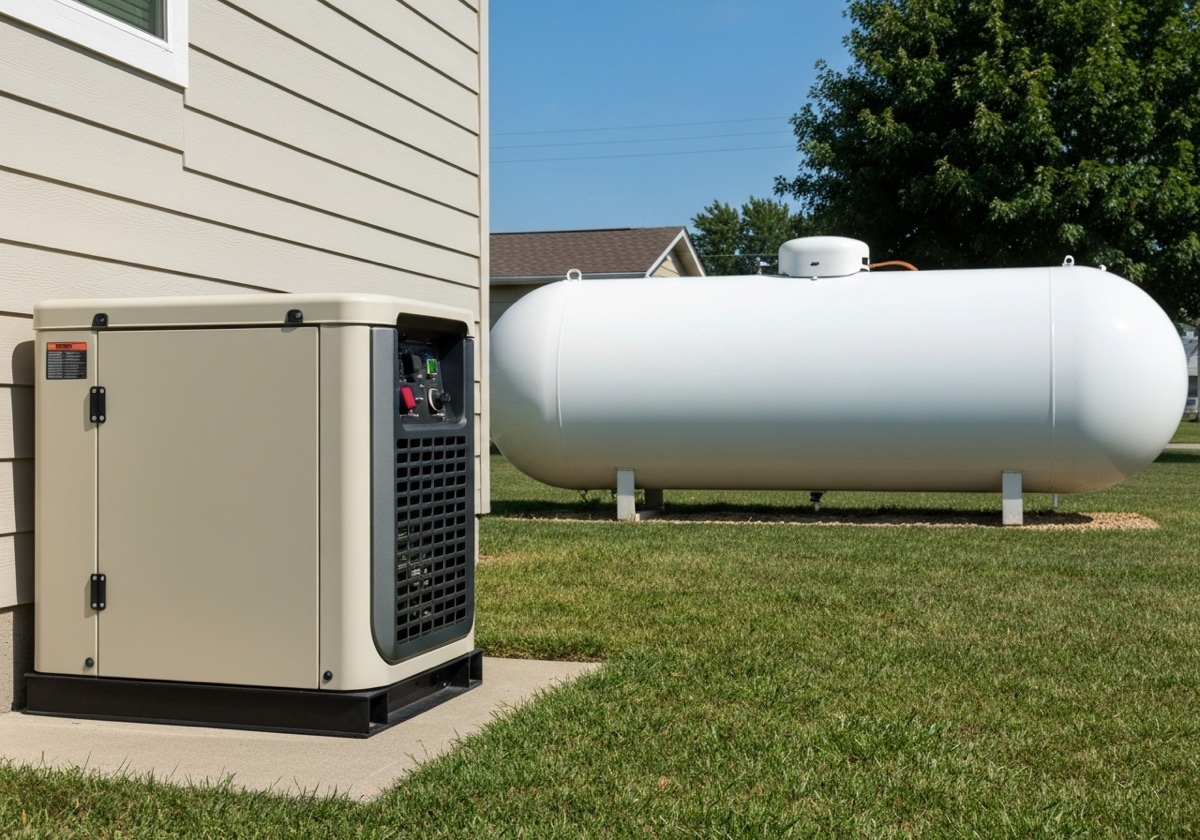
You have decided on a standby generator for your home. Good call: it is the difference between riding out a week-long outage in comfort and living out of coolers by lantern light. But before anyone pours a concrete pad, you have to answer one question that will shape the cost, reliability, and logistics of your backup power for the next 20 years: natural gas or propane?
Most home standby generators, including the popular Generac, Kohler, Cummins, and Champion models, can run on either fuel. The engine barely cares. Your wallet, your utility connection, and your disaster planning care a great deal.
This guide covers how each fuel behaves in a standby generator, what each costs to install and run, which one keeps working when disaster strikes, and finishes with a worked example: what a seven-day outage costs in fuel for a 20kW generator on each. If you are still weighing a standby unit against other options, our guide to home backup power for every budget maps out the alternatives.
Quick Answer: Natural Gas vs Propane Generator
- Choose natural gas if you have a gas line at the house. Unlimited runtime, no fuel deliveries, no tank in the yard, and the lowest cost per hour of operation in most of the country.
- Choose propane if you are rural or off the gas grid. A 250 to 1,000 gallon tank stores days of fuel on your own property, independent of any utility.
- Cost to run: Natural gas is usually 40 to 60% cheaper per kilowatt-hour of backup power than propane at typical U.S. prices.
- Disaster resilience: Propane wins. It is on-site and cannot be shut off by an earthquake, pipeline failure, or utility curtailment.
- Power output: Expect roughly 10% less output from the same generator on natural gas, because propane packs about 2.5 times more energy per cubic foot.
- Storage: Natural gas never runs out but never stores; propane stores for decades but is finite between refills.
How Each Fuel Works With a Home Standby Generator
A standby generator is permanently installed outside your home, wired to your electrical panel through an automatic transfer switch. When utility power drops, it starts itself within about 10 seconds and carries the house until power returns.
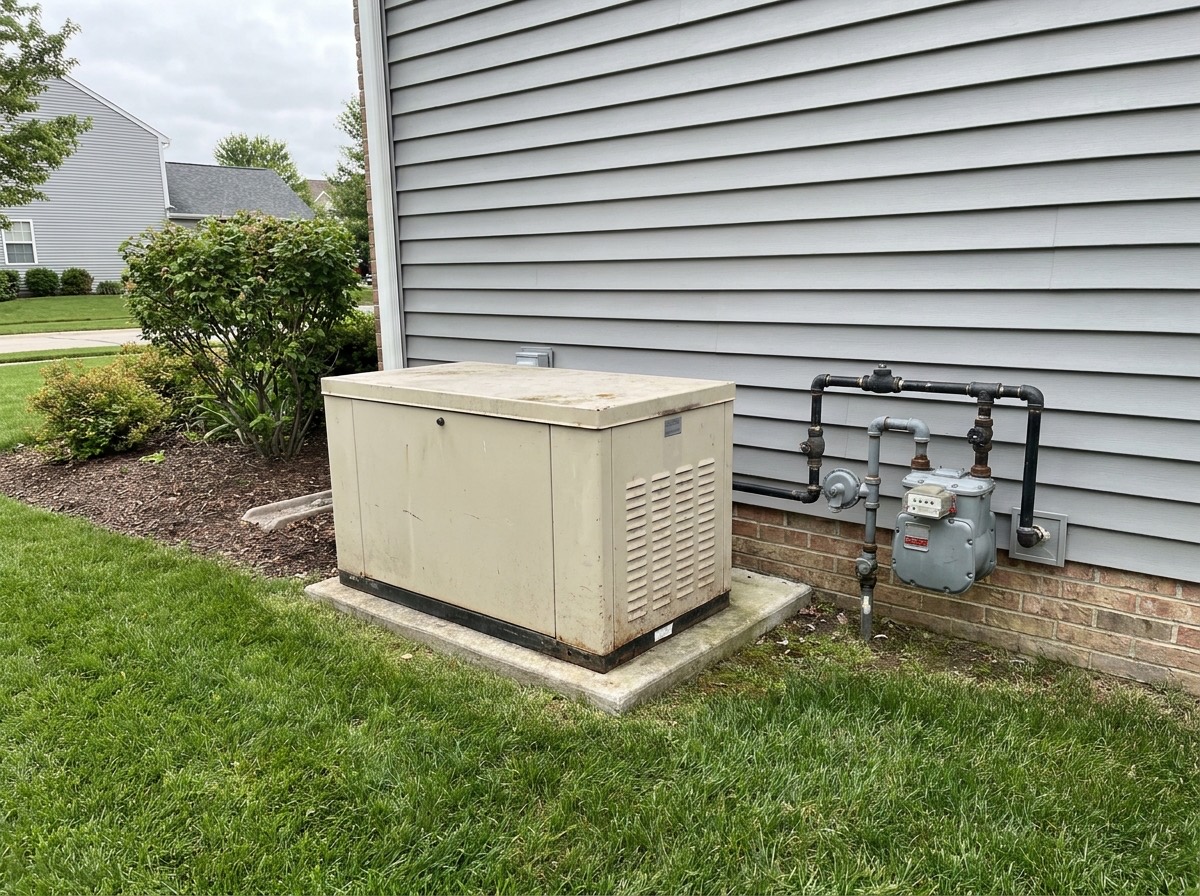
On natural gas, the generator tees into the same buried utility line that feeds your furnace and water heater. Fuel arrives continuously at low pressure, metered like the rest of your gas usage. There is no tank, no fuel gauge, and no refueling. As long as the gas utility is delivering, the generator can run for weeks.
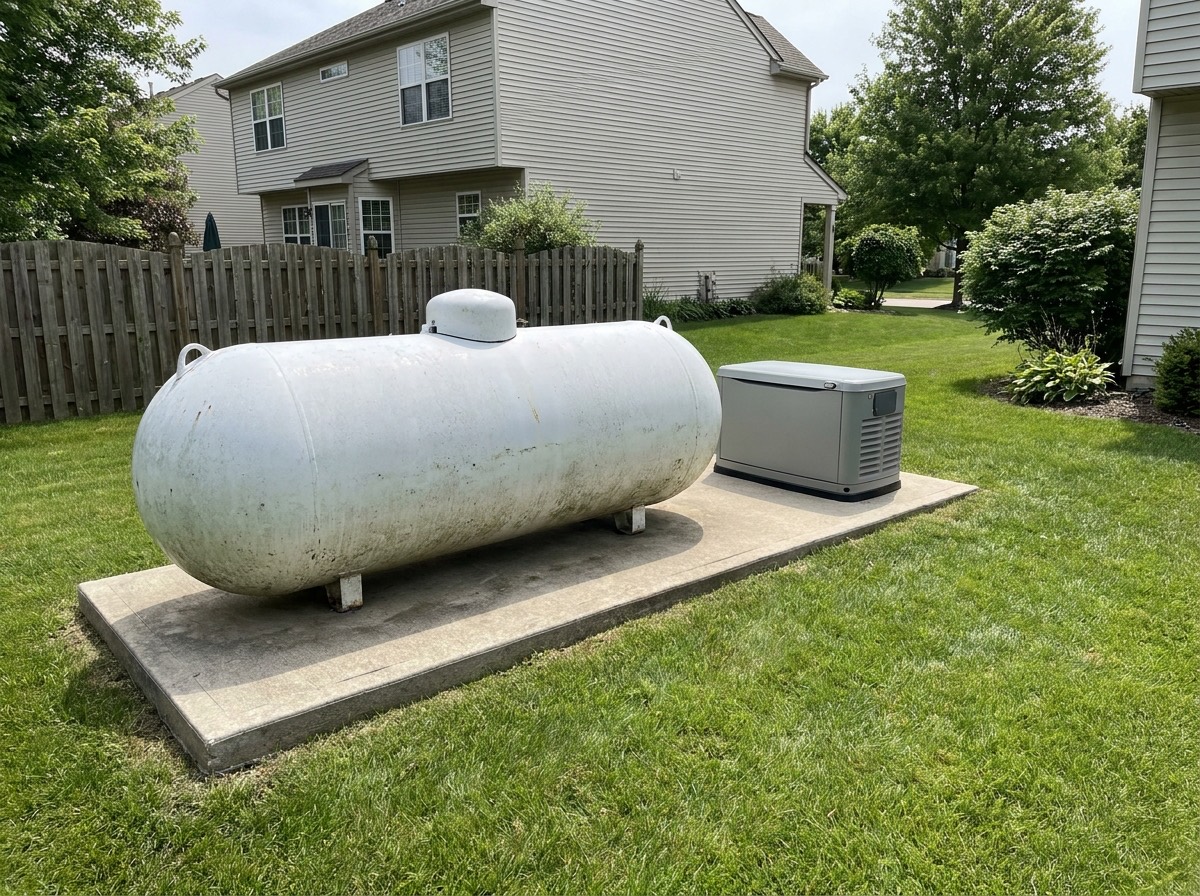
On propane, the generator draws from a tank on your property, typically 250, 500, or 1,000 gallons, above ground or buried. The generator runs until the tank runs low, and a propane company refills it by truck, ideally on an automatic delivery schedule.
Most modern standby generators are configurable for either fuel at setup. The decision locks you in at installation, not at the factory, because the fuel infrastructure is the expensive part.
Availability: The Decision Often Makes Itself
For many homeowners, this choice takes five seconds. If your street has no natural gas service, propane is your answer, full stop. That describes a large share of rural America, which is exactly where long outages are most common.
If you do have gas service, check two things before assuming you are set:
- Meter and line capacity. A 20kW generator can demand roughly 200 to 300 cubic feet of gas per hour on top of your furnace and water heater. Many homes need a meter upgrade or a larger-diameter run to the generator; your installer will do this math.
- Utility reliability in your hazard zone. More on this below, because it is the strongest argument for propane even when gas is available.
Propane has its own logistics. You need space for the tank, with clearance rules from the house and property lines, and a supplier who can actually reach you after a storm. Tanks are filled only to about 80% of capacity to allow for expansion, so a “500-gallon” tank really holds around 400 usable gallons.
Energy Content and the 10% Derating
Here is the physics that surprises people: propane carries roughly 2,500 BTU per cubic foot, while natural gas carries only around 1,000 BTU per cubic foot. Propane is simply a denser fuel.
The practical consequence is that the same generator produces about 10% less power on natural gas. A unit rated 20kW on propane might deliver roughly 18kW on natural gas. Manufacturers publish both ratings, and a good installer sizes against the natural gas number if that is your fuel.
For most homes this derating is a footnote. But if your load calculation is tight, say a large house with two air conditioners that pencils out at 19kW, the fuel choice can push you into the next generator size, adding roughly $1,000 to $2,000 to the project.
Cost to Run: Natural Gas Usually Wins Clearly
This is where natural gas earns its popularity. At typical U.S. residential prices, natural gas runs around $1.20 to $1.60 per therm (100,000 BTU), while propane runs around $2.50 to $3.50 per gallon (91,500 BTU). Do the division and natural gas delivers energy at roughly half the price.
Translated into generator terms, a 20kW unit at half load burns:
- Natural gas: roughly 200 cubic feet per hour, about $2.50 to $3.00 per hour
- Propane: roughly 2 gallons per hour, about $5.00 to $7.00 per hour
Over a short outage the difference is beer money. Over a long one it is real money, as the worked example shows.
Reliability in Disasters: Propane’s Strongest Card
Natural gas arrives through hundreds of miles of pipeline that you do not control. That system is impressively reliable in ordinary storms; gas lines are buried, so the wind event that snaps power poles rarely touches gas service. For hurricanes and ice storms, natural gas generators have an excellent track record.
But there are failure modes worth taking seriously:
- Earthquakes. Seismic events can rupture gas mains, and utilities may shut down sections preemptively. In earthquake country, many installers steer clients toward propane for exactly this reason.
- Regional supply crises. During the February 2021 Texas freeze, wellheads and processing plants froze, pressure dropped across the system, and some gas-fired equipment starved even as electricity failed.
- Utility curtailment. In an extreme demand crunch, pressures can sag in some neighborhoods as utilities prioritize supply.
Propane has none of these dependencies. The fuel is already in your yard, and no earthquake, pipeline outage, or utility crisis can touch it. Its weakness is the mirror image: when the tank is empty, you are done until a truck arrives, and after a regional disaster deliveries can lag days behind demand. The mitigation is simple: size the tank generously and keep it topped up through storm season. And if you want a backup layer with no fuel dependency at all, see our guide to the best whole-house battery backup systems.
Storage: Unlimited vs On-Hand
Think of it as a trade between flow and stock. Natural gas is unlimited flow with zero stock: you can never run out, but you hold no reserve if the flow stops. Propane is pure stock: a 500-gallon tank holds roughly 400 usable gallons, around 8 days of continuous half-load runtime for a 20kW generator, and unlike gasoline or diesel, propane never degrades in storage. A tank filled today is still good fuel a decade from now, which is a big part of why standby generators start so much more reliably than gasoline portables with stale fuel and gummed carburetors.
Installation Costs: Where the Fuels Differ
The generator itself costs the same either way: roughly $5,000 to $7,000 for a 20 to 24kW unit, plus roughly $3,000 to $6,000 for electrical work, the transfer switch, the pad, and permits. The fuel side is where the paths diverge.
- Natural gas hookup: roughly $500 to $2,000 for the gas line run from your meter to the generator, more if the meter needs upsizing or the run is long. No tank, no delivery contract.
- Propane setup: roughly $1,500 to $4,500 for a purchased 500-gallon tank, trenching, and gas plumbing, plus roughly $1,000 to $2,500 more to bury the tank if you want it out of sight. Many propane companies lease tanks for roughly $50 to $200 per year instead, usually with the condition that you buy fuel exclusively from them, often at a premium per gallon.
- First fill: around $1,000 to $1,400 to put 400 gallons in a new tank at typical prices.
All in, a propane installation typically runs roughly $2,000 to $5,000 more than the equivalent natural gas installation, before the higher ongoing fuel cost.
Maintenance and Dual-Fuel Options
Maintenance is nearly identical for both fuels, and both are far cleaner than gasoline or diesel: no carbon-fouled carburetors, cleaner oil, and long intervals between service. Budget roughly $200 to $400 per year for an annual service visit either way.
What about hedging your bets? True automatic dual-fuel standby systems are uncommon, but there are two practical middle paths. Most standby units are field-convertible, so a natural gas generator can be switched to propane later if you add a tank, though the switch requires a technician, not a button. And in the portable world, dual-fuel and tri-fuel inverter generators (gasoline, propane, sometimes natural gas) run roughly $700 to $1,500 and make an excellent backup layer alongside a standby unit. For specific model picks, see our guide to the best dual fuel generators.
Worked Example: 7 Days of Outage on a 20kW Generator
Picture a hurricane takes your neighborhood down for a full week. Your 20kW standby generator runs 24 hours a day at an average of 50% load, carrying the fridge, freezer, well pump, lights, internet, and some air conditioning. That is 168 hours of runtime.
On natural gas: at roughly 200 cubic feet per hour, the week consumes around 33,600 cubic feet, about 336 therms. At $1.30 per therm, the fuel bill is roughly $435. Just as important: you never think about fuel once.
On propane: at roughly 2 gallons per hour, the week consumes around 336 gallons. At $3.00 per gallon, that is roughly $1,000. And notice the logistics: 336 gallons nearly drains a 500-gallon tank that started at its 80% fill of 400 gallons. A tank at half when the storm hit means an emergency delivery mid-outage, exactly when every propane truck in the region is booked solid.
Two honest takeaways from the same numbers. Natural gas costs less than half as much and removes fuel logistics entirely. Propane costs more, but every one of those gallons was sitting in your yard before the storm was even named. You can also stretch propane dramatically by running the generator 12 to 14 hours a day instead of 24, which roughly halves fuel use with modest sacrifice in comfort.
Which Should You Choose? Scenario by Scenario
- Suburban or urban home with a gas line: Natural gas. Cheaper to install, cheaper to run, unlimited runtime, zero logistics. This is the default answer for most of America, and it is the right one.
- Rural home without gas service: Propane, the only practical option and a good one. Go with the biggest tank your site allows: 500 gallons minimum, 1,000 if outages run long.
- Earthquake country (California, Pacific Northwest): Lean propane even if gas is available. The scenario you are insuring against is the same one most likely to interrupt gas service.
- Home already heated by propane: Propane, easily. The tank is already there; you may only need to upsize it so the generator and furnace do not compete.
- Hurricane and ice storm zones with gas service: Natural gas performs very well here, since buried lines survive wind and ice. For extra insurance, add a dual-fuel portable and a few 20 lb propane cylinders.
Frequently Asked Questions
Can I convert a natural gas generator to propane later?
Usually yes. Most home standby generators run on either fuel, and a qualified technician can switch the configuration in under an hour of labor. The real cost is the infrastructure: adding a propane tank, trenching, and plumbing runs roughly $2,000 to $5,000.
How long will a 500-gallon propane tank run my generator?
A 500-gallon tank holds about 400 usable gallons at its standard 80% fill. A 20kW generator at half load burns roughly 2 gallons per hour, so figure around 8 days of continuous runtime, or roughly two weeks if you run it half the day. A smaller 10 to 14kW unit stretches the same tank considerably further.
Is natural gas or propane cheaper to run a generator on?
Natural gas, in almost every U.S. market. Expect roughly $2.50 to $3.00 per hour for a 20kW generator at half load on natural gas versus roughly $5.00 to $7.00 on propane. Propane also swings more seasonally, and winter emergencies hit when it is most expensive.
Does a propane generator produce more power than the same model on natural gas?
Yes, by around 10%. Propane carries roughly 2,500 BTU per cubic foot versus around 1,000 for natural gas, so manufacturers rate the same engine slightly higher on propane. If your home’s load calculation is close to the generator’s limit, size against the natural gas rating.
This article is for general information only. Standby generator and fuel system installation involves gas plumbing and electrical work that must be performed by licensed professionals and inspected under local codes. Always follow your generator manufacturer’s instructions and never operate any fuel-burning generator indoors or near openings to the home.