
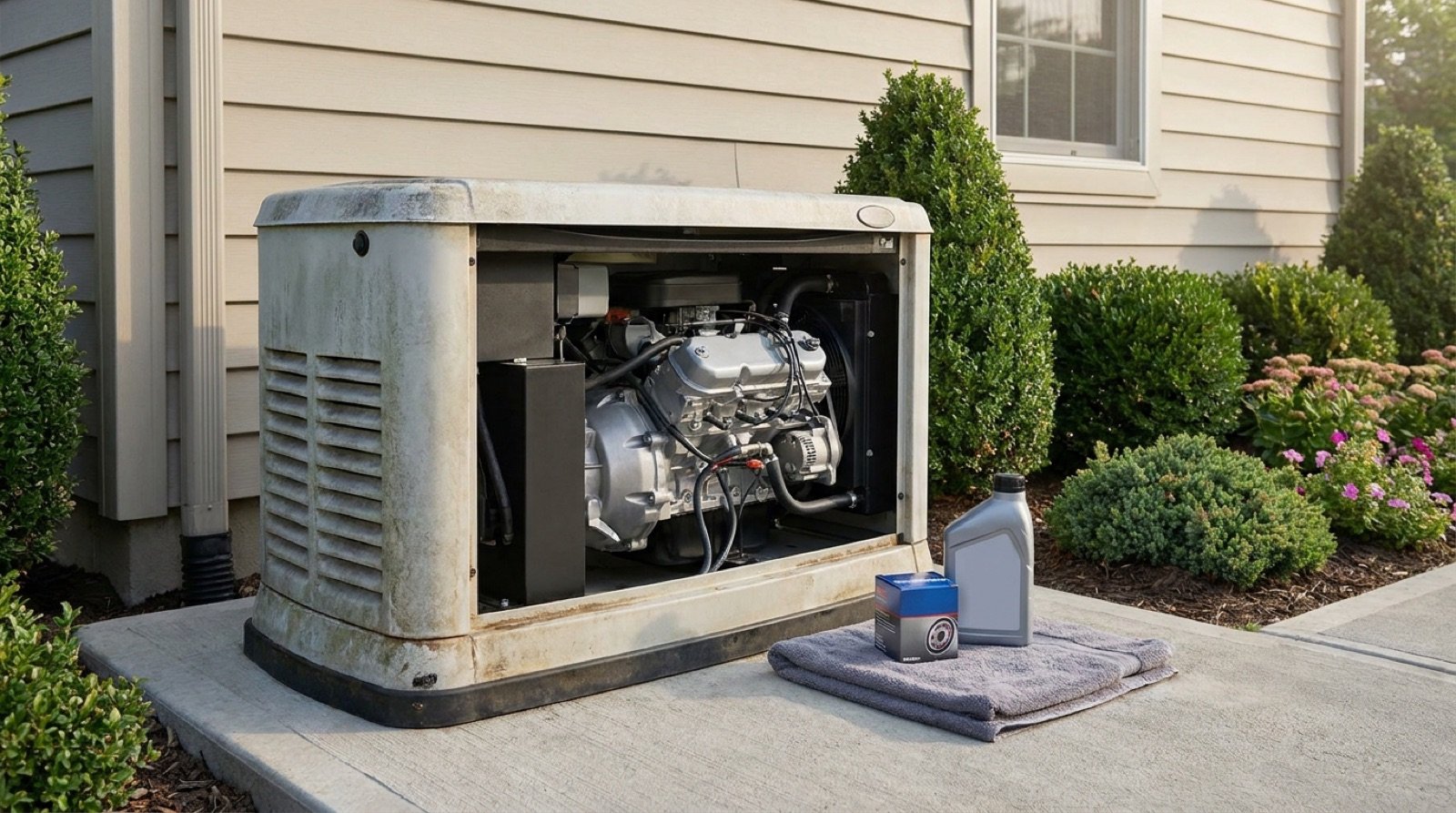
Short answer: A home standby generator needs a short automatic exercise every week (most units run 5 to 20 minutes), a quick monthly walk-around, and a full service once a year or every 100 to 200 run hours, whichever comes first. That service covers oil, oil filter, air filter, spark plugs and a battery load test. After a long outage, count the hours: 5 days of nonstop running is 5 x 24 = 120 hours, which can use up most or all of one oil change interval.
Why a Standby Generator Needs Its Own Schedule
A permanently installed standby generator sits outside for years, mostly idle, and then has to start on its own within seconds and run for days. That pattern is hard on an engine in specific ways. Batteries slowly lose capacity. Oil breaks down with age even when the engine barely runs. Mice nest in warm enclosures. Leaves and snow block airflow.
The schedule also differs from a portable unit. A standby generator runs on natural gas or propane, so there is no gasoline to stabilize or drain, but it has an automatic transfer switch, a controller and a battery that a portable usually lacks. If you also own a portable, it follows a different routine, covered in our portable generator maintenance checklist.
One rule overrides everything below: your owner’s manual. Intervals vary by brand, engine size and whether the engine is air-cooled or liquid-cooled. The numbers here are typical figures for residential air-cooled units, and they are a starting point, not a substitute for the manual.
The Full Schedule at a Glance
| When | Task | Who |
|---|---|---|
| Weekly | Automatic exercise cycle runs; confirm it happened and sounds normal | Homeowner (passive) |
| Monthly | Walk-around: clearances, debris, leaks, controller status lights, alarms | Homeowner |
| Monthly | Check oil level on the dipstick (engine off and cool) | Homeowner |
| Every 6 months | Clean enclosure vents, check battery terminals for corrosion | Homeowner |
| Every 100 to 200 hours or yearly | Oil and oil filter change | Homeowner (if comfortable) or dealer |
| Every 200 hours or 1 to 2 years | Air filter replacement, spark plug inspection or replacement | Homeowner or dealer |
| Yearly | Battery load test, transfer switch test, fuel pressure check, firmware check | Dealer or licensed technician |
| Every 2 to 3 years (typical) | Replace starting battery | Homeowner or dealer |
| After every long outage | Check hour meter, change oil if the interval was reached, inspect everything | Homeowner and dealer |
Weekly: Let the Exercise Cycle Do Its Job
Every modern standby generator has a built-in exercise cycle. Once a week, at a day and time set in the controller, the engine starts and runs for a short period, usually without transferring your house load. This circulates oil, keeps seals lubricated, charges the battery and proves the unit will start.
The run time is small. At 12 minutes a week, the yearly total is 52 x 12 = 624 minutes, or about 10.4 hours. That is why calendar-based oil changes matter: many homes never hit the hour limit in a normal year, but the oil still ages.
Your weekly job is light:
- Set the exercise for a time when someone is usually home, so you can hear it once in a while.
- Listen for anything new: knocking, a rough idle, squealing or a start that takes several tries.
- If your unit has a Wi-Fi or cellular monitoring app, glance at it. A missed exercise or a fault code is the early warning you want.
- Choose a time that respects neighbors. Exercise mode on many units runs at lower speed and is quieter, but it is still audible. Our guide to generator noise levels explains what to expect.
Monthly: A 10-Minute Walk-Around
Once a month, walk out to the unit and check these items. You do not need tools for most of them.
- Clearance. Keep shrubs, firewood, trash cans and stored items away from the enclosure. Follow the clearance in your installation manual; many call for several feet in front and on the exhaust side.
- Debris. Clear leaves, grass clippings and snow from intake and exhaust vents.
- Status lights. The controller should show ready or auto mode with no warning lights.
- Leaks. Look for oil spots on the pad. If you smell gas near the unit or the meter, leave the area and call your gas utility from a safe distance.
- Pests. Look for droppings, chewed wires or nesting material.
- Oil level. With the engine off and cool, pull the dipstick and confirm the level sits between the marks.
Inside the house, confirm your carbon monoxide alarms work. A standby unit installed outdoors at the proper distance is designed to vent safely, but exhaust can still drift toward windows or vents if something changes. Our guide to generator carbon monoxide safety covers placement and alarms in detail.
Oil and Oil Filter
Oil is the single most important maintenance item. Most residential air-cooled standby engines call for an oil and filter change every 100 to 200 run hours or once a year, whichever comes first. Some manufacturers specify a shorter first change after break-in, often around 25 hours. Liquid-cooled units usually have longer intervals and larger oil capacity.
Use the oil weight and type listed in your manual. Many manuals call for synthetic oil in standby units because it handles cold starts and long runs better, and some list different weights for very cold climates.
If you change the oil yourself, the safe sequence matters because the unit can start automatically at any moment:
- Turn the controller to off (not auto).
- Follow the manual’s steps to disable automatic starting, which often means removing a control fuse and disconnecting the battery negative cable.
- Let the engine cool before touching it.
- Drain the oil, replace the filter, refill to the mark and check for leaks.
- Reconnect the battery, restore the fuse and return the controller to auto. Confirm it shows ready.
Forgetting step 5 is a common and costly mistake. The generator sits in off mode for months, and nobody notices until the next outage.
Air Filter and Spark Plugs
A typical interval for the air filter is every 200 hours or every 1 to 2 years, with an inspection at each oil change. Replace it sooner if you live on a dirt road, near construction, or in a dusty or pollen-heavy area.
Spark plugs on air-cooled units are commonly inspected or replaced on a similar 200-hour or 1 to 2 year cycle. Use the exact plug and gap your manual specifies. A worn plug often shows up first as a hard start during the weekly exercise.
The Battery: The Most Common Failure Point
The generator’s engine is often fine when an outage-day failure happens. The battery is not. A standby generator uses a small 12-volt starting battery that sits on a trickle charger in an enclosure that bakes in summer and freezes in winter. That is a hard life.
- Every 6 months: check terminals for white or green corrosion and make sure the cables are tight.
- Yearly: have the battery load tested. A simple voltage reading can look fine on a battery that cannot crank the engine under load.
- Every 2 to 3 years (typical): replace it, even if it still works. Write the install date on the battery with a marker.
If the weekly exercise starts sounding slow or the controller logs a low battery warning, replace the battery right away. Our generator troubleshooting guide walks through what to check when a unit refuses to start.
Annual Professional Service: What Should Be on the Invoice
Even if you handle the oil yourself, a yearly visit from an authorized dealer or qualified technician is worth it. Many warranties require documented maintenance, and some tasks need training and test equipment. A thorough annual service typically includes:
- Oil, oil filter, air filter and spark plugs (if due)
- Battery load test and terminal cleaning
- Fuel pressure check at the regulator under load
- Valve clearance check, if the manual calls for it at this hour count
- Transfer switch test with the house load actually transferred
- Inspection of wiring, connections and the enclosure
- Controller firmware update and a review of the fault log
- On liquid-cooled units: coolant level and condition, belts and hoses
Typical annual service visits run roughly $200 to $500 depending on region, unit size and what parts are due. Ask for a written list of what was done. If you are still choosing a unit, dealer support and service network matter as much as the engine, a point covered in our Generac vs Kohler vs Briggs and Stratton comparison.
After a Long Outage: Do the Hour Math
A standby generator running nonstop adds 24 hours a day to the hour meter. That changes the schedule fast. Here is how quickly common intervals arrive:
| Outage length | Run hours (days x 24) | 100-hour oil interval | 200-hour oil interval |
|---|---|---|---|
| 1 day | 1 x 24 = 24 hours | 24% used | 12% used |
| 3 days | 3 x 24 = 72 hours | 72% used | 36% used |
| 5 days | 5 x 24 = 120 hours | Past due by 20 hours | 60% used |
| 10 days | 10 x 24 = 240 hours | Past due by 140 hours | Past due by 40 hours |
Those percentages assume the interval started fresh. If your last oil change was 60 hours ago, a 100-hour interval runs out after just 40 more hours, less than 2 days.
What to do before and during a long outage:
- Stock supplies before storm season. Keep at least two oil changes worth of the correct oil, two oil filters, an air filter and a spare spark plug at home. Dealers run out after big storms.
- Check the oil level every 24 hours during extended runs, following the manual’s shutdown procedure. Top off as needed.
- If an oil change comes due mid-outage, follow the manual. Many manufacturers allow a short planned shutdown for an oil change. Use daylight, let the engine cool, and use the safe disable sequence above.
- On propane, watch the tank gauge. Fuel use climbs with load, and a delivery after a regional storm can take days. Our article on natural gas vs propane generators explains how each fuel behaves in a long outage.
After power returns, confirm the unit transferred back to utility and went to ready mode. Then change the oil if you passed even half the interval, inspect the air filter, and schedule a dealer check if the unit ran more than a few days or logged any faults.
Seasonal Tasks
- Before hurricane or winter storm season: stock supplies, test the battery, and confirm the exercise cycle has been running.
- Fall: clear leaves from vents and around the pad.
- Winter: keep snow cleared from the intake, exhaust and enclosure lid after each storm. Some cold-climate units use a battery warmer or oil heater kit; ask your dealer if yours needs one.
- Spring: check for rodent nests and trim new plant growth back from the enclosure.
What You Should Not Do Yourself
Oil, filters, plugs and battery swaps are reasonable homeowner tasks on most units. Leave these to licensed professionals:
- Transfer switch and panel work. Any repair, rewiring or inspection inside the transfer switch or electrical panel must be done by a licensed electrician.
- Gas lines and regulators. Gas piping, fuel pressure adjustments and regulator replacement require a licensed plumber or gas fitter.
- Controller faults that keep returning. Repeated fault codes point to a problem a dealer should diagnose with the right tools.
Never move a standby generator closer to the house, enclose it, or relocate it without a professional who can verify the manufacturer’s clearance requirements and local code.
Bottom line: Let the weekly exercise run, walk around the unit monthly, change the oil and filter yearly or every 100 to 200 hours, replace the battery every 2 to 3 years, and book a professional service once a year. During any outage longer than a few days, multiply days by 24 and compare that number to your oil interval before the engine does it for you.
Frequently Asked Questions
How often should a standby generator run its exercise cycle?
Most manufacturers set the exercise to once a week, running about 5 to 20 minutes. Some newer controllers allow every other week or monthly. Weekly is the common default, and it is the setting that best keeps the battery charged and the engine lubricated.
Do I need to change the oil if the generator barely ran this year?
Yes, in most cases. Manuals typically say to change the oil at the hour limit or once a year, whichever comes first. Oil ages and picks up moisture and acids even with little use, and weekly exercise alone adds only about 10 hours a year.
Can I service my standby generator myself without voiding the warranty?
It depends on the manufacturer. Some warranties accept owner maintenance if you use the specified parts and keep dated receipts and a log, while others require authorized dealer service. Read your warranty terms before your first oil change, and keep records either way.
How long can a standby generator run continuously?
Many residential units are designed to run for days as long as fuel is supplied, but they still need oil checks and oil changes at the scheduled hour intervals. Plan to check oil every 24 hours of nonstop running. Follow your manual on how often the engine must be shut down for service.