
This post contains affiliate links. If you buy through them, we may earn a commission at no extra cost to you.
Short answer: a typical portable generator runs 8 to 12 hours on a full tank at half load, and the tank size, not the wattage, is the number that matters most. A 2,200-watt inverter generator with a 1-gallon tank runs about 8 hours at 25 percent load and 3 to 4 hours at full load. A 7,500-watt open-frame unit with a 6.6-gallon tank runs 10 to 12 hours at half load and 6 to 7 hours flat out. Manufacturers quote runtime at 25 or 50 percent load because that is where engines are most efficient; double the load and you will roughly halve the hours.
Runtime by Generator Class
These figures are typical for current models in each class, drawn from published specs and cross-checked against owner-reported data. Individual models vary by 10 to 20 percent either way.
| Generator Class | Tank Size | Runtime at 25% Load | Runtime at 50% Load | Runtime at 100% Load | Gallons per Hour at 50% |
|---|---|---|---|---|---|
| 2,000-2,200W inverter | 0.95-1.2 gal | 8-10 hours | 5-6 hours | 3-4 hours | ~0.18 |
| 3,000-3,500W inverter | 1.5-2.5 gal | 10-14 hours | 7-9 hours | 4-5 hours | ~0.25 |
| 4,000-4,500W open frame | 3.5-4 gal | 12-14 hours | 9-11 hours | 5-6 hours | ~0.4 |
| 5,500-7,500W open frame | 5-7 gal | 13-16 hours | 10-12 hours | 6-7 hours | ~0.55 |
| 9,000-12,000W open frame | 6.6-8.5 gal | 12-16 hours | 8-11 hours | 5-7 hours | ~0.75 |
Two things jump out. First, big generators are not less efficient per watt, but they burn far more fuel per hour, so a multi-day outage on a 9,500-watt unit is a fuel-logistics problem. Second, the small inverter unit’s 1-gallon tank is its real limitation; it is efficient, but you are refueling every few hours.
The Fuel Consumption Formula
You can estimate any gasoline generator’s consumption with a rule of thumb: a small engine burns roughly 0.08 to 0.1 gallons per hour per 1,000 watts of actual electrical load, plus a fixed “idle” cost of about 0.1 to 0.15 gallons per hour just to keep the engine spinning.
Worked example, 5,000-watt generator at 2,500 watts of load (50 percent):
- Load portion: 2.5 × 0.09 = 0.23 gal/hr
- Idle portion: 0.12 gal/hr
- Total: about 0.35 gal/hr
- With a 4-gallon tank: 4 ÷ 0.35 = roughly 11.4 hours
That matches the table. The same unit at 1,000 watts (a fridge and some lights) burns about 0.21 gal/hr and runs 19 hours on the tank. At full 5,000 watts, about 0.57 gal/hr and 7 hours. The idle cost is why a generator that is far too big for your load wastes fuel: a 9,500-watt unit running a 600-watt load still burns nearly a third of a gallon per hour. If you have not sized your loads yet, the generator size calculator does the arithmetic.
Why Inverter Generators Stretch a Tank Further
A conventional generator runs the engine at a constant 3,600 RPM regardless of load, because that is what produces 60Hz power. An inverter generator produces DC and converts it electronically, so the engine can slow down when the load is light. In economy mode at a 300-watt load, a 2,200-watt inverter unit idles at a fraction of full speed and burns about 0.1 gal/hr. A conventional 3,500-watt unit doing the same job burns closer to 0.3 gal/hr because the engine is spinning just as fast as it does at full load. Over a three-day outage running mostly light loads, that difference is 10 to 15 gallons of gasoline. Our comparison of inverter vs conventional generators goes deeper into where each design wins.
Propane: Runtime on a 20-Pound Tank
Dual-fuel generators run on propane at roughly 10 percent less output and slightly worse fuel efficiency by energy content. A 20-pound grill cylinder holds about 4.6 gallons of propane, and a mid-size generator burns 0.5 to 0.8 gallons of propane per hour at half load.
| Generator Class (on propane) | Runtime per 20 lb Tank at 50% Load | Runtime per 100 lb Tank |
|---|---|---|
| 3,500-4,500W dual fuel | 7-10 hours | 35-50 hours |
| 7,000-9,500W dual fuel | 5-7 hours | 25-35 hours |
| 12,000W dual fuel | 4-5 hours | 20-25 hours |
The advantage is storage, not runtime. Propane never goes stale, a 100-pound tank sits safely for years, and the tank does not need to be inside the generator. The best models switch fuels while running; see our best dual-fuel generators roundup, and the Champion 4500W dual-fuel review for real propane consumption on a mid-size unit.
How Much Fuel to Store for an Outage
Work from your actual load, not the generator’s rating. A realistic “essentials” load of a refrigerator, a freezer, a furnace blower, lights, and phone charging averages 800 to 1,200 watts over a day, with short peaks. On a 5,000-watt generator run 16 hours a day (off overnight), that is about 0.25 gal/hr, or 4 gallons per day.
| Outage Length | Light Use (16 hr/day, ~1,000W avg) | Moderate Use (20 hr/day, ~2,000W avg) | Heavy Use (24 hr/day, ~3,500W avg) |
|---|---|---|---|
| 1 day | 4 gal | 7 gal | 12 gal |
| 3 days | 12 gal | 21 gal | 36 gal |
| 7 days | 28 gal | 49 gal | 84 gal |
Most households store 10 to 20 gallons, which covers three days of light use. Beyond that, the plan has to include finding fuel during the outage, which after a hurricane can mean two-hour lines. Read our guide to storing generator fuel at home for safe quantities, container types, and stabilizer rotation.
Check the current price of 5-gallon no-spill gas cans on Amazon
Six Ways to Make a Tank Last Longer
- Run the generator in shifts. A refrigerator holds temperature for four hours closed. Run the generator two hours on, two hours off during the day and shut it down overnight. This alone cuts daily fuel use by 40 to 60 percent.
- Use economy mode on an inverter unit. It only costs you surge response, and at light loads it can double runtime.
- Match the generator to the load. A 2,200-watt unit running 800 watts is at its efficient point. A 9,500-watt unit running 800 watts is wasting most of its fuel on idle.
- Stagger high-draw appliances. Run the well pump, then the microwave, then the coffee maker. Peaks force the engine to work harder and burn richer.
- Pair with a power station. Charge a battery during the generator’s daytime run, then run lights, the router, and a CPAP off the battery overnight in silence. Our guide to power station vs generator covers this hybrid approach.
- Keep the air filter clean and the plug fresh. A dirty engine burns 10 to 15 percent more fuel for the same output. Our portable generator maintenance checklist covers the intervals.
Runtime of Popular Models
Representative manufacturer-rated runtimes for units we have covered in detail:
| Model | Rated Watts | Tank | Rated Runtime | Load Basis |
|---|---|---|---|---|
| Honda EU2200i | 1,800W | 0.95 gal | 8.1 hours | 25% load, eco mode |
| Champion 4500W dual fuel (gas) | 3,500W | 2.3 gal | 14 hours | 25% load |
| Westinghouse WGen9500DF (gas) | 9,500W | 6.6 gal | 12 hours | 50% load |
| Westinghouse WGen9500DF (propane) | 8,500W | 20 lb tank | 7 hours | 50% load |
Detailed consumption notes are in our Honda EU2200i review and Westinghouse WGen9500DF review.
Refueling Safely
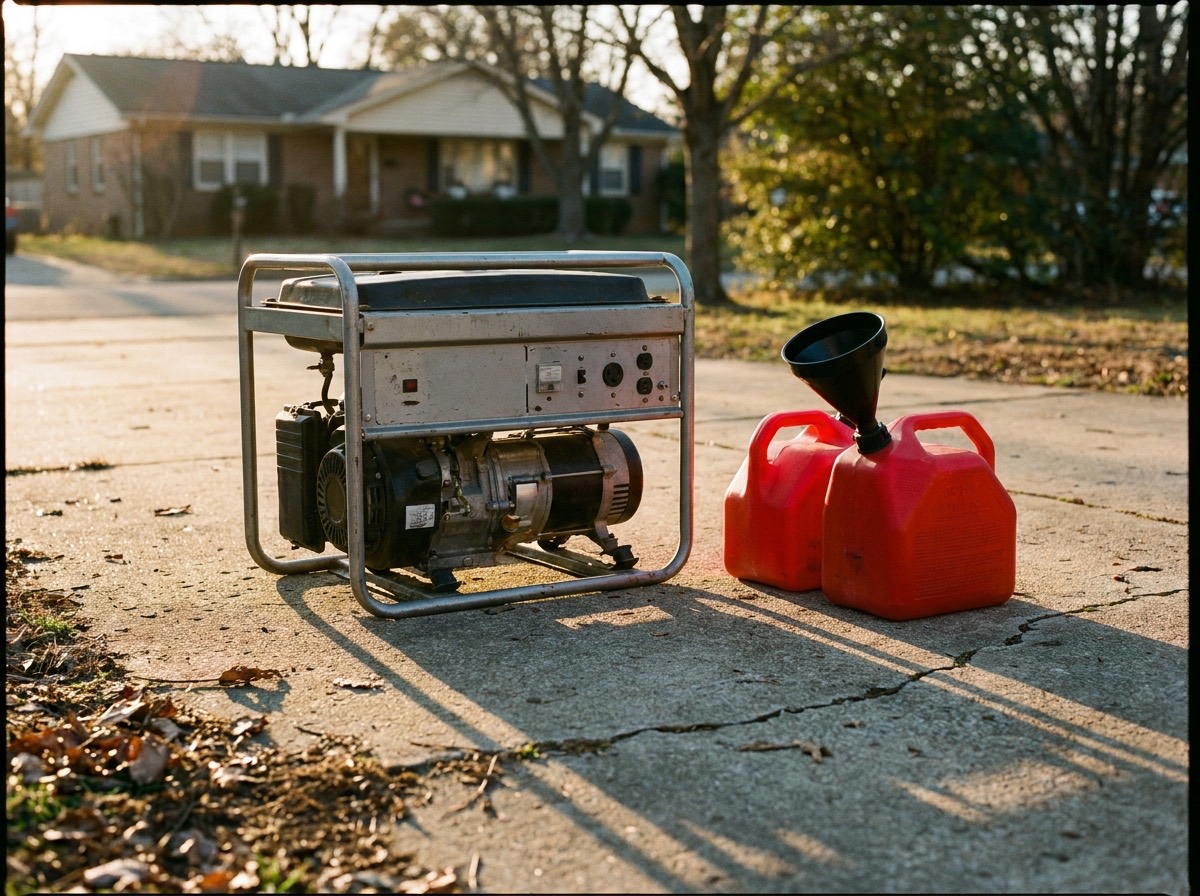
Every storm season, someone pours gasoline into a hot generator and gets burned. Shut it down, wait 10 to 15 minutes for the muffler to cool, and refuel with a no-spill can and a funnel. Never refuel by lantern or headlamp held close to the tank opening. Keep fuel cans at least 10 feet from the running generator, and never inside the house or an attached garage. If the generator runs out of fuel under load, it can damage sensitive electronics as the voltage collapses; shut appliances off first when the tank is nearly empty.
Frequently Asked Questions
How long will a generator run on 5 gallons of gas?
A 5,000 to 7,500-watt generator at half load burns about 0.5 gallons per hour, so 5 gallons lasts roughly 10 hours. A 2,200-watt inverter at light load burns about 0.15 gallons per hour and would run over 30 hours on the same 5 gallons, though its 1-gallon tank means refueling five times.
Can I run a generator 24 hours a day?
Most portable units are designed for continuous operation with refueling stops, but the manual will specify an oil check every 8 to 24 hours and a cooling period during refueling. For multi-day outages, plan on running 12 to 16 hours a day and letting the refrigerator coast overnight.
Does a bigger generator use more gas?
Yes, at every load level, because a bigger engine has a higher idle cost. Choose the smallest generator that covers your peak load with about 20 percent headroom.
How long does a generator run on a 20 lb propane tank?
About 5 to 10 hours at half load depending on generator size. A 100-pound tank gives 25 to 50 hours.
Is it cheaper to run a generator on gas or propane?
Per hour of runtime, gasoline is usually a little cheaper at retail prices, but propane never goes bad, so there is no wasted fuel from stale gas. For occasional emergency use, propane’s storage advantage often outweighs the small cost difference.