
This post contains affiliate links. If you buy through them, we may earn a commission at no extra cost to you.
Short answer: a typical residential well pump is 1/2 to 1 horsepower and runs on 240 volts, which rules out small generators and most portable power stations. A 1/2 HP pump draws about 1,000 watts running and 2,000 to 3,000 watts at start; a 1 HP pump draws 1,500 to 2,000 watts running and can surge to 4,000 or more. You need a generator with a 240-volt outlet, which starts at roughly 5,000 watts, and a proper connection through a transfer switch or interlock, because a well pump is hardwired. For most well homes, a 7,000 to 9,500-watt dual-fuel generator with an interlock kit is the right setup, and it runs the rest of the house too.
Why Well Pumps Are the Hardest Load in the House
Roughly 15 million U.S. homes are on private wells. When the power fails, the water stops with it, which means no toilets, no showers, and no drinking water beyond what you stored. The pump itself is a submersible motor 100 to 400 feet down a pipe, and it has three properties that make backup power tricky:
- It is almost always 240 volts. Most 1/2 HP and larger pumps are wired for 240V. Only some 1/3 HP shallow-well jet pumps run on 120V.
- Its starting surge is large. A submersible motor starts under full load against a column of water. Locked-rotor current is typically 4 to 6 times running current for a second or two.
- It is hardwired to a dedicated breaker, usually a 2-pole 20 or 30 amp, through a pressure switch and often a control box. There is no plug to move.
Well Pump Power Requirements by Size
| Pump Size | Voltage | Running Watts | Starting Surge | Minimum Generator (rated) | Comfortable Generator |
|---|---|---|---|---|---|
| 1/3 HP (shallow jet) | 120V or 240V | 750W | 1,500-2,200W | 2,500W (120V models only) | 3,500W |
| 1/2 HP | 240V | 1,000W | 2,000-3,000W | 4,000W with 240V outlet | 5,500-7,500W |
| 3/4 HP | 240V | 1,300-1,500W | 3,000-4,000W | 5,500W | 7,500-9,500W |
| 1 HP | 240V | 1,500-2,000W | 4,000-5,500W | 7,000W | 9,500-12,000W |
| 1.5 HP | 240V | 2,200-2,800W | 5,500-7,500W | 9,500W | 12,000W+ |
The “comfortable” column assumes you also want the refrigerator, furnace, lights, and a few outlets on at the same time, and that the generator is not running at its limit for hours. Find your pump’s horsepower on the control box near the pressure tank, on the original well report, or on the breaker label. If nothing is labeled, the breaker size is a hint: a 2-pole 20A is usually 1/2 to 3/4 HP, a 2-pole 30A is often 1 to 1.5 HP. The generator size calculator will add the pump to the rest of your loads.
Choosing the Generator
Three features are non-negotiable for a well pump generator:
- 240-volt output. Look for an L14-30R (30 amp) or 14-50R / CS6365 (50 amp) outlet. Many 3,000 to 4,000-watt units are 120V only and cannot run the pump at all.
- Surge capacity above the pump’s start. Generator peak ratings last a few seconds, which is enough, but the peak must exceed the pump’s surge plus whatever else is running. A 7,500-watt rated / 9,500-watt peak unit handles a 1 HP pump with the fridge and furnace on.
- Dual fuel. Well homes are usually rural, where the gas station may be 20 miles away and closed. Propane stores indefinitely. Our roundup of the best dual-fuel generators is built around this class, and the Westinghouse WGen9500DF review covers a popular 240V unit in detail.
Inverter or conventional? Either runs a pump. An inverter unit in the 7,000 to 9,500-watt class is quieter and far more fuel-efficient at the light loads that make up most of an outage, which matters when the pump runs only a few minutes an hour. A conventional unit costs about half as much. See best inverter generators for home backup for the quiet option.
Check the current price of 9,500W dual-fuel 240V generators on Amazon
Connecting the Generator to the Well Pump
Because the pump is hardwired, you cannot run an extension cord to it. Three legitimate methods:
- Interlock kit and inlet box (most common). A 30 or 50-amp power inlet on the outside wall feeds a backfeed breaker in the main panel, with a mechanical interlock that prevents the main and the generator breaker from being on together. The well pump breaker stays exactly where it is. Cost installed: $400 to $900. Full explanation in how to connect a portable generator to your house.
- Manual transfer switch. A 6 to 10-circuit switch with at least one 240V double-pole position for the pump. Confirm the switch’s 240V circuit is rated for the pump’s breaker size. Cost installed: $800 to $1,500. Details in manual vs automatic transfer switches.
- Dedicated pump transfer switch. A small 2-pole switch installed only on the well pump circuit, with its own inlet. Cheap and simple if the pump is the only thing you care about, but it does nothing for the rest of the house.
Never plug a generator into a dryer outlet with a double-male cord. It energizes the utility lines and can kill a lineworker.
Running the Pump: Sequence and Tips
- Start the generator, let it warm up two minutes, turn eco mode off.
- Turn on the generator breaker, then the well pump breaker alone. Listen for the pump to start and the pressure gauge to climb.
- Once the tank is at pressure and the pump has cycled off, add the refrigerator, furnace, and lights.
- Keep high-draw appliances (microwave, coffee maker, space heater) off while the pump is running. Stagger them.
- Fill bathtubs and jugs while the generator is running, so water is available during the hours it is off.
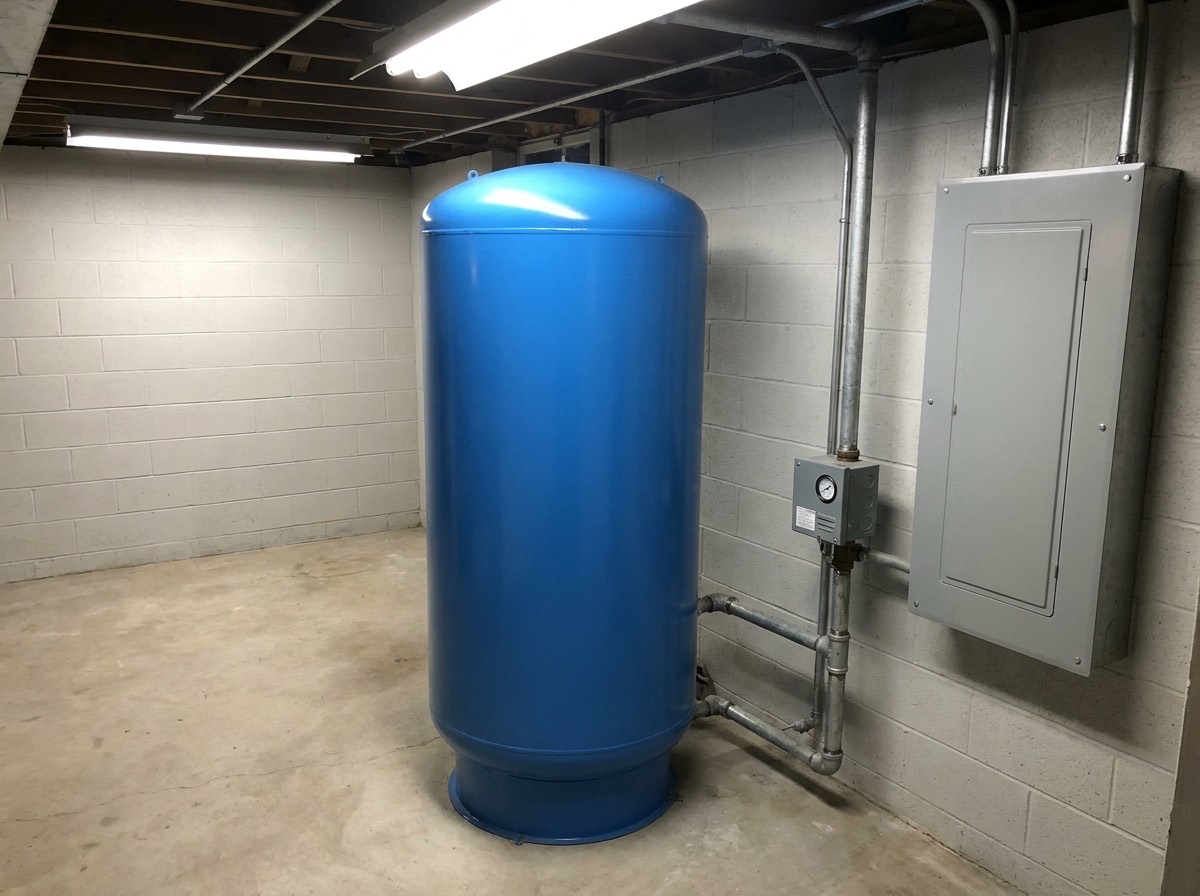
The pressure tank is your friend. A 40-gallon tank holds roughly 10 to 12 gallons of usable water between pump cycles, and a larger tank means the pump runs less often. If you are replacing the tank anyway, going bigger reduces generator runtime.
Can a Power Station Run a Well Pump?
Only the largest ones. You need 240-volt output and surge capacity above the pump’s start. The 4kWh class with 120/240V output, like the unit in our EcoFlow Delta Pro 3 review, delivers 4,000 watts continuous and can start a 1/2 to 3/4 HP pump. At roughly 1,000 watts running for 2 minutes per cycle, 20 cycles a day, the pump uses under 1kWh per day, so a 4kWh battery covers the pump for days if it is doing nothing else. The battery also switches on automatically, which a generator cannot. Pair it with a generator to recharge during long outages. Whole-home batteries are the fully automatic option; see best whole-house battery backup systems.
Water Storage: The Backup for the Backup
Even with a generator, store water. Fill every bathtub and a few 5-gallon jugs when a storm is forecast. Keep a case of drinking water. A tub holds 40 to 60 gallons, enough to flush toilets for two days. A hand pump on a shallow well, or a 12-volt pump that can drop into the well casing, is a last-resort layer some rural homes keep in the garage.
Check the current price of stackable 5-gallon water storage containers on Amazon
Frequently Asked Questions
What size generator do I need to run a well pump?
For a 1/2 HP 240V pump, at least 4,000 rated watts with a 240V outlet, and 5,500 to 7,500 watts if you want the rest of the house too. For a 1 HP pump, 7,000 watts minimum, 9,500 comfortable.
Can I run my well pump with an extension cord from the generator?
No. The pump is hardwired at 240V. You need an interlock kit, a transfer switch, or a dedicated pump transfer switch installed by an electrician.
Will a 3,500-watt generator run a well pump?
Only a 120V shallow-well jet pump of 1/3 HP or so. Nearly all submersible pumps are 240V, and most 3,500-watt generators have no 240V outlet.
How much fuel does running a well pump use?
Very little. The pump runs a couple of minutes per cycle. The fuel cost is in keeping the generator running between cycles; a 7,500-watt unit at light load burns about 0.4 gallons per hour. Run the generator in shifts and fill tubs and jugs while it is on.
Do I need an inverter generator for a well pump?
No. The pump motor does not care about waveform. Inverter units are quieter and more efficient, but a conventional 240V generator runs a well pump perfectly well.