
This post contains affiliate links. If you buy through them, we may earn a commission at no extra cost to you.
Short answer: installing a manual transfer switch for a portable generator costs $800 to $1,500 in most of the United States in 2026, including the switch, the outdoor inlet, wiring, and two to four hours of a licensed electrician’s time. An interlock kit, which does the same job using your existing breaker panel, costs $400 to $900 installed. An automatic transfer switch for a standby generator runs $1,500 to $4,000 installed, and is usually priced as part of the generator package. Permits add $50 to $250 depending on the jurisdiction.
Cost Breakdown by Type
| Option | Parts | Labor | Permit | Total Installed |
|---|---|---|---|---|
| Interlock kit + 30A inlet box | $120-$300 | $250-$600 | $50-$150 | $400-$900 |
| Manual transfer switch, 6-circuit, 30A | $300-$500 | $400-$800 | $50-$150 | $800-$1,300 |
| Manual transfer switch, 10-circuit, 30A/50A | $400-$700 | $500-$900 | $50-$150 | $1,000-$1,700 |
| Manual whole-house transfer switch, 100-200A | $500-$1,200 | $600-$1,200 | $100-$250 | $1,200-$2,500 |
| Automatic transfer switch (standby generator) | $600-$2,000 | $800-$2,000 | $100-$250 | $1,500-$4,000 |
Labor rates drive most of the variation. An electrician in a rural Midwest county may charge $85 per hour; in a coastal metro, $150 to $200. Ask for a flat quote that includes the permit and inspection.
What Is Included in a Transfer Switch Installation
A complete manual transfer switch job for a portable generator includes:
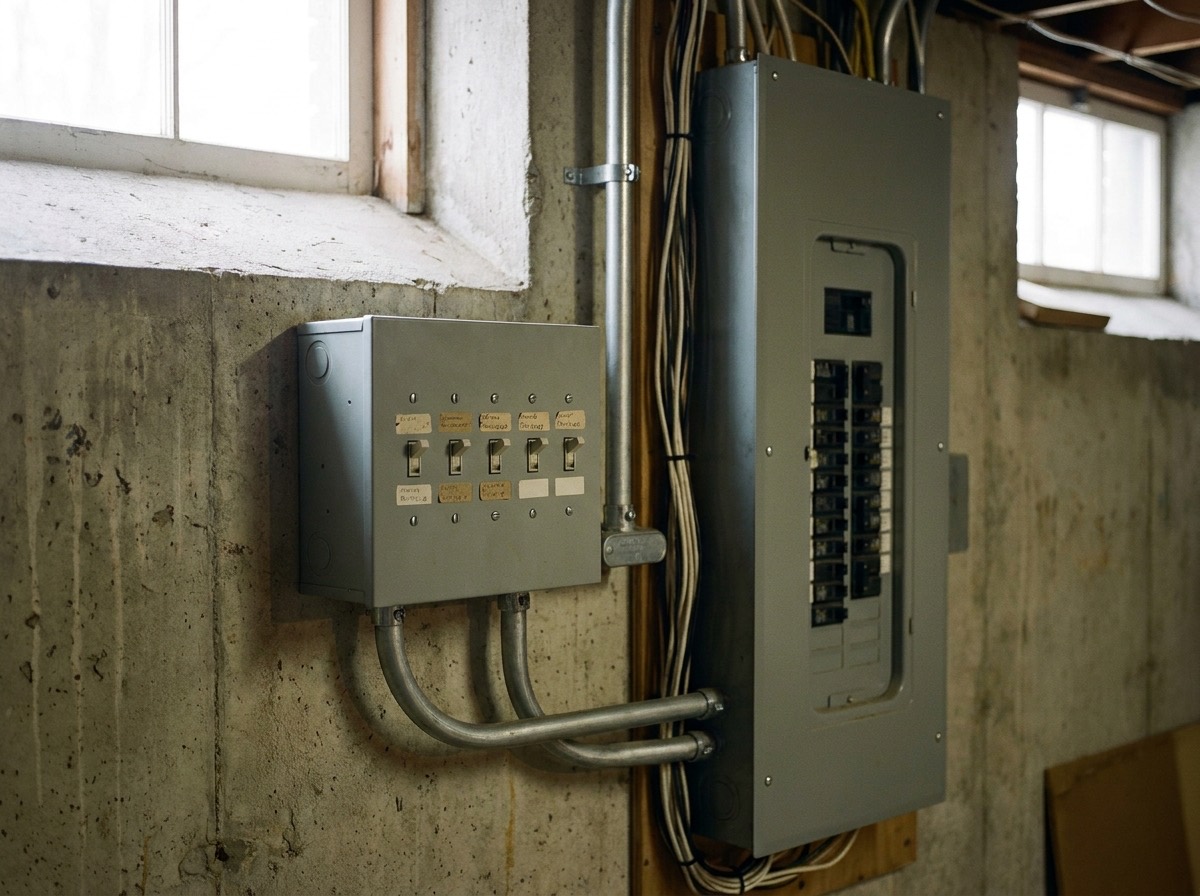
- The transfer switch itself, mounted next to the main panel. Pre-wired 6, 8, or 10-circuit units come with a wiring harness that runs into the main panel through a single conduit.
- Moving the selected circuits. The electrician disconnects each chosen circuit (furnace, refrigerator, well pump, a few lighting and outlet circuits) from its breaker and rewires it through the switch. This is most of the labor.
- The power inlet box. A weatherproof outdoor receptacle on the exterior wall where the generator cord plugs in, usually 30 amps (L14-30) or 50 amps (CS6375 or 14-50).
- Wiring from inlet to switch. 10-gauge for 30A, 6-gauge for 50A, in conduit through the wall. Distance matters; a panel on the far side of the basement from a suitable exterior wall adds an hour or two.
- Permit and inspection. Required nearly everywhere for work inside the panel. The inspection is your documentation for insurance.
- The generator cord. Often not included. A 25-foot 30A generator cord is $60 to $120; a 50A cord is $100 to $200.
Check the current price of 10-circuit manual transfer switch kits with inlet box on Amazon
Interlock Kit: The Cheaper Alternative
An interlock kit is a metal plate ($50 to $150) mounted on your existing panel that physically prevents the main breaker and a new generator backfeed breaker from being on at the same time. With it, any circuit in the panel can run from the generator, chosen by flipping breakers. Installation is faster because no circuits move. Total cost is usually half that of a transfer switch.
The catch: the kit must be listed for your exact panel model, some older or off-brand panels have no listed kit, and a few jurisdictions do not accept interlocks. Ask the electrician which your panel supports. Our guide to connecting a portable generator to your house compares interlock and transfer switch operation step by step, and manual vs automatic transfer switches covers when automatic makes sense.
Check the current price of generator interlock kits on Amazon
Automatic Transfer Switch Cost (Standby Generators)
An automatic transfer switch (ATS) senses the utility failure, signals the standby generator to start, and transfers the house in about 10 seconds with nobody home. The switch is usually bundled with the generator; a 100 to 200-amp ATS adds $600 to $2,000 in parts. Installation is more involved than a manual switch because the ATS sits between the meter and the main panel and needs a control wire to the generator. Whole-house standby packages, generator included, typically land at $8,000 to $15,000 installed. See how much a whole house generator costs for the full picture.
Factors That Raise the Price
- Panel distance from exterior wall. Every 10 feet of conduit run adds material and time.
- Full or outdated panel. If there is no room for a 2-pole backfeed breaker, or the panel is a recalled brand, you may be looking at a panel upgrade ($1,500 to $3,500) first.
- 50-amp instead of 30-amp. Heavier wire and a bigger inlet add $100 to $300.
- 240-volt circuits. A well pump or a small central AC needs a double-pole position on the switch, which pushes you to a larger, pricier model.
- Finished walls. Fishing wire through drywall costs more than running conduit across an unfinished basement.
- Local permit and inspection fees. Some cities charge $200-plus for electrical permits.
Is It Worth It?
Compared to running extension cords through windows, a transfer switch or interlock lets you power hardwired loads (furnace, well pump, sump pump, ceiling lights, hardwired appliances) and eliminates the cord-through-the-door problem. It also removes the temptation to backfeed through a dryer outlet, which is the one way to turn a generator into a lineworker’s death. For anyone whose backup plan involves a furnace or a well, the answer is yes. For a household that only needs a fridge and phone charging during rare short outages, a 12-gauge cord and a small inverter generator is the cheaper answer.
The generator side of the math is in our roundup of the best portable generators for home outages; the generator size calculator tells you whether a 30A or 50A inlet is the right one to install.
Getting an Accurate Quote: What to Ask the Electrician
Quotes for the same job can differ by $500 or more depending on what each electrician assumes. Ask these questions so the numbers are comparable:
- Interlock or transfer switch, and why? A good electrician will look at your panel and tell you whether a listed interlock kit exists for it. If one does, ask for both prices.
- Is the permit and inspection included? Some quotes leave it out and add it on the final invoice.
- Where will the inlet box go? It should be on the side of the house where the generator can sit 20 feet from any window or door, with a short conduit run to the panel. If the electrician suggests the wall right outside a bedroom, push back.
- 30 amp or 50 amp? Match the generator’s outlet. Installing 50-amp wiring now costs a little more and means a future larger generator does not need a second job.
- Which circuits? For a transfer switch, write the list down together: furnace, refrigerator, well or sump pump, a bathroom, the kitchen outlets, a few lights. Changing the list after the switch is wired costs extra.
- Is the generator cord included? Usually not. Budget $60 to $200 separately.
- Will you label the panel and walk me through the startup sequence? The best installers leave a laminated card next to the switch. That card is what your spouse or teenager will follow at 2 a.m.
Get two or three quotes in the fall, before storm season. During and right after a major outage, electricians are booked for weeks and prices climb.
Long-Term Cost: Interlock vs Transfer Switch Over 10 Years
Both options have essentially zero maintenance cost once installed. The difference over a decade comes from flexibility. An interlock powers any circuit, so if you buy a bigger generator or add a well pump later, nothing changes. A 6-circuit transfer switch may need to be replaced or supplemented if your needs grow, which is a second $800-plus job. For homeowners who expect to stay put and expand their backup over time, the interlock is usually the better value even where the up-front difference is small. For a home where the operator will be someone unfamiliar with breakers, the transfer switch’s labeled toggles and built-in meters justify the premium.
DIY or Electrician?
The transfer switch itself is a straightforward device, and the pre-wired kits are designed to be approachable. The work happens inside the main panel, where the service lugs stay energized even with the main breaker off, and a mistake there can be fatal. Most jurisdictions also require a licensed electrician or a homeowner permit with inspection for any work inside the panel. The labor portion is $300 to $900 for a job that takes a professional a morning. Hire it out.
Frequently Asked Questions
How much does it cost to install a transfer switch for a portable generator?
$800 to $1,500 for a manual 6 to 10-circuit switch including the inlet box, wiring, labor, and permit. An interlock kit alternative runs $400 to $900.
Is an interlock kit cheaper than a transfer switch?
Yes, usually by $400 to $700, because it reuses your existing panel and no circuits have to be moved.
Do I need a permit to install a transfer switch?
Almost everywhere, yes. Expect $50 to $250. The inspection also protects your homeowner’s insurance coverage.
How long does installation take?
Two to four hours for an interlock kit or a pre-wired manual transfer switch in an accessible basement or garage. Longer if the panel is far from an exterior wall or the walls are finished.
Can a transfer switch run my whole house?
A 6 to 10-circuit switch runs selected circuits. A whole-house manual switch (100 to 200 amps) transfers the entire panel, and you manage loads by flipping breakers, the same way an interlock works. Either way, the generator’s output sets the real limit.