
Short answer: Most generator surging comes from one of three things: a load too light for the engine, stale or ethanol-damaged fuel, or a partly clogged carburetor jet. First add a steady 500 to 1,000 watt load and switch to fresh gasoline. If the engine still revs up and down every 1 to 5 seconds, clean or replace the carburetor. Governor adjustments and any work on a standby unit’s gas supply belong to a small engine shop or a licensed technician.
What Surging Actually Is (and Why It Matters)
Surging, also called hunting, means the engine speed rises and falls in a steady rhythm even though nothing you plugged in has changed. You hear a repeating vroom, vroom, and you see lights brighten and dim along with it.
On a conventional generator, engine speed is your frequency. A typical two-pole alternator has to spin at 3,600 RPM to make 60 Hz power: 3,600 revolutions per minute divided by 60 seconds equals 60 revolutions per second, or 60 Hz. A mechanical governor holds that speed by opening and closing the throttle.
When the engine hunts between 3,400 and 3,800 RPM, frequency swings from about 57 Hz (3,400 / 60) to about 63 Hz (3,800 / 60), and voltage moves with it. Refrigerator compressors, well pumps, furnace blowers and some electronics do not like that. Until the surging is fixed, keep sensitive electronics unplugged.
Inverter generators behave differently. In eco or economy mode, the engine speeds up and slows down on purpose as the load changes, and the electronics keep the output steady. A rev change that happens when a load switches on and then settles is normal. Rhythmic revving with a steady load is not.
Quick Diagnosis Table
Match what you are seeing to the most likely cause, then start with the cheapest fix.
| What you notice | Most likely cause | First fix | DIY or pro |
|---|---|---|---|
| Surges with little or nothing plugged in, smooths out under load | Lean no-load mixture, light load hunting | Add a steady 500 to 1,000 W load | DIY |
| Surges at every load, started after storage | Stale fuel, varnish in carburetor jets | Fresh fuel, drain the bowl, clean the carburetor | DIY with care |
| Runs fine, then starts surging after 20 to 30 minutes | Blocked fuel cap vent, restricted fuel filter or valve | Loosen cap test, replace filter | DIY |
| Surges with black smoke or a sooty plug | Choke partly on, clogged air filter, rich mixture | Check choke, clean or replace filter | DIY |
| Surges only when the fridge, pump or AC cycles | Overload or motor starts near the limit | Cut loads, stagger starts | DIY |
| Surges with steady load, fuel and carburetor confirmed good | Governor linkage, spring or adjustment | Small engine shop | Pro |
| Surges on propane only | Kinked hose, regulator, cold tank pressure | Check hose, use a larger tank | DIY check, pro repair |
| Home standby generator hunting | Gas supply pressure, regulator, controls | Call the dealer or a licensed technician | Pro |
Cause 1: The Load Is Too Light
This is the most common cause on conventional open-frame generators, and often the engine is not broken at all. Small engine carburetors are set lean from the factory to meet emissions rules. With almost no load, the governor has very little to push against, so it overshoots, corrects, and overshoots again.
Look at the numbers. A single 10 W LED lamp on a 7,000 W running generator is 10 / 7,000, or about 0.1% of capacity. That is essentially no load. Ten percent of that generator is 7,000 x 0.10 = 700 W, and many engines settle down once they reach roughly that range.
The test is simple. Plug in a steady resistive load, such as a 750 W space heater setting or a halogen work light, and listen. If the hunting stops or nearly stops, you have light load behavior. Keep a small steady load on the generator during outages, and know that a slightly lean carburetor often makes it worse, so cleaning still helps.
If you mostly run small loads like a fridge, lights and phone chargers, a conventional generator will spend a lot of time at the edge of its comfort zone. Our guide to the best inverter generators for home backup covers units that throttle down smoothly at light loads instead of hunting.
Cause 2: Old or Ethanol-Damaged Fuel
Gasoline sold in most of the US contains up to 10% ethanol (E10). It absorbs moisture from the air, and its lighter parts evaporate over time. Untreated gas can start to degrade within a month or two in a generator tank, leaving gummy varnish that narrows the tiny passages in the carburetor.
Never use E15 or E85 in a portable generator. Most owner’s manuals limit small engines to E10 or less, and higher blends can damage fuel system parts.
To clear a fuel problem:
- Shut the engine off and let it cool completely. Work outdoors, away from any flame or spark.
- Close the fuel valve and open the carburetor bowl drain screw into an approved container.
- Look at what comes out. Water beads, brown color or a sour varnish smell confirm bad fuel.
- Drain the tank if the fuel is older than a few months or untreated.
- Refill with fresh gasoline treated with fuel stabilizer.
- Run the generator 10 to 15 minutes with a steady load to pull fresh fuel through.
If surging fades as the fresh fuel works through, you caught it early. Prevent a repeat with the habits in our article on how to safely store generator fuel at home.
Cause 3: A Partly Clogged Carburetor
A partial clog in the main jet or the emulsion tube is the classic mechanical cause of surging. Here is the cycle: the clog starves the engine of fuel, RPM drops, the governor opens the throttle wide, a gulp of fuel gets through, the engine overshoots, and the governor closes the throttle again. That loop repeats every few seconds.
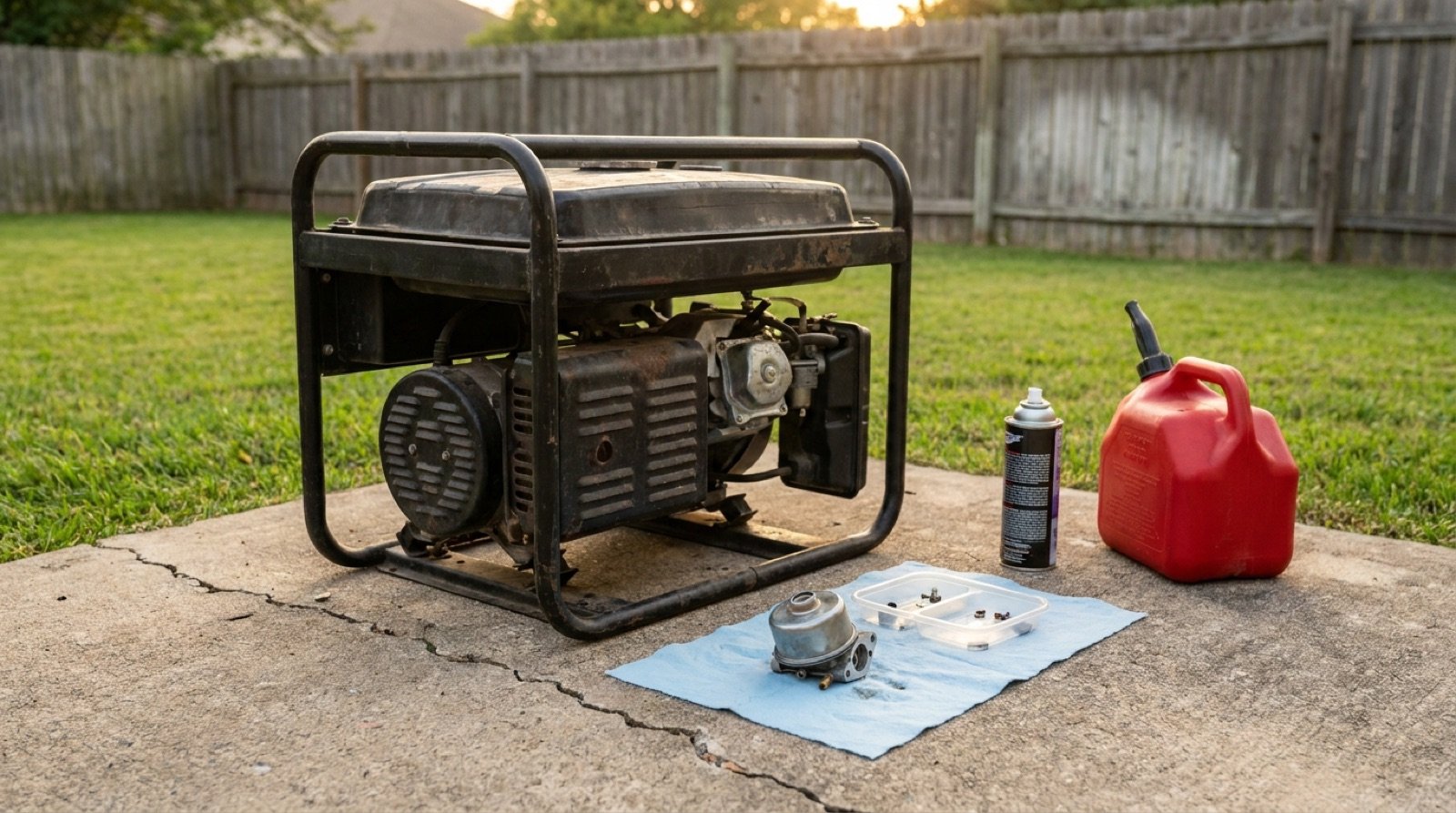
Fuel system cleaner added to fresh gas can loosen light varnish, but a real clog usually needs hands-on cleaning. On most portable generators, this is a reasonable DIY job if you are careful:
- Take photos of the throttle linkage and governor spring before you touch anything. Hooking the spring in the wrong hole causes its own surging.
- Remove the float bowl, then the main jet. Spray carburetor cleaner through every passage and blow it clear with compressed air.
- Hold the jet up to light. You should see a perfectly round, clean hole.
- Do not push drill bits or hard wire through jets. Enlarging the hole changes the fuel mixture permanently.
- Reassemble with a new bowl gasket so it does not leak.
Wear eye protection and do this outside with the engine cold. If the carburetor is heavily varnished or the float sticks, a replacement carburetor is often simpler than a second cleaning. If you are not comfortable taking it apart, a small engine shop can do it quickly.
Cause 4: Air, Fuel Flow and Spark
Several small restrictions can mimic a carburetor problem. Check these before assuming the worst:
- Fuel cap vent: Run the engine with the cap slightly loosened (well away from any ignition source). If surging stops, the vent is blocked and a vacuum is forming in the tank.
- Fuel filter and valve screen: Inline filters and the small screen inside the fuel shutoff valve collect debris. Replace or clean them.
- Air filter: A dirty or oil-soaked filter chokes the engine. Clean foam elements, replace paper ones.
- Choke: A choke left partly closed makes the engine run rich and stumble. Confirm it opens fully once warm.
- Spark plug: A fouled or worn plug causes misfires that the governor chases. Replace it and set the gap listed in your manual.
Most of these are routine items covered in our portable generator maintenance checklist. If the engine will not run long enough to diagnose, start with our generator troubleshooting guide for storm day instead.
Cause 5: The Governor
The mechanical governor uses spinning flyweights inside the engine, connected by an arm, a spring and a linkage rod to the throttle. If any part binds, bends or stretches, the engine cannot hold speed.
With the engine off, you can safely check a few things: the linkage should move freely by hand with no sticking, the spring should be hooked where your photos or manual show, and nothing should be bent or rubbing.
Do not bend linkage rods or stretch springs to tune it yourself. Setting the governor means loosening the arm on its shaft and adjusting speed with a frequency meter. A wrong setting can overspeed the engine and damage both the engine and anything plugged in. Many conventional units are set slightly high at no load, often around 61 to 63 Hz, and drop toward 60 Hz at rated load. That calibration is a job for a small engine shop.
A plug-in power meter that shows hertz and volts is a cheap way to see what is happening. Watch it for a minute with a steady load. A healthy conventional generator holds within a hertz or so. Swings of several hertz back and forth confirm hunting.
Cause 6: Overloading and Motor Starts
Some surging is really the engine bogging under too much load. Here is a typical example on a generator rated 4,000 W running:
| Load | Running watts | Notes |
|---|---|---|
| Refrigerator | 700 W | Compressor cycles on and off |
| Well pump | 1,000 W | Cycles with water use |
| Window AC | 1,200 W | Start surge about 3 x 1,200 = 3,600 W |
| Lights, TV, router | 300 W | Steady |
| Total running | 3,200 W | 3,200 / 4,000 = 80% of capacity |
Now the AC compressor restarts while everything else runs: 3,200 W, minus the AC’s 1,200 W running, plus its 3,600 W start surge, equals 5,600 W. That is well past the 4,000 W rating. The engine bogs, the governor opens fully, and it recovers. Every compressor cycle sounds like a surge.
The fix is load management. Keep continuous load at roughly 80% of rated running watts or less, and avoid letting two big motors start at the same time.
Propane, Dual Fuel and Standby Units
If a dual-fuel generator surges on propane but runs smoothly on gasoline, look at the propane side. Check for a kinked hose and a fully open tank valve. In cold weather, a 20 lb tank can struggle to vaporize fuel fast enough under heavy load, and the tank may frost on the outside. A larger tank helps. Never heat a propane tank with a flame or heater. Regulator repairs should go to a qualified technician.
A home standby generator that hunts under load often points to low natural gas or propane supply pressure, such as an undersized gas line or meter. Gas line work must be done by a licensed plumber or gas fitter, and controller or governor issues by the authorized dealer. Problems with the transfer switch or panel connection belong to a licensed electrician. Never backfeed a house through a dryer outlet.
Fix It in This Order
Always test outdoors with the exhaust pointed away from the house. The CDC says to run generators at least 20 feet from the home, and our guide to generator carbon monoxide safety explains why garages and open windows are not safe.
- Add a steady 500 to 1,000 W load and listen.
- Check the choke, air filter and fuel cap vent.
- Drain old fuel and refill with fresh, stabilized E10 or ethanol-free gas.
- Replace the spark plug and fuel filter.
- Clean or replace the carburetor.
- Check loads against the rating and stagger motor starts.
- If it still hunts, take it to a small engine shop for governor service.
When to Call a Pro
- Surging continues after fresh fuel and a clean carburetor.
- You see bent linkage, a broken spring or oil leaking near the governor shaft.
- The engine overspeeds, sounds like it is screaming, or the meter reads above about 63 Hz.
- It is a standby generator, or the issue involves gas lines, the transfer switch or the electrical panel.
- The unit is still under warranty. DIY carburetor work may affect coverage, so check first.
Bottom line: most surging is cheap to fix. Give the engine a real load, feed it fresh fuel and clean the carburetor before you blame the governor. If those three steps do not settle it, let a shop with a frequency meter take it from there.
Frequently Asked Questions
Is it normal for an inverter generator to change speed?
Yes. In eco mode, an inverter generator raises and lowers engine speed to match the load, and the electronics keep the output at a steady 60 Hz. That is normal as long as the speed settles after each load change. Rhythmic revving with a steady load still points to fuel or carburetor trouble.
Can generator surging damage my appliances?
It can. Swings in frequency and voltage stress motors, compressors and some electronics, and repeated swings add up over hours of runtime. Unplug sensitive devices until the surging is fixed, and check output with a plug-in meter that shows hertz and volts.
Will a fuel additive fix surging?
Sometimes, if the problem is light varnish and you catch it early. Fuel system cleaner in fresh gas can loosen deposits over a few hours of running. A jet that is truly clogged usually needs the carburetor removed and cleaned, or replaced.
Why does my brand-new generator surge?
New conventional generators often hunt a little with no load because their carburetors are set lean for emissions. Add a steady load of about 10% of the rated watts and it usually smooths out. If it surges badly under real load during the first hours, contact the manufacturer before opening anything, since the unit is under warranty.