
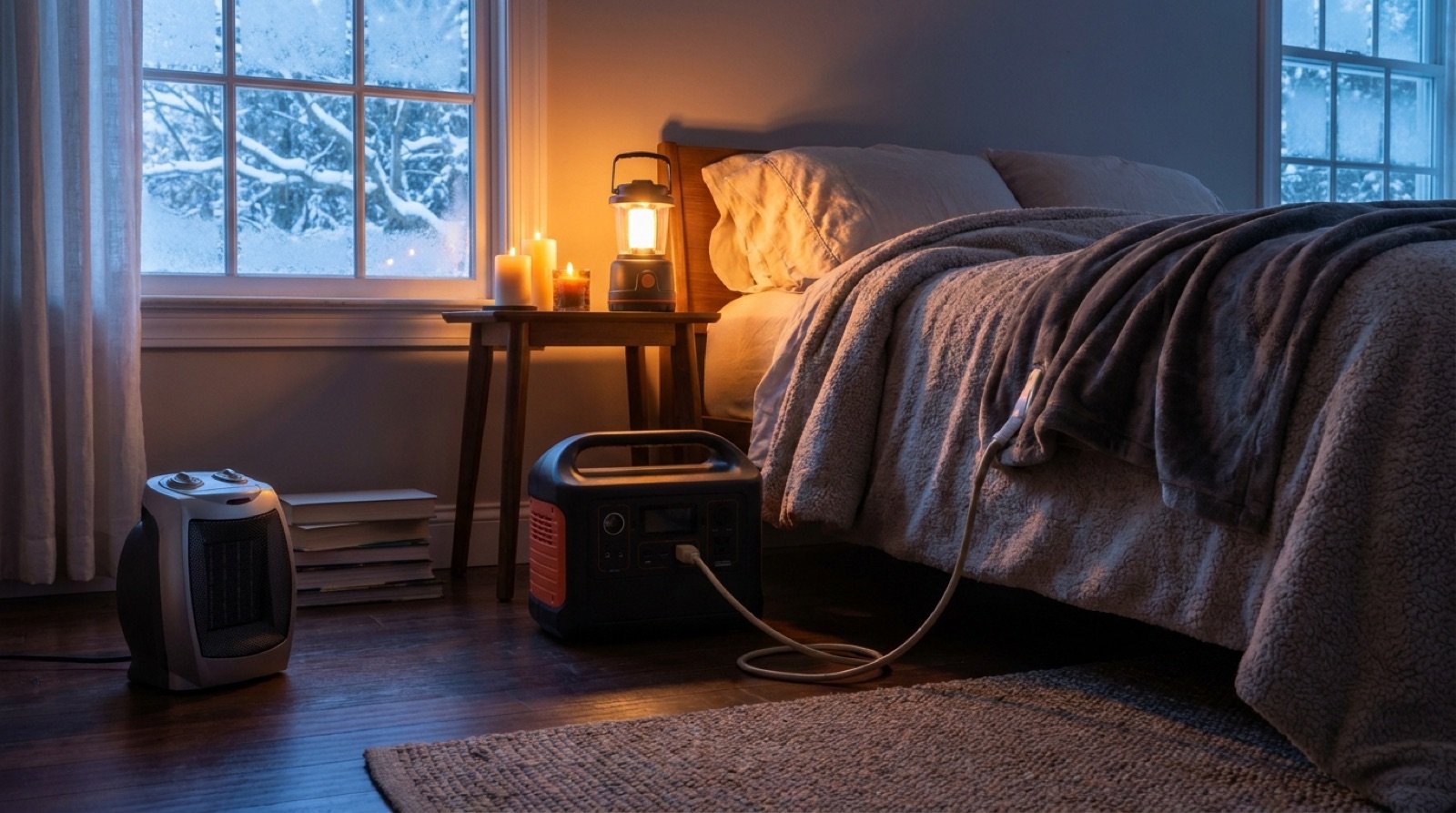
Short answer: yes, but only for a short time. A typical 1,500 W space heater will drain a 1,000 Wh power station in about 34 minutes (850 usable Wh ÷ 1,500 W = 0.57 hours), and the station needs an inverter rated for at least 1,500 W continuous just to start it. On a 750 W low setting you get about 68 minutes. A 75 W heated blanket on that same station runs about 11 hours, which is why most people are better off warming themselves instead of the room.
Why Space Heaters Are the Hardest Load You Can Plug In
Most devices people run during an outage are small. A router draws 10 to 20 W, a phone charger 10 W, an LED lamp 10 W. Even a refrigerator averages only 100 to 200 W once you account for its compressor cycling on and off. A space heater sits in a different class.
Nearly every plug-in space heater sold in the US tops out at 1,500 W. That limit exists because a standard 120 V, 15 A household circuit can safely carry about 1,440 to 1,800 W, and heater makers design right up to that ceiling. The heater turns every watt into heat through a resistive element, so there is no efficiency trick that makes it use less power for the same warmth. 1,500 W in means 1,500 W of heat out, no more and no less.
Here is the problem in one line: a heater on high uses 1,500 Wh every hour. That is more than the entire capacity of most portable power stations people keep in a closet.
Two Hurdles: Inverter Output and Battery Capacity
A power station has to clear two separate bars before it can run a heater.
Hurdle 1: Continuous inverter rating
The AC inverter must be rated for more than the heater’s draw, continuously. A heater on high needs at least 1,500 W, and you want headroom, so look for 1,800 W or more. Heaters do not have the big startup surge that motors do, but they pull their full load for as long as the element is on. A station rated at 1,000 W continuous will usually shut down or trip its overload protection within seconds.
Some brands offer a voltage-reducing mode that lets a resistive load like a heater run on an undersized inverter. It works, but the heater produces proportionally less heat because it is actually drawing fewer watts. Think of it as an automatic low setting, not a free upgrade.
Hurdle 2: Usable battery energy
Even with a big enough inverter, the battery decides how long it lasts. Converting stored DC energy to 120 V AC costs about 10 to 15 percent, so a conservative rule is to count 85 percent of the rated capacity as usable. A 2,000 Wh station gives you roughly 2,000 x 0.85 = 1,700 Wh at the outlet.
Runtime Chart: Space Heater vs Heated Blanket
The table below uses 85 percent usable capacity and assumes the load runs continuously. That is realistic for a heater in a cold house, because the thermostat keeps calling for heat and the element rarely switches off.
| Station capacity | Usable Wh (x 0.85) | Heater on high (1,500 W) | Heater on low (750 W) | Eco or small ceramic (400 W) | Heated blanket (60 W) |
|---|---|---|---|---|---|
| 500 Wh | 425 Wh | 17 minutes | 34 minutes | about 1 hour | about 7 hours |
| 1,000 Wh | 850 Wh | 34 minutes | 68 minutes | about 2 hours | about 14 hours |
| 2,000 Wh | 1,700 Wh | 68 minutes | 2.3 hours | 4.25 hours | about 28 hours |
| 3,600 Wh | 3,060 Wh | 2 hours | 4 hours | 7.6 hours | about 51 hours |
| 5,000 Wh | 4,250 Wh | 2.8 hours | 5.7 hours | 10.6 hours | about 70 hours |
The math for any row is the same: usable Wh ÷ watts = hours. For example, 3,060 Wh ÷ 1,500 W = 2.04 hours. Keep in mind that a 500 Wh or 1,000 Wh station often cannot run a heater on high at all, because its inverter is too small. Those columns show what the battery could deliver if the inverter allowed it.
For the same math across lamps, routers, fans and other everyday devices, see our power station runtime chart for 300 Wh to 3,600 Wh.
How Much Heat Are You Actually Getting?
Watts convert to heat at a fixed rate: 1 W equals about 3.41 BTU per hour. So a 1,500 W heater delivers 1,500 x 3.41 = about 5,100 BTU per hour. That is enough to take the edge off one small, closed room. A typical home furnace is rated somewhere around 40,000 to 100,000 BTU per hour, so one heater is a small fraction of what your house normally gets in winter.
Now look at it from the battery side. A fully charged 2,000 Wh station holds about 1,700 usable Wh, which equals 1,700 x 3.41 = about 5,800 BTU total. That is barely more than one hour of a single space heater, and then the battery is empty.
For comparison, one gallon of propane contains roughly 91,500 BTU. Stored energy in a battery is simply not a dense or cheap way to make heat. If you want to see how the cost of a kWh from batteries stacks up against fuel, our breakdown of what backup power really costs per kWh walks through each source.
Do Low Settings and Thermostats Help?
They help a little, under the right conditions.
- Low setting: Most heaters with two settings run around 600 to 900 W on low. That roughly doubles runtime, but it also cuts heat output in half.
- Eco or thermostat mode: The heater cycles off once the room hits the set temperature. In a well-insulated room that is already warm, the element might run only 40 to 60 percent of the time, so average draw falls to 600 to 900 W even on high. In a cold house during an outage, the room never reaches the setpoint and the heater runs nonstop.
- Small ceramic or personal heaters: Some desk-size units draw 200 to 500 W. They warm your hands and feet, not a room.
The honest takeaway: a low setting buys minutes, not a night. If your plan depends on keeping a room warm for 8 hours on a battery, the heater is the wrong tool.
Can Solar Keep Up?
Not in winter. Days are short, the sun is low, and panels may be covered in snow. A 200 W portable panel might produce somewhere around 300 to 600 Wh on a clear winter day, and far less when it is overcast. A heater on high uses 1,500 Wh in a single hour. One day of solar recharge covers 15 to 25 minutes of heater time. Solar is great for keeping a blanket, lights and phones going for days, but it cannot feed a heater.
Better Ways to Spend Your Watts
The trick is to heat people, not air. Heated bedding puts warmth directly against your body, and it is wrapped in insulation (the blanket itself), so very little is wasted.
| Option | Typical draw | Hours on 1,000 Wh station (850 usable Wh) | What it warms |
|---|---|---|---|
| Heated mattress pad | 50 to 100 W (higher while preheating) | about 11 hours at 75 W | You, in bed |
| Heated blanket | 50 to 100 W | about 11 hours at 75 W | You, in bed or on the couch |
| Heated throw | about 100 W | about 8.5 hours | One person sitting |
| USB heated vest or socks | 5 to 15 W | 50 hours or more at 15 W | Your core or feet |
| Gas furnace blower and controls | 300 to 800 W while running | about 3.4 hours at a 250 W average | The whole house |
| Space heater on low | 750 W | 68 minutes | One small room |
Heated blankets and pads cycle on and off on most settings, so real draw is often lower than the label. The figures above assume a steady draw to stay conservative.
The big one: run your gas furnace
If your home has a natural gas or propane furnace, it already makes tens of thousands of BTU per hour. It just cannot run without electricity for the igniter, control board and blower fan. Those draw roughly 300 to 800 W while running, and the furnace cycles, so the average can be closer to 200 to 400 W. A 3,600 Wh station (3,060 usable Wh) at a 300 W average runs it for about 10 hours, and in that time it delivers far more heat than any space heater could.
The catch is the connection. A furnace is hardwired, so it needs a properly installed power inlet, furnace transfer switch or interlock. That work must be done by a licensed electrician, and some furnaces have specific grounding needs that the electrician should check. Never make a cord with two male plugs, and never backfeed power through a dryer outlet. Our guide on how to connect a portable generator to your house safely explains the legal options, and the same equipment applies to large power stations.
A Realistic One-Night Plan on a 2,000 Wh Station
Here is how a medium station can keep one person or a couple comfortable through a cold night, with the heater used only in short bursts.
| Load | Watts x hours | Energy used |
|---|---|---|
| Heated mattress pad, all night | 60 W x 8 h | 480 Wh |
| Space heater on low, morning warmup | 750 W x 0.5 h | 375 Wh |
| Router and modem | 15 W x 8 h | 120 Wh |
| LED lamps in the evening | 20 W x 4 h | 80 Wh |
| Phone charging | 2 phones x 15 Wh | 30 Wh |
| Total | 1,085 Wh |
That leaves about 1,700 − 1,085 = 615 Wh in reserve. Swap the heated pad for a heater on low running all night (750 W x 8 h = 6,000 Wh) and you would need more than three fully charged 2,000 Wh stations.
To get the most out of short heater bursts, pick the smallest room you can live in, close the door, hang a blanket over the window, and run the heater for 20 to 30 minutes before bed or while dressing in the morning. For more ways to hold heat in a cold house, see our guide to keeping your home warm during a winter storm power outage.
What About a Generator?
A fuel generator handles a space heater easily. A 2,000 W or larger inverter generator can run a 1,500 W heater for hours on one tank, because gasoline and propane hold far more energy than any portable battery. The tradeoff is safety and noise. The CDC says to run generators outdoors at least 20 feet from the home, with the exhaust pointed away from doors and windows, and never in a garage, basement or porch, even with the door open. Use a heavy-duty outdoor extension cord rated for the load.
If you are shopping for a station that can at least run a heater for short bursts and handle a heated pad all night, our best portable power stations for home backup guide is sized by outage length and inverter output.
Safety Rules When You Do Run a Heater
- Plug the heater directly into the station’s AC outlet. No power strips and no thin extension cords. Heater manuals specifically warn against them.
- Keep anything that can burn at least three feet from the heater, which is the long-standing guidance from fire safety organizations.
- Never leave a running heater unattended or run it while sleeping.
- Put the power station on a hard, flat surface with its vents clear. Running near its maximum output makes the station and its fans work hard and run warm.
- Never use a grill, camp stove, gas oven or generator to heat a room. Keep working carbon monoxide alarms on every floor.
Bottom Line
A power station can run a space heater, but the math is brutal: 1,500 Wh per hour on high, which empties most portable units in well under an hour. Use the heater for short warmups in a small closed room, and spend the rest of your battery on a heated blanket or mattress pad that lasts all night. If you have a gas furnace, having an electrician install a proper connection so a large station or generator can run it is the most effective way to heat your whole home.
Frequently Asked Questions
What size power station do I need to run a 1,500 W space heater?
You need an inverter rated for at least 1,500 W continuous, ideally 1,800 W or more. For runtime, every hour on high needs about 1,765 Wh of rated capacity (1,500 Wh ÷ 0.85). A 3,600 Wh station gives about 2 hours on high or 4 hours on low.
Will a space heater damage my power station?
Not if the inverter is rated for the load, since the station’s protection circuits will shut off before an overload. However, draining the battery fully every day uses up charge cycles faster than light loads do. Keep the station’s vents clear, because running near maximum output produces a lot of heat inside the unit.
How long will a power station run an electric blanket?
A heated blanket typically draws 50 to 100 W. A 1,000 Wh station with about 850 usable Wh runs a 75 W blanket for about 11 hours, and longer on lower settings because the blanket cycles on and off. That easily covers a full night.
Is it better to run a space heater or my furnace on backup power?
If you have a gas or propane furnace, running it is far better. Its blower and controls draw about 300 to 800 W while running, yet it delivers many times the heat of a 1,500 W space heater. It must be connected through an inlet, transfer switch or interlock installed by a licensed electrician.