
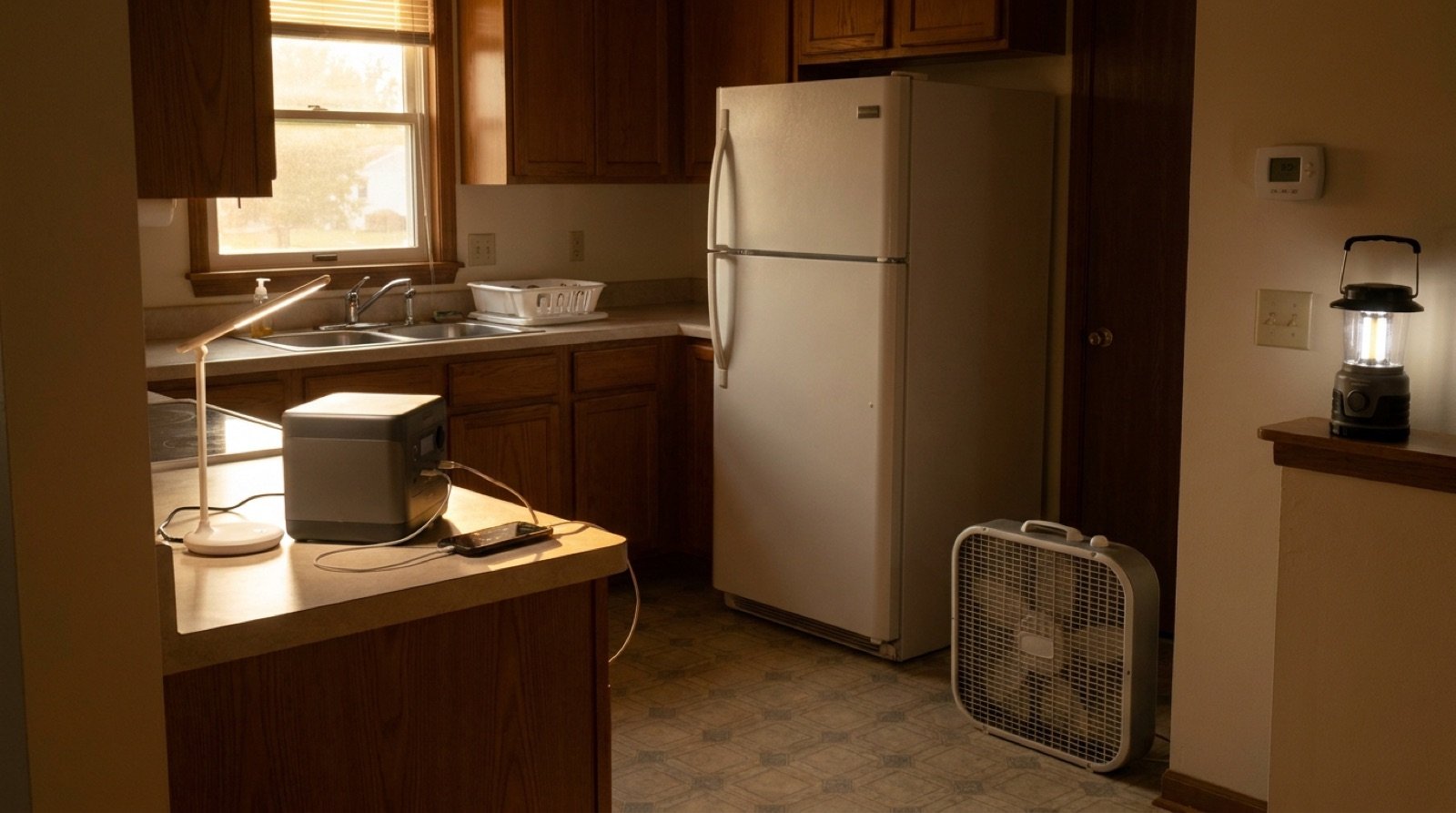
Short answer: Rolling blackouts usually cut power to one neighborhood circuit at a time for roughly 30 minutes to 2 hours, then rotate to the next. To prepare, top off every battery as soon as your grid operator issues a conservation alert, pre-cool or pre-heat your home 2 to 3 degrees, and keep the fridge closed. A 2-hour block for basic needs (phones, Wi-Fi, a fan, lights, a laptop) takes about 300 Wh, so a power station in the 500 to 1,000 Wh range covers most households.
What a Rolling Blackout Is (and What It Is Not)
A rolling blackout, also called a rotating outage, is a deliberate power cut. It happens when demand on the grid gets close to the available supply and the grid operator orders utilities to shed load before the whole system becomes unstable. Instead of letting one large area go dark for hours, the utility switches off small groups of circuits in turns.
It helps to separate three kinds of planned outages, because each one comes with a different amount of warning:
- Rotating outages from a grid emergency. Triggered by extreme heat, extreme cold, or a sudden loss of power plants. Warning can range from a day of conservation appeals to just minutes.
- Public Safety Power Shutoffs (PSPS). Used mainly in Western states to reduce wildfire risk during high winds. Utilities generally aim to notify customers a day or more ahead when conditions allow, and these shutoffs can last a day or longer.
- Scheduled maintenance outages. Your utility replaces equipment and tells you days or weeks in advance by mail, call, or text. Usually a few hours, during the day.
This guide focuses on the first kind, since it gives the least notice and catches the most people off guard.
How Utilities Decide Who Goes Dark and When
Most of the US grid is run by regional grid operators such as ERCOT in Texas, CAISO in California, and PJM, MISO, and SPP across the East and Midwest. When reserves get thin, they move through a standard set of Energy Emergency Alert (EEA) levels defined by NERC, the national reliability organization.
| Stage | What it means | What you should do |
|---|---|---|
| Conservation appeal or watch | Tight supply forecast, often for the late afternoon or early morning peak | Charge everything, pre-cool or pre-heat, fill the car’s tank |
| EEA 1 | All available generation is running | Finish charging, cut nonessential loads, set out flashlights |
| EEA 2 | Emergency resources and demand response programs are in use | Expect outages are possible within hours, unplug sensitive electronics you will not need |
| EEA 3 | Firm load shedding is imminent or underway | Rotating outages can start with little or no further warning |
Once the operator orders load shedding, each utility decides which circuits to drop. Circuits that feed hospitals, 911 centers, water treatment plants, and similar critical facilities are typically protected. That is why one street can lose power three times in an afternoon while the next street over never flickers. If you share a circuit with a hospital, you may be skipped entirely.
Utilities try to keep each block short so food and indoor temperatures stay safe, commonly 30 minutes to 2 hours. If the shortage gets worse, rotations can stretch out or stop rotating altogether. That is what happened during the February 2021 Texas winter storm, when many homes lost power for days instead of hours. Plan for short blocks, but have a fallback for a long one.
Where the Warnings Come From
Rolling blackouts are announced in layers. Sign up for all of them now, not on the day of the heat wave.
- Your grid operator. Most publish conservation alerts and grid conditions on their websites, on social media, and in some cases through text or app alerts. Texas residents can sign up for the state’s grid alert system, and California’s operator issues Flex Alerts.
- Your utility. Enroll in outage texts and email, and confirm your phone number is on your account. Many utilities publish rotating outage block numbers or circuit lists. Find your block number on your bill or account page if your utility uses them.
- The utility’s outage map. Bookmark it. It will be slow during an event, so check it before your phone battery is low.
- Local emergency management. County and city alert systems often relay grid warnings and cooling or warming center locations.
- Medical baseline or critical care programs. If anyone in your home relies on powered medical equipment, ask your utility about these programs. They may give earlier notification. They do not guarantee your power stays on.
The Countdown: What to Do Once an Alert Is Issued
| When | Task |
|---|---|
| As soon as an appeal is issued | Charge phones, power banks, laptops, and any power station to 100 percent. Run the dishwasher and laundry now, not at peak. |
| Same day | Fill the car’s gas tank or charge the EV (gas pumps need power). Get some cash. Fill a few pitchers of water if you are on a well. |
| 2 to 3 hours before the peak | Pre-cool or pre-heat the house 2 to 3 degrees past your normal setting. Close blinds on sunny windows in summer. |
| 1 hour before | Set out flashlights and lanterns. Pull the garage door’s manual release cord if you will need the car. Fill a cooler with ice for drinks so the fridge stays shut. |
| During the block | Keep the fridge and freezer closed. Run only what matters from battery power. Treat dark traffic signals as an all-way stop. |
| Between blocks | Recharge batteries immediately. Rotations can come back a few hours later. |
That last row matters. A rolling blackout is often not one event but several. The homes that do best treat every hour of restored power as charging time.
What to Charge and How Much Battery You Need
Use watts times hours to get watt-hours (Wh). Then divide by about 0.85 to account for inverter losses in a portable power station. Here is a typical 2-hour block:
| Device | Typical draw | Math | Wh needed |
|---|---|---|---|
| Two phone charges | About 15 Wh per charge | 15 Wh x 2 | 30 Wh |
| Modem and router | 15 W | 15 W x 2 h | 30 Wh |
| Box fan, medium speed | 50 W | 50 W x 2 h | 100 Wh |
| Two LED lamps | 10 W each | 20 W x 2 h | 40 Wh |
| Laptop | 50 W | 50 W x 2 h | 100 Wh |
| Subtotal | 300 Wh / 0.85 | About 350 Wh of battery | |
| CPAP overnight, no heated humidifier | 40 W | 40 W x 8 h | 320 Wh |
| Total with CPAP | 620 Wh / 0.85 | About 730 Wh of battery |
So a 500 Wh unit handles one short block of basics, and a 1,000 Wh unit gives you headroom for a CPAP or a second block before you can recharge. Many current power stations refill from a wall outlet in 1 to 2 hours, which fits neatly between rotations. Our guide to the best portable power stations for home backup sorts models by outage length if you are shopping.
Keeping the internet up is the item people forget. A small battery on the modem and router keeps work, school, and outage updates flowing. See how to keep your internet, Wi-Fi, and phone working during a power outage for setups that run them for hours.
A gasoline or propane generator also works for rolling blackouts, but it is a lot of setup for a 1-hour block. If you use one, run it outdoors only, at least 20 feet from the house as the CDC advises, never in a garage. Connecting a generator to your home’s wiring requires a transfer switch or interlock installed by a licensed electrician. Never backfeed through a dryer outlet or any other receptacle.
Staying Cool During a Summer Rotation
Summer rolling blackouts usually hit during the late afternoon and early evening peak, when the house is hottest. Your best tool is the thermal mass of the house itself.
- Pre-cool. Drop the thermostat 2 to 3 degrees a few hours before the expected peak. A cooler starting point buys you time before the house gets uncomfortable.
- Block the sun. Close blinds and curtains on south and west windows. Keep exterior doors shut.
- Pick one room. Shut doors to unused rooms and gather in the coolest interior or lowest level room.
- Move air across skin. A 50 W fan on battery power is far cheaper in Wh than any air conditioner. A damp cloth on the neck plus a fan helps a lot.
- Watch vulnerable people. Older adults, infants, and anyone on heat-sensitive medication need extra attention. If indoor heat becomes dangerous, go to a cooling center.
Running a small window unit from batteries is possible but drains them fast. A 500 W window AC uses about 500 W x 2 h = 1,000 Wh in a 2-hour block, before losses. Details and sizing are in how to run a window air conditioner on a generator or power station.
Staying Warm During a Winter Rotation
Winter rolling blackouts tend to land in the early morning peak, when people wake up and turn on heat at the same time. The same pre-loading strategy applies in reverse.
- Raise the thermostat 2 to 3 degrees before the morning or evening peak.
- Close curtains at night, open south-facing curtains on sunny days.
- Layer clothing, use sleeping bags or extra blankets, and keep everyone in one room.
- Most gas furnaces still need electricity for the blower and controls, so plan on losing heat even if you have gas service.
- Never use a gas oven, grill, or camp stove to heat the home. Make sure a battery-powered carbon monoxide alarm is working.
An electric blanket or heated mattress pad draws far less than a space heater, often well under 100 W, so it is a realistic battery load. If short rotations stretch into a multi-day outage, follow our guide on keeping your home warm without grid power.
Fridge, Freezer, and Water
Short rotations are usually easy on food. The USDA says a closed refrigerator keeps food safe for about 4 hours, and a full freezer holds temperature for about 48 hours (about 24 hours if half full). A 1 to 2 hour block barely dents that, as long as the doors stay shut.
The risk is repeated blocks. Three 90-minute outages in one afternoon add up to 4.5 hours without power, even if the fridge recovers somewhat in between. Keep a refrigerator thermometer inside and check it after the last rotation. Food held above 40°F for more than 2 hours should be discarded. Our fridge and freezer food safety guide covers what to keep and what to toss.
If you rely on a well pump, the pump stops with the power. Fill a few gallons of drinking water and a bathtub for flushing before the peak.
When the Power Comes Back
Restoration can bring a brief surge, and thousands of compressors starting at once can strain the circuit. A few habits help:
- Turn off or unplug computers, TVs, and other sensitive electronics during the block, or keep them on surge protectors.
- Leave one light on so you know when power returns.
- Wait a few minutes before turning the thermostat back on, so your AC or heat pump does not restart into a voltage dip.
- Plug your batteries back in right away, and keep conserving until the grid operator cancels the alert. Every bit of reduced demand makes the next rotation less likely.
Bottom line: Rolling blackouts reward people who act early. Sign up for grid and utility alerts now, treat any conservation appeal as your cue to charge everything and pre-cool or pre-heat, and keep 300 to 700 Wh of battery ready for the basics. Do that and a rotating outage becomes an inconvenience instead of an emergency.
Frequently Asked Questions
How long do rolling blackouts usually last?
Most rotating outage blocks are planned for roughly 30 minutes to 2 hours per circuit before the utility moves on to another area. Your neighborhood may get hit more than once in the same day if the shortage continues. In severe events, rotations can stretch into much longer outages, so keep a plan for a full day without power.
Can I find out if my neighborhood is next?
Sometimes. Many utilities assign customers to an outage block or circuit number shown on the bill or online account, and some publish the order of rotation during an event. Because grid conditions change by the minute, the exact timing is rarely guaranteed, so prepare as soon as an alert is issued.
Will being on a hospital’s circuit keep my power on?
Often it does, because utilities typically protect circuits that serve hospitals, emergency services, and water treatment. That is not a promise, since equipment failures and wider outages can still reach you. Even if you have never lost power in a rolling blackout, keep basic batteries charged.
Is a portable power station or a generator better for rolling blackouts?
For short rotations, a power station is usually more practical: it runs indoors, makes no fumes, starts instantly, and recharges between blocks. A generator makes more sense when outages last many hours or you need to run large loads like a well pump or central AC. Any generator must run outdoors at least 20 feet from the home, and any connection to your wiring must be installed by a licensed electrician.