
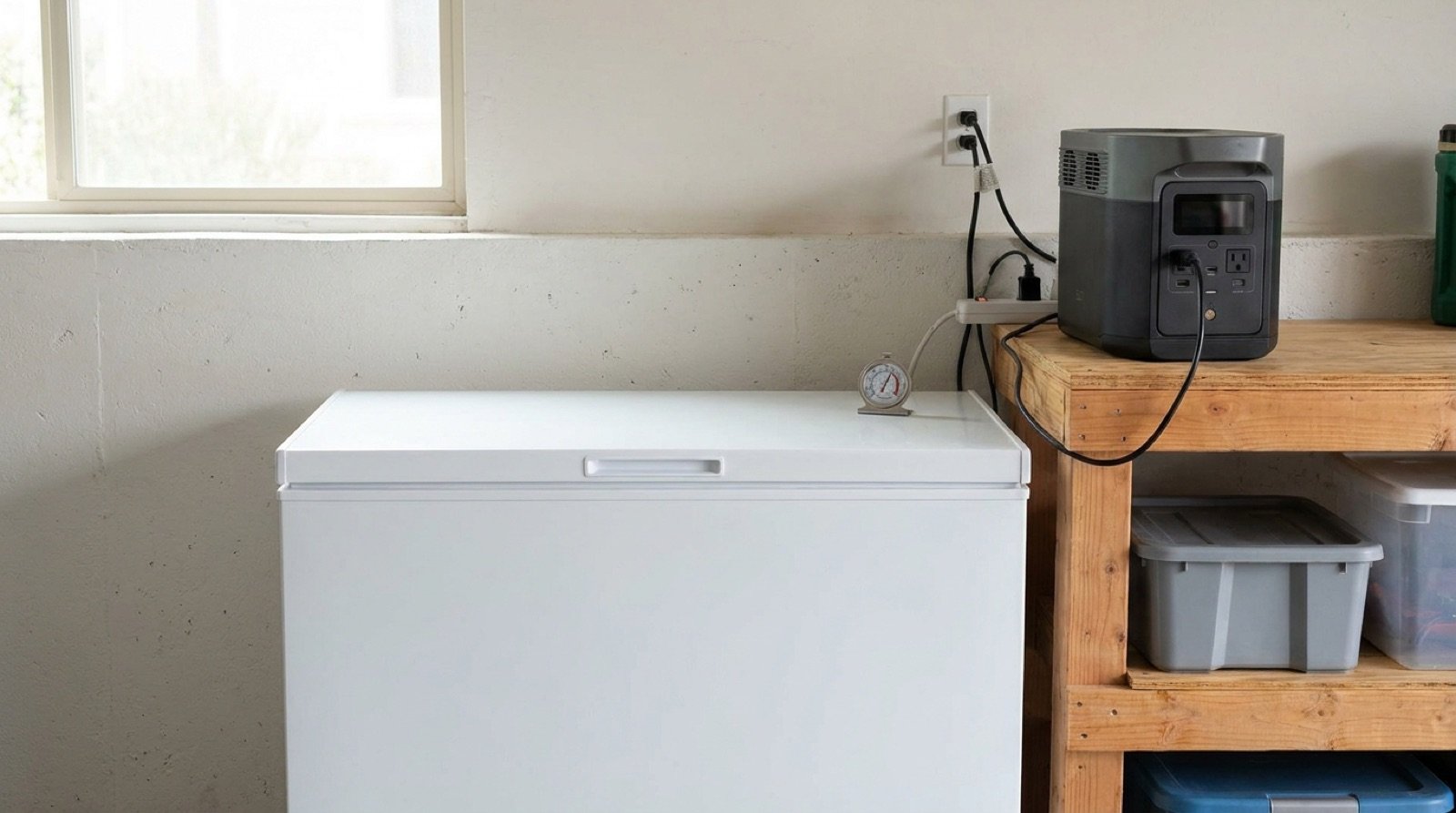
Short answer: A typical chest freezer uses about 0.5 to 1.3 kWh per day. That works out to an average of only 20 to 55 watts, because the compressor runs roughly a third to half of the time. A 1,000 to 1,500 Wh portable power station can carry most chest freezers for about a day. A small generator run 2 hours, three times a day, can keep one frozen on about three quarters of a gallon of gas or less per day, and a full freezer left closed keeps food safe for about 48 hours with no power at all.
Why a Chest Freezer Is One of the Easiest Appliances to Back Up
A chest freezer has three things working in its favor. It has thick insulation on all sides. Its lid opens on top, so cold air, which is heavier, stays inside when you open it. It also usually holds a dense mass of frozen food, and that mass acts like a big ice block that resists warming.
So you don’t need to keep a chest freezer running every minute of an outage. You only need to put back the cold it loses. That changes the sizing problem completely. You can get by with a smaller battery, a smaller generator or less fuel than you’d need for most other loads.
This guide covers the freezer itself. For a full room-by-room food plan, including the refrigerator and what to throw out, see our guide on keeping food safe during a power outage.
How Much Power a Chest Freezer Actually Draws
When people size backup power for a freezer, they often confuse three different numbers:
- Running watts: what the compressor pulls while it is on. For most household chest freezers that is about 60 to 120 watts.
- Startup surge: a short spike, usually lasting under a second, when the compressor kicks on. It typically runs about 3 to 5 times the running watts, so roughly 300 to 600 watts.
- Average watts: running watts multiplied by the duty cycle, meaning the share of time the compressor is actually on. This is the number that drains a battery or burns fuel.
A chest freezer in a 70°F room commonly runs its compressor 30 to 50 percent of the time. Here is the arithmetic for a mid-size unit:
90 W running x 40% duty cycle = 36 W average. 36 W x 24 hours = 864 Wh, or about 0.86 kWh per day.
The nameplate on the back or inside the lid usually lists amps, often 1.5 to 2.5 A at 115 V. Multiply that out and you get 170 to 290 W. That is a maximum rating for safety purposes. It is not what the freezer draws on an average hour, so don’t size a battery from it.
Measure Yours in 24 Hours
The best way to get a real number is a plug-in watt meter, the kind that sits between the outlet and the plug. Leave it in place for a full 24 hours with normal use and read the kWh total. Older freezers, units with worn door gaskets and freezers in hot garages can use twice what a newer one in a basement does, so a measured number beats any chart, including this one.
Sizing a Portable Power Station for a Chest Freezer
Two losses matter when you run a freezer from a battery:
- Inverter conversion loss. Turning battery DC into household AC usually costs 10 to 15 percent. Plan on getting about 85 percent of the battery’s rated Wh as usable AC power.
- Inverter idle draw. With the AC output switched on, the inverter itself uses power even when the compressor is off. Typical figures run 10 to 30 W. At 15 W, that is 15 W x 24 hours = 360 Wh per day, which can be almost as much as a small freezer uses.
The working formula is: battery Wh needed for 24 hours = (freezer daily Wh / 0.85) + (idle watts x 24).
| Freezer size (cool room) | Typical daily use | Average draw | Math for 24 hours | Battery to plan for |
|---|---|---|---|---|
| Small, about 5 cu ft | 500 Wh | About 21 W | 500 / 0.85 = 590 + 360 idle = 950 | About 1,000 Wh |
| Medium, about 7 cu ft | 700 Wh | About 29 W | 700 / 0.85 = 820 + 360 idle = 1,180 | About 1,200 Wh |
| Large, about 15 cu ft | 1,000 Wh | About 42 W | 1,000 / 0.85 = 1,180 + 360 idle = 1,540 | About 1,500 Wh |
| Extra large, 20 cu ft and up | 1,300 Wh | About 54 W | 1,300 / 0.85 = 1,530 + 360 idle = 1,890 | About 1,900 to 2,000 Wh |
These are conservative, rounded figures for a freezer in a room around 70°F. If your freezer sits in a garage that hits 90°F or more, add 30 to 50 percent. For two days of coverage, double the battery figure, or plan to recharge from solar or a generator.
Surge is rarely a problem. Nearly any power station with a continuous output of 1,000 W or more will start a chest freezer compressor without tripping. Smaller units in the 300 to 500 W range can sometimes start a small freezer, but it is hit or miss, so check the surge rating before you count on one. Our roundup of the best portable power stations for home backup groups models by outage length, which lines up well with the table above.
Stretching Runtime: Run the Freezer in Blocks
Because idle draw adds up, you’ll often get more out of a battery by not leaving it connected around the clock. Plug the freezer in for 2 to 3 hours to pull the temperature down, then switch the AC output off and let the freezer coast for 4 to 6 hours with the lid closed. You lose the idle cost during the off periods, and the compressor runs efficiently in long stretches instead of short cycles.
Here is an example for a 7 cu ft freezer: run it three times a day for 2.5 hours each at about 90 W of nearly continuous compressor draw. That gives 90 W x 7.5 hours = 675 Wh, divided by 0.85 = about 795 Wh, plus 15 W of idle x 7.5 hours = about 115 Wh. The total is roughly 910 Wh per day, compared with about 1,180 Wh when it stays connected around the clock.
If you have a fridge to back up too, the numbers stack. Our guide on how long a portable power station will run a refrigerator covers the fridge side so you can add the two together.
Running a Chest Freezer on a Generator: The Cycling Method
A generator is the opposite case. Fuel goes into keeping the engine turning, and a generator powering only a 90 W freezer is mostly burning gas to spin. Running it 24 hours a day for one freezer wastes most of that fuel. Running it in shifts is the smarter move.
| Shift | Generator | What to do |
|---|---|---|
| Morning, 7 to 9 a.m. | On, 2 hours | Run the freezer and fridge, charge phones and any power station |
| Midday, 9 a.m. to 3 p.m. | Off, 6 hours | Keep the lid closed, check the thermometer once without opening |
| Afternoon, 3 to 5 p.m. | On, 2 hours | Pull the freezer back down, top off batteries |
| Evening, 5 to 9 p.m. | Off, 4 hours | Coast |
| Night, 9 to 11 p.m. | On, 2 hours | Final pull-down before the longest off stretch |
| Overnight, 11 p.m. to 7 a.m. | Off, 8 hours | Coast, with neighbors and noise rules respected |
Fuel math: a small inverter generator lightly loaded commonly burns somewhere around 0.1 to 0.15 gallons per hour. Three 2-hour shifts = 6 hours x about 0.12 gallons = roughly 0.7 gallons per day. Running the same generator around the clock = 24 hours x 0.12 = roughly 2.9 gallons per day. That is about four times the fuel for no real gain in food safety. A larger conventional generator burns more per hour even at light load, so the savings from cycling are bigger still. For runtime by generator size and load, see how long a portable generator runs on a tank of gas.
Adjust the shifts to your freezer. In a hot garage, or if the thermometer climbs faster than expected, shorten the off periods. In a cool basement with a packed freezer, you can often stretch them.
Generator Safety Is Not Optional
- The CDC says to run generators at least 20 feet from the home, with the exhaust pointed away from doors, windows and vents.
- Never run a generator in a garage, even with the door open, or in a basement, crawl space or porch enclosure. If the freezer lives in the garage, run a cord out to the generator, never the other way around.
- Use a heavy-duty outdoor extension cord rated for the load and the length. A 12-gauge cord is a sensible choice for runs up to about 50 feet.
- Install battery-powered carbon monoxide alarms near sleeping areas. Our generator carbon monoxide safety guide covers placement in detail.
- Never connect a generator to house wiring through a dryer outlet or any other outlet. Feeding power into the panel requires an interlock or transfer switch installed by a licensed electrician.
- Shut the engine off and let it cool before refueling.
Combining a Generator and a Power Station
The most fuel-efficient setup uses both. During each 2-hour generator shift, the freezer runs directly off the generator while the power station charges from it too. When the generator shuts off, the power station can carry the freezer through the overnight stretch, so the longest off period isn’t really off at all.
This also helps with noise. You can skip the late-night shift completely and still keep the freezer cold. Many mid-size power stations can take a full charge in 1 to 2 hours from a wall-style AC input, which fits neatly inside a generator shift.
Solar works the same way on a smaller scale. A 200 W portable panel in decent sun yields roughly 200 W x 4 peak sun hours x 0.75 real-world factor = about 600 Wh per day. That covers most of a small or medium chest freezer’s daily use if you run it in blocks.
How Long a Chest Freezer Holds Cold With No Power
The USDA says a full freezer keeps food safe for about 48 hours if the door stays closed, and a half-full freezer about 24 hours. Food that still has ice crystals, or that has stayed at 40°F or below, can be refrozen. A chest design generally does at least as well as an upright because of how it holds cold air, but plan around the USDA figures rather than hoping for better.
| Situation | Approximate safe hold, lid closed | Plan |
|---|---|---|
| Full freezer | About 48 hours (USDA) | Backup is optional for short outages, useful for multi-day ones |
| Half-full freezer | About 24 hours (USDA) | Fill empty space with frozen jugs of water before storm season |
| Outage expected beyond 2 days | Not enough on insulation alone | Battery, generator shifts or dry ice |
Ways to stretch the hold time:
- Keep it full. Frozen jugs of water fill gaps, add thermal mass and give you drinking water later.
- Don’t open the lid. Every opening lets cold air out. Keep a list of what is inside taped to the lid.
- Insulate the top while it is off. Moving blankets over the lid help during unpowered stretches. Pull them off while the freezer runs so the condenser and vents can shed heat.
- Dry ice as a fallback. The USDA notes that 50 pounds of dry ice should keep a full 18 cubic foot freezer cold for 2 days. Handle it with gloves, never seal it in an airtight container and keep the room ventilated.
A Thermometer Is Your Real Fuel Gauge
Put an appliance thermometer inside the freezer. Better yet, use a wireless unit with a remote display so you can read it without opening the lid. Normal operation is 0°F. The thermometer tells you whether your cycling schedule is working. If the temperature rises only a few degrees during an off stretch, you can stretch the gaps. If it climbs into the teens, shorten them.
When the power comes back, check the thermometer before you trust anything. A freezer that stayed at 40°F or below is fine to keep running.
Mistakes to Avoid
- Sizing from the nameplate. It overstates average draw by several times and pushes you toward a bigger battery than you need.
- Forgetting idle draw. Leaving the AC output on all day can eat a third of a small battery.
- Using a thin indoor extension cord. Voltage drop makes the compressor work harder and the cord run hot.
- Checking the food by opening the lid. Read the thermometer instead.
- Ignoring garage heat. A summer garage can push a freezer’s energy use up by half.
Bottom Line
A chest freezer is one of the cheapest loads to protect. Measure its daily kWh, add about 15 percent for inverter loss and allow for idle draw, and a 1,000 to 1,500 Wh power station covers most units for a day. For longer outages, run a generator in 2-hour shifts, charge a battery while it runs and let the freezer’s insulation do the rest. Keep it full, keep it closed and trust the thermometer.
Frequently Asked Questions
Can a 500 Wh power station run a chest freezer?
It can run a small chest freezer for roughly 8 to 12 hours, depending on room temperature and idle draw. The math: 500 Wh x 0.85 = about 425 Wh usable, and a small freezer averaging 21 W plus 15 W of idle uses about 36 W, so 425 / 36 = about 12 hours at best. Check that the unit’s surge rating can start the compressor before you rely on it.
How many hours a day does a chest freezer need power during an outage?
Most chest freezers stay frozen with about 6 hours of power a day, split into two or three blocks. Freezers in hot garages or ones that are half empty may need 8 hours or more. A thermometer inside the freezer is the best way to fine-tune the schedule.
Is it safe to plug a chest freezer into a generator with an extension cord?
Yes, with a heavy-duty outdoor cord rated for the load, and with the generator at least 20 feet from the house and never in a garage. Plug the freezer directly into the cord rather than a chain of power strips. Connecting a generator to your home wiring is a separate job that requires a transfer switch or interlock installed by a licensed electrician.
Should I unplug the chest freezer when the power goes out?
You don’t need to unplug it, but switching it off at a power strip or unplugging it can protect the compressor from voltage swings when the grid comes back. Plug it back in a few minutes after power returns and stays stable. Keep the lid closed the whole time either way.