
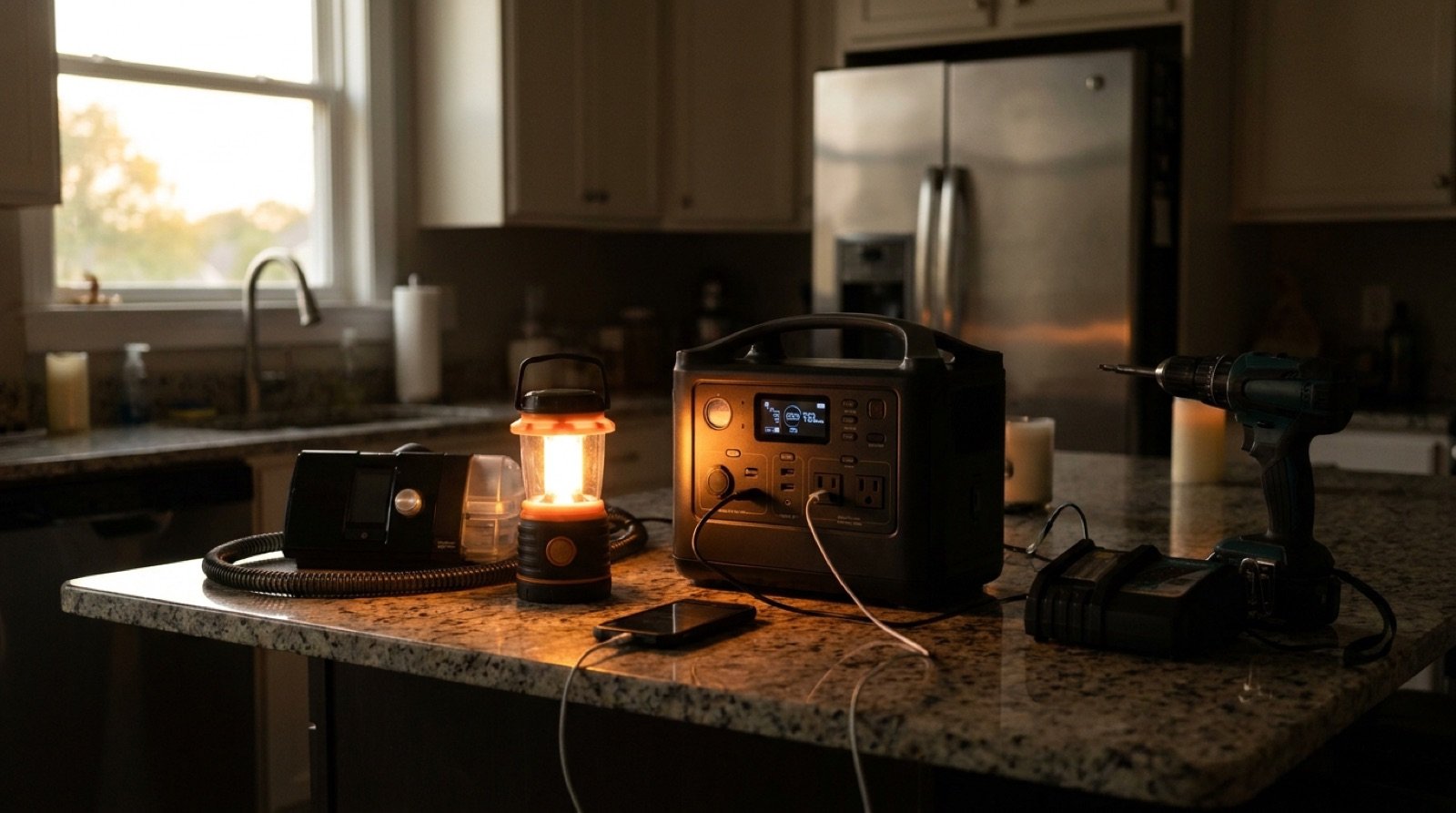
Short answer: A pure sine wave inverter puts out the same smooth AC power as your wall outlet, usually with under 3% total harmonic distortion (THD), and it runs everything in a home safely. A modified sine wave inverter puts out a stepped, blocky approximation instead. That is fine for space heaters, incandescent bulbs and most phone chargers. It can make refrigerator compressors run hotter, cause CPAP humidifiers and some cordless tool chargers to act up, and make clocks gain time. For home backup, buy pure sine and the question goes away.
What the Two Waveforms Actually Are
Household power in the US is alternating current at about 120 volts and 60 hertz. The voltage swings smoothly from positive to negative and back 60 times a second. If you drew it, it would look like a smooth rolling wave. That shape is a sine wave, and every appliance in your home was designed around it.
Batteries make direct current, which is flat. An inverter turns that DC into AC by switching it on and off very quickly. How well it does that is the whole difference:
- Pure sine wave (sometimes called true sine wave): the inverter uses fast switching and filtering to rebuild a smooth curve that closely matches grid power.
- Modified sine wave (also sold as quasi sine or, on some packaging, simulated sine): the inverter jumps between positive, zero and negative in a few flat steps. It looks like a staircase or a square wave with a pause in the middle.
Both deliver roughly the same average voltage, which is why many devices seem to run fine on either. The problem is in the details: the sharp corners and the flat tops.
Why the Shape Matters to a Device
A stepped waveform is a smooth wave plus a lot of extra, higher-frequency energy riding on top of it. Engineers call that extra energy harmonics, and they measure it as THD. Good pure sine inverters are typically rated under 3% THD. A modified sine wave is far rougher, often in the range of 20% or more, because the shape is so far from a curve.
That extra energy has to go somewhere. Depending on the device, it shows up as:
- Heat in motors and transformers, because the harmonics push current through windings without doing useful work.
- Noise, like a buzz in speakers or a louder hum from fans and motors.
- Confused electronics, such as timers that count the waveform to keep time, or controllers that expect a clean zero crossing.
- Stressed power supplies, especially very cheap ones that use simple capacitors instead of a proper switching circuit.
Nothing usually explodes. The more common outcome is a device that runs warm, runs noisy, shuts itself off, or quietly wears out sooner than it should.
Which Household Devices Care
Here is a practical sensitivity guide. Treat “usually fine” as a general rule, not a promise: the manufacturer of a specific device always has the final word.
| Device | On modified sine | Why |
|---|---|---|
| Space heater, toaster, coffee maker, incandescent bulb | Usually fine | Pure resistive heating; the wave shape barely matters |
| Phone and tablet USB chargers | Usually fine, may run warmer | Switching power supplies convert to DC anyway |
| Laptop power bricks | Usually fine, some buzz or run hot | Same as above; very cheap bricks are the exception |
| LED bulbs | Mixed; some flicker or fail early | Low-cost drivers can dislike sharp voltage steps |
| Refrigerator and freezer | Runs, but hotter and noisier | Compressor motors waste harmonic energy as heat |
| Furnace blower, fans, well and sump pumps | Runs, but hotter; variable-speed models may fail to run | Induction and electronically controlled motors |
| CPAP and BiPAP machines | Avoid | Manufacturers generally specify pure sine; humidifier heaters and controls can misbehave |
| Oxygen concentrators and other medical equipment | Avoid | Motors plus sensitive controls; follow the device manual |
| Cordless tool and battery chargers | Risky; some refuse to charge or overheat | Smart charging circuits expect clean AC |
| Microwave oven | Runs, often weaker and louder | Transformer-based; heats less efficiently |
| Clocks on stoves, microwaves, coffee makers | Often run fast or blink | Some count the waveform cycles to keep time |
| Dimmer switches, variable-speed tools | Often erratic | Controls rely on a clean zero crossing |
| Audio equipment, TVs | Often buzz or show interference | Harmonics leak into sensitive circuits |
| Laser printers, some modern appliances with active power supplies | Risky | Can fault, shut off or be damaged |
CPAP and Other Medical Devices
This is the category where you should not experiment. CPAP makers generally recommend pure sine wave power when running from an inverter, and the heated humidifier is often the part that behaves worst on rough power. If someone in your home depends on a medical device overnight, pure sine is not an upgrade, it is the requirement. For runtime planning, see our guide on how long a portable power station can run a CPAP.
Refrigerators, Freezers and Anything With a Motor
A fridge will usually start and cool on modified sine power, which is why people assume it is fine. The compressor motor, though, turns part of that harmonic energy into heat instead of cooling. Over a long outage, that means more energy drawn from the battery and more wear on the motor. Variable-speed or inverter-driven compressors in newer fridges are more sensitive still, and some will simply refuse to run. Surge handling also matters here, and we cover it in detail in how to run a refrigerator on a generator.
Chargers and Power Bricks
Most phone and laptop chargers are switching power supplies. They chop incoming AC into DC regardless of its shape, so they tend to tolerate modified sine power. The exceptions are the ones that matter: smart chargers for cordless tool batteries, electric toothbrush and shaver bases, and very cheap no-name adapters. Some will blink an error, some will charge slowly, and a few can overheat. If a charger gets noticeably hot or hums loudly, unplug it.
Clocks, Timers, Dimmers and Audio
These are mostly annoyances rather than hazards. A stove clock that gains several minutes an hour, a dimmer that flickers, or a speaker that buzzes are classic signs you are on a modified sine source.
How to Tell What You Have
You do not need an oscilloscope. Work through these steps in order:
- Read the spec sheet or label. Look for “pure sine wave” or “true sine wave” and a THD figure. Under 3% is a clean pure sine output. “Modified sine,” “quasi sine” or a missing waveform spec usually means modified.
- Be careful with the word “simulated.” Some brands use “simulated sine wave” for a stepped output, especially on budget UPS units. If there is no THD number, assume it is not pure sine.
- Check the product type. Nearly all current portable power stations from established brands output pure sine. Cheap plug-in car inverters and older budget inverters are often modified sine.
- Look at the price tier and age. A small, very inexpensive cigarette-lighter inverter is very likely modified sine. A unit sold specifically for home backup or RV use is more likely pure sine, but still confirm.
- Watch for the symptoms. Buzzing from a fan or speaker, a fast-running clock, a hot charger, or a CPAP showing an error on inverter power but not on wall power all point to a rough waveform.
Common Backup Sources Compared
| Power source | Typical output | Safe for sensitive devices? |
|---|---|---|
| Portable power station (major brands) | Pure sine | Yes, confirm on spec sheet |
| Budget plug-in car inverter | Often modified sine | Not for medical devices or motors |
| Inverter generator | Pure sine, low THD | Yes |
| Conventional open-frame generator | True sine shape, but higher distortion and voltage swings | Usually fine for motors; less ideal for electronics |
| Standby UPS for computers | Often stepped on battery | Check; some computer power supplies dislike it |
| Home battery system | Pure sine | Yes |
Note that conventional generators are not modified sine. Their alternator makes a real sine wave, but voltage and frequency drift as the engine load changes, and distortion is higher than an inverter’s. The trade-offs are covered in inverter vs conventional generator, and if clean power for electronics is your priority, our list of the best inverter generators for home backup is a good starting point.
On UPS units, the waveform question decides whether a desktop computer stays on or reboots when the power blinks. We compare that setup in UPS vs portable power station for a home office.
The Inverter Loss Math, and a Shortcut for CPAP
Every inverter, pure or modified, burns some energy converting DC to AC. A reasonable planning figure is 85% efficiency. Here is how that plays out for a CPAP over one night:
- CPAP without humidifier: about 40 W x 8 hours = 320 Wh. Through an inverter: 320 Wh / 0.85 = about 375 Wh from the battery.
- CPAP with heated humidifier: about 90 W x 8 hours = 720 Wh. Through an inverter: 720 Wh / 0.85 = about 850 Wh from the battery.
Many CPAP makers sell a DC power cord or converter that runs the machine straight from a 12 volt or DC port. That skips the inverter entirely, so the waveform question disappears and you keep most of that 15% loss. On a 500 Wh power station, the difference between roughly 375 Wh and 330 Wh per night can be the difference between one night and a comfortable margin. Turning the humidifier off, if the user’s doctor agrees, cuts the load by more than half.
Motors on modified sine power add a further penalty on top of the inverter loss, because they turn part of the harmonics into heat. There is no single reliable number for this, so the conservative move is simple: do not plan a refrigerator or pump around a modified sine inverter at all.
If You Are Stuck With a Modified Sine Inverter
Maybe you already own one, or it is the only thing in the car during an outage. It still has real uses:
- Use it for resistive loads: a small heater, a kettle, incandescent work lights.
- Use it for phone and laptop chargers, and unplug any that get hot.
- Do not use it for CPAP, oxygen, insulin refrigeration or any medical equipment.
- Do not use it for refrigerators, freezers, well pumps, furnace blowers or tool battery chargers.
- Never connect any inverter or generator to your home wiring through an outlet or a dryer receptacle. Feeding the house requires a transfer switch or interlock installed by a licensed electrician.
When you replace it, pure sine is the only spec worth buying for home backup. The price gap that once made modified sine attractive has largely closed in the power station category.
Bottom Line
Modified sine wave power works for heat and simple chargers, and that is about where it should stop. Anything with a motor, a medical purpose, a smart charger or sensitive electronics belongs on pure sine power with a published THD under 3%. Check the label before an outage, not during one, and use DC cords for CPAP machines whenever the manufacturer offers them.
Frequently Asked Questions
Can a modified sine wave inverter damage my refrigerator?
It usually will not destroy it right away, but the compressor runs hotter and less efficiently, which adds wear over long outages. Newer fridges with variable-speed compressors may not run on it at all. For multi-day backup, a pure sine source is the safer choice.
Is it safe to run a CPAP on a modified sine wave inverter?
Avoid it. CPAP manufacturers generally specify pure sine wave power, and the heated humidifier and control electronics can malfunction on a stepped waveform. A pure sine power station or the manufacturer’s DC cord is the right setup.
Do generators produce pure sine wave power?
Inverter generators produce clean pure sine power with low distortion. Conventional generators produce a true sine shape, but with more distortion and voltage swings as the load changes. Neither is a modified sine source, but inverter models are better for electronics.
Will my phone charger work on modified sine wave power?
Most standard phone and laptop chargers work, because they convert AC to DC internally. Some run warmer or hum, and very cheap adapters can fail. If a charger gets hot to the touch, unplug it and use a USB port on the power station instead.