
This post contains affiliate links. If you buy through them, we may earn a commission at no extra cost to you.
Short answer: a running portable generator produces as much carbon monoxide as hundreds of idling cars. It must sit at least 20 feet from the house with the exhaust pointed away from every door, window, and vent, and never in a garage, basement, carport, or under an open window, even with fans running. Install battery-backed CO alarms on every level of the home, and if anyone feels dizzy, nauseous, or headachy during an outage, get everyone outside first and ask questions later. Those four rules would prevent almost every generator CO death in the United States.
Why Generators Are Uniquely Dangerous
The Consumer Product Safety Commission counts roughly 85 to 100 deaths per year from portable generator carbon monoxide, with sharp spikes after hurricanes and ice storms. The reason is simple physics. A small gasoline engine without a catalytic converter emits carbon monoxide at concentrations that can exceed 30,000 parts per million at the exhaust outlet. The level that causes headaches and confusion in a healthy adult is around 200 ppm over a couple of hours. The level that kills in under an hour is roughly 1,600 ppm. A generator in a closed garage can reach lethal concentrations in five to ten minutes.
Carbon monoxide is colorless, odorless, and slightly lighter than air. It does not sink into a basement or linger only near the floor; it mixes throughout a space. You cannot smell it. Exhaust fumes have an odor, but by the time a room smells like exhaust, CO may already be far above safe levels.
The Placement Rules That Actually Matter
| Rule | Why |
|---|---|
| At least 20 feet from the house | CDC and CPSC guidance. At 20 feet, outdoor air dilutes CO before it reaches openings. At 10 feet, tests show CO still enters through window frames and soffit vents. |
| Exhaust pointed away from the home and neighbors | Wind carries a plume 30 feet or more. Point the outlet at open yard, not at any building. |
| Never in a garage, even with the door open | An open garage door does not provide enough airflow. This is the single most common fatal scenario. |
| Never in a basement, crawlspace, porch, or carport | Partially enclosed spaces trap CO. A screened porch is not outdoors. |
| Away from window AC units and dryer vents | These pull outdoor air inside. A generator upwind of a window AC feeds CO straight into a bedroom. |
| Not under a deck or against a wall | Both create dead-air pockets where CO concentrates and then finds its way inside. |
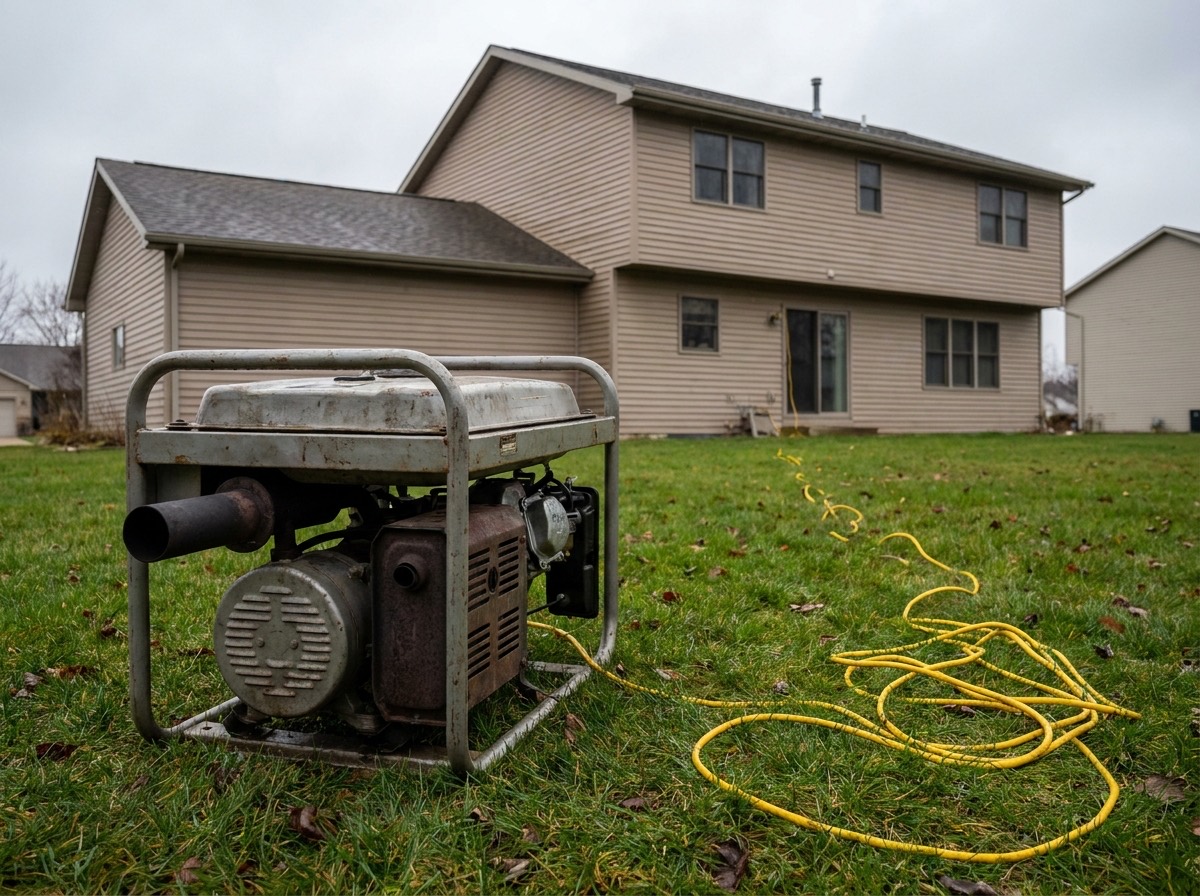
Twenty feet is farther than most people imagine. Measure it with a tape once, on a calm day, and mark the spot with a paint dot or a paver. When the storm hits at midnight, you will not be pacing it off. Rain is not a reason to move the generator closer; our guide to running a generator in the rain covers canopies and covers that keep it dry where it belongs.
CO Shutoff Sensors: The Feature Worth Paying For
Since 2018, most major manufacturers have added a CO sensor that shuts the engine down if carbon monoxide accumulates around the unit. Two standards exist: PGMA G300 and UL 2201. Generators that meet UL 2201 also have reduced-emission engines, which produce far less CO in the first place. Look for labels like “CO Shield,” “CO Sense,” “CO Guard,” “CO Detect,” or “CO Minder” on the spec sheet.
These sensors are excellent, and they are not a substitute for placement. They shut the generator down when CO builds up around the generator itself. If the wind carries exhaust from an open-air unit to a bedroom window, the sensor never trips. Buy one anyway; it covers the human error of “just for a few minutes in the garage.” Every unit in our roundup of the best portable generators for home outages has CO shutoff.
CO Alarms Inside the Home: Placement and Type
Every home that will ever run a generator, gas furnace, or fireplace needs carbon monoxide alarms, and during an outage they must work without grid power.
- Battery-powered or battery-backup units only. A plug-in alarm without battery backup is dead during the exact event it exists for.
- One on every level, including the basement, and one within 10 feet of every sleeping area. CO poisoning during sleep is the leading fatal scenario.
- Mount at knee height or higher on a wall, or on the ceiling, per the manufacturer. Unlike smoke, CO mixes evenly, so height is less critical than being away from dead corners and not near a window.
- Replace the whole unit every 7 to 10 years. The electrochemical sensor inside wears out. The manufacture date is printed on the back.
- Consider a digital readout model. A display that shows 30 ppm tells you something is wrong long before the alarm threshold of 70 ppm.
Check the current price of battery-powered CO alarms with a digital display on Amazon
A portable CO meter is also worth owning if you live in hurricane or ice-storm country. Handheld units cost less than a tank of gas and let you walk the house and check the air near the generator side of the building.
Check the current price of a handheld carbon monoxide meter on Amazon
Symptoms: What CO Poisoning Feels Like
The early symptoms mimic the flu, tiredness, or a hangover, which is exactly why people ignore them during a stressful outage.
| CO Level | Symptoms | Time to Effect |
|---|---|---|
| 50-100 ppm | Mild headache, fatigue after several hours | 2-8 hours |
| 200 ppm | Headache, dizziness, nausea | 2-3 hours |
| 400 ppm | Severe headache; life-threatening after 3 hours | 1-2 hours |
| 800 ppm | Dizziness, convulsions, unconsciousness | 45 minutes to 2 hours |
| 1,600 ppm | Death | Under 1 hour |
Red flags that it is CO and not the flu: more than one person feels ill at the same time, symptoms improve when you go outside, and pets seem sick too. If you notice any of those, do not investigate. Get everyone out of the house, call 911 from outside, and do not go back in until the fire department clears the air.
The Scenarios That Kill: Learn Them So You Recognize Them
- “Just in the garage with the door open.” The classic. Wind pushes exhaust back in, CO fills the garage and seeps into the house through the door and shared walls.
- “On the covered porch to keep it dry.” A roof and one wall are enough to trap CO. The bedroom above the porch fills first.
- “Right outside the window so the cord reaches.” The window becomes an intake. Buy a longer cord. A 100-foot 10-gauge cord costs less than a hospital visit.
- “Under the deck, out of the rain.” Same dead-air pocket problem. CO rises through the deck boards and enters the sliding door above.
- “The neighbor’s generator.” CO does not respect property lines. If a neighbor’s generator is running near your open windows, close them and talk to the neighbor.
- Refueling a hot generator. This is a fire and burn hazard rather than CO, and it happens every storm. Shut it down and let it cool 10 to 15 minutes before opening the fuel cap.
After a hurricane, all of these risks compound with exhaustion and darkness. Our checklist on generator safety after a hurricane is written for exactly that moment.
Cord Length Solves Most Placement Problems
Nearly every unsafe placement happens because the cord is too short. A generator 20 feet from the house needs at least a 25-foot cord to the inlet or the first appliance, and often 50 feet to reach a sensible spot in the yard. Voltage drop on a 10-gauge cord at 50 feet and 20 amps is under 3 percent, which is fine. At 100 feet, step up to 8-gauge for heavy loads. If you are feeding the house through an inlet box, read our guide on how to connect a portable generator to your house safely, which covers inlet placement on the side of the house farthest from bedrooms.
Battery Power Stations: The Zero-CO Option
A lithium power station produces no carbon monoxide at all and can run indoors, in a bedroom, next to a CPAP or an oxygen concentrator. For households with elderly members, infants, or anyone with heart or lung conditions, that alone justifies keeping one on hand even if a fuel generator handles the heavy loads outside. Our roundup of the best portable power stations for home backup covers sizes from a single night of fridge and lights to multi-day setups. The one thing to remember: the generator that recharges the power station still lives outside, 20 feet away.
Frequently Asked Questions
How far away from the house should a generator be?
At least 20 feet, with the exhaust pointed away from the house. Farther is better on calm days when the plume does not disperse.
Can I run a generator in the garage with the door open?
No. This is the most common fatal generator scenario in the United States. An open door does not provide enough ventilation to keep CO below dangerous levels.
Do CO shutoff generators make placement rules unnecessary?
No. The sensor protects against CO building up around the generator. It does not detect CO drifting toward your windows 15 feet away. Follow the placement rules and buy the sensor as a backup.
Will a smoke detector detect carbon monoxide?
Not unless it is a combination smoke and CO alarm. Check the label. Many homes have only smoke alarms, which are blind to CO.
What do I do if the CO alarm goes off during an outage?
Get everyone and every pet outside immediately. Call 911 from outside. Do not open windows and stay inside “to air it out,” and do not go back for belongings. Have the generator moved or shut off, and let the fire department confirm the house is clear.