
This post contains affiliate links. If you buy through them, we may earn a commission at no extra cost to you.
Short answer: there are three legitimate ways to connect a portable generator to your house. Extension cords are the cheapest and need no electrician, but they only power what you can physically plug in. An interlock kit with a power inlet box costs roughly $400 to $900 installed and lets you feed your existing breaker panel. A manual transfer switch costs $800 to $1,500 installed and gives you a dedicated set of circuits. The one method you must never use is a so-called suicide cord plugged into a wall outlet. It can kill a utility lineworker, burn down your house, and it is illegal in every U.S. jurisdiction.
The Three Safe Connection Methods Compared
| Method | Typical Cost | Electrician Needed? | What It Powers | Best For |
|---|---|---|---|---|
| Heavy-duty extension cords | $60-$200 | No | Plug-in appliances only | Renters, small generators, occasional outages |
| Interlock kit + inlet box | $400-$900 installed | Yes | Any circuit in your panel, within generator capacity | Most homeowners with 5,000W or larger generators |
| Manual transfer switch | $800-$1,500 installed | Yes | 6 to 10 pre-selected circuits | Homes that want a foolproof, labeled setup |
All three work. The difference is how much of your house comes back on, how much thinking you have to do at 2 a.m. in the dark, and how much you pay up front. Below is what each one actually involves.
Method 1: Extension Cords (No Wiring Required)
This is how most people run a generator the first time, and for a small inverter unit it is often the right call. The generator sits outside, at least 20 feet from the house, and heavy-gauge outdoor cords run through a window or door to the refrigerator, a lamp, a fan, and a phone charger.
The rules that matter:
- Use 12-gauge or 10-gauge cords rated for outdoor use. A thin 16-gauge cord on a 1,500-watt space heater will get hot and can melt. For runs over 50 feet, use 10-gauge.
- Do not daisy-chain cords. Every connection adds resistance and a point of failure.
- Never run a cord through a closed door or window that pinches it. Crushed insulation causes shorts and fires.
- Keep total load under the generator’s rated (not peak) output. Add up the running watts of everything plugged in. Our appliance wattage guide lists real numbers for common household loads.
What cords cannot do: power anything hardwired. Your furnace blower, well pump, water heater, ceiling lights, and central air all live inside the walls. If you need any of those, you need one of the next two methods.
Check the current price of a 10-gauge 50-foot outdoor generator cord on Amazon
Method 2: Interlock Kit With a Power Inlet Box
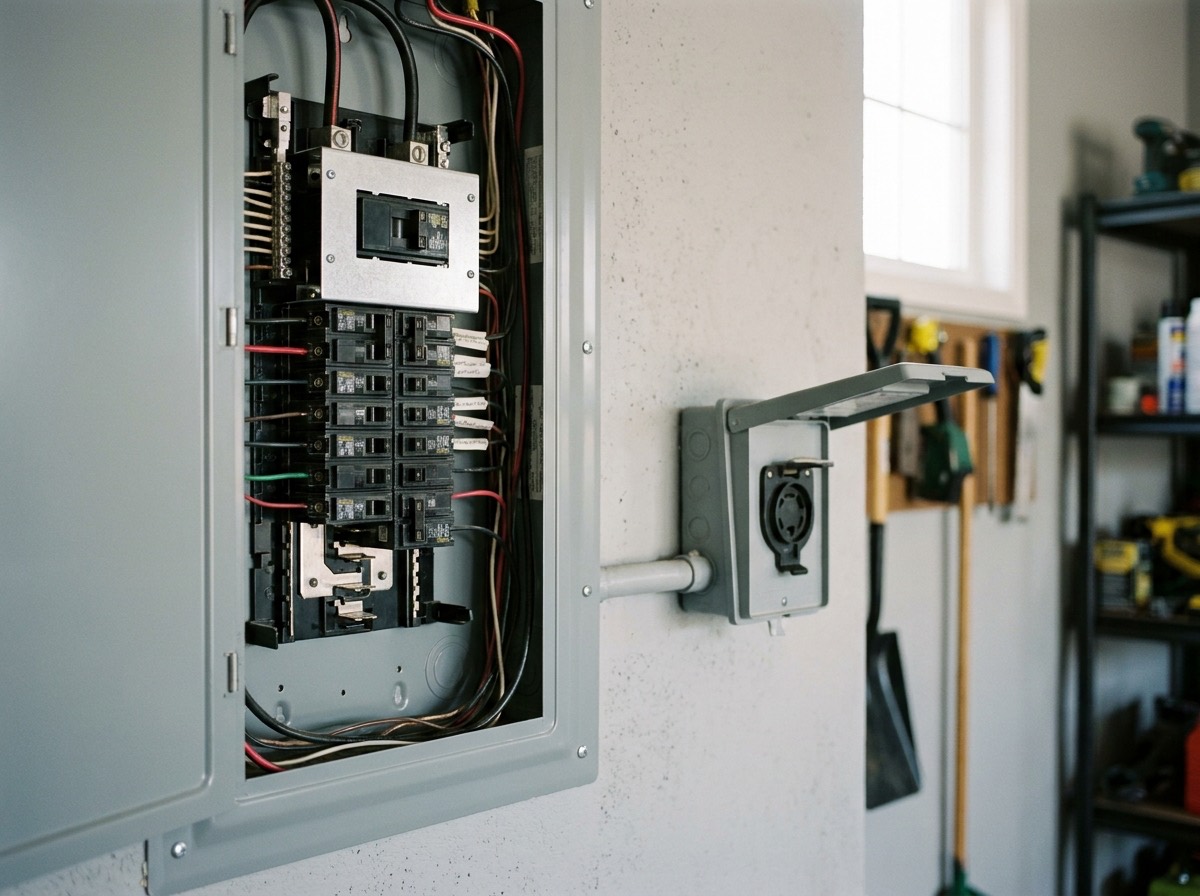
An interlock kit is a small metal plate mounted on your existing breaker panel. It mechanically blocks the main breaker and the generator backfeed breaker from being on at the same time. When the utility is out, you switch the main off, slide the interlock, switch the generator breaker on, and your panel is now fed by the generator through a power inlet box on the outside wall.
Why electricians and inspectors like this method:
- It uses your existing panel, so the parts cost is low, typically $60 to $150 for the kit and $50 to $100 for the inlet box.
- It powers any circuit in the house. You choose what to turn on by flipping individual breakers, so you can run the furnace for an hour, then switch to the well pump, then back.
- Because the main is physically locked off, it is impossible to backfeed the grid.
What to watch out for:
- The kit must be listed for your exact panel brand and model. A generic kit on the wrong panel will fail inspection and may not block the breakers properly.
- You are responsible for load management. Turn on too many breakers and the generator will trip or stall. Label the panel with what each breaker draws.
- Some jurisdictions require a permit and inspection. Most do. Skipping it can void your homeowner’s insurance if there is ever a fire.
Installation usually takes an electrician two to four hours. Expect $300 to $700 in labor on top of parts, more if the panel is far from an exterior wall and conduit has to be run.
Check the current price of generator interlock kits on Amazon
Check the current price of a 30-amp generator power inlet box on Amazon
Method 3: Manual Transfer Switch
A manual transfer switch is a separate small panel installed next to your main panel. The electrician moves 6 to 10 critical circuits (furnace, fridge, well pump, a few lights, a bathroom outlet) into it. When the power fails, you plug the generator into the inlet, flip each switch from “Line” to “Gen,” and those circuits come alive. Nothing else in the house can draw from the generator, which is the point.
Advantages over an interlock:
- Built-in wattage meters on most models show you the load on each leg in real time, so you cannot accidentally overload the generator.
- Anyone in the household can operate it. There is no breaker sequence to remember.
- It is the method most inspectors are most comfortable with, and it never depends on your panel brand.
Downsides: it costs more, it only powers the circuits you chose on install day, and a 10-circuit switch will not run central air or an electric range. For a deeper comparison of manual versus automatic switches, read our guide to manual vs automatic transfer switches.
Check the current price of a 10-circuit manual transfer switch on Amazon
The Method That Kills People: Backfeeding Through an Outlet
Every year, people plug a male-to-male cord from the generator into a dryer or wall outlet to “feed the house.” Do not do this. Here is what actually happens:
- Backfeed to the grid. With the main breaker still on, your generator pushes power out through the meter and into the neighborhood lines. The transformer steps it up to thousands of volts. A utility crew working on a “dead” line can be electrocuted.
- Exposed live prongs. The moment one end is plugged in, the other end’s prongs are energized at 120 or 240 volts.
- No overcurrent protection. The generator’s output is now on wiring never designed for it, and the breaker for that outlet is in the wrong place to protect anything.
- Fire and insurance. A fire traced to a backfeed cord is a claim denial and, in many states, a criminal charge.
Every method above exists precisely so that this one never happens.
Sizing the Generator and the Inlet
The connection hardware has to match the generator’s output. Most portable generators between 5,000 and 9,500 watts use a 30-amp L14-30 outlet, which delivers 120/240 volts at up to 7,200 watts continuous. Larger units use a 50-amp CS6365 outlet good for up to 12,000 watts. Buy the inlet box, cord, and breaker to match that outlet, not the generator’s peak rating.
| Generator Outlet | Amps | Max Continuous Watts | Inlet Box | Backfeed Breaker |
|---|---|---|---|---|
| L14-30R | 30 | 7,200W | 30A L14-30P inlet | 2-pole 30A |
| CS6365 (twist-lock 50A) | 50 | 12,000W | 50A CS6375 inlet | 2-pole 50A |
| 14-50R (RV style) | 50 | 12,000W | 50A 14-50 inlet | 2-pole 50A |
If you are still choosing the generator itself, our roundup of the best portable generators for home outages covers what each size class will realistically run, and the generator size calculator will add up your loads in a minute.
Step-by-Step: Running the House on the Generator (Interlock Setup)
- Roll the generator to its outdoor spot, at least 20 feet from any door, window, or vent, exhaust pointed away from the house.
- Confirm every breaker you plan to use is OFF. Confirm the main is OFF. Slide the interlock plate to lock it.
- Connect the generator cord to the inlet box first, then to the generator. Never connect a live cord to the inlet.
- Start the generator and let it stabilize for one to two minutes. If it has an economy mode, leave it off until loads are on.
- Turn on the generator backfeed breaker.
- Turn on circuits one at a time, largest motor loads first (well pump, furnace, fridge), then lights and outlets. Wait a few seconds between each.
- When utility power returns, reverse the order: circuits off, generator breaker off, slide the interlock back, main on, then shut down the generator.
Rain and snow do not cancel the outage. Read can you run a generator in the rain before you need a canopy at midnight.
What About Portable Power Stations?
Larger battery power stations, like the 4kWh-class units we cover in our EcoFlow Delta Pro 3 review, offer an optional transfer switch or smart home panel that does the same job without fuel, noise, or exhaust. The connection principles are identical: an inlet or hardwired feed, a mechanical or electronic lockout from the grid, and load management. The difference is that a battery has a fixed number of watt-hours, so you also have to think about runtime, which we cover in power station vs generator.
Frequently Asked Questions
Can I install an interlock kit myself?
In most jurisdictions, work inside the main panel requires a licensed electrician or a homeowner permit with inspection. Even where DIY is allowed, the main lugs stay live when the main breaker is off, and a mistake there is often fatal. Hire the electrician. The parts are cheap; the labor is a few hundred dollars.
Will a 30-amp inlet run my whole house?
It will run 7,200 watts continuously, which covers a furnace, refrigerator, freezer, well pump, lights, and electronics in most homes. It will not run central air conditioning, an electric range, or an electric water heater at the same time. Manage loads by flipping breakers.
Do I need a permit for a transfer switch or interlock?
Almost always yes. The permit is typically $50 to $150, and the inspection is your proof to the insurance company that the installation is code-compliant.
Is an interlock kit safer than a transfer switch?
Both are equally safe when installed correctly. A transfer switch is more foolproof to operate because the circuits are pre-selected and metered. An interlock is more flexible and cheaper. Choose based on who will be operating it during the outage.
How far from the house should the generator sit?
At least 20 feet, with the exhaust pointed away from the home and any neighbor’s home. Carbon monoxide from generators kills dozens of people every year in the United States. Install battery-powered CO alarms on every floor.