
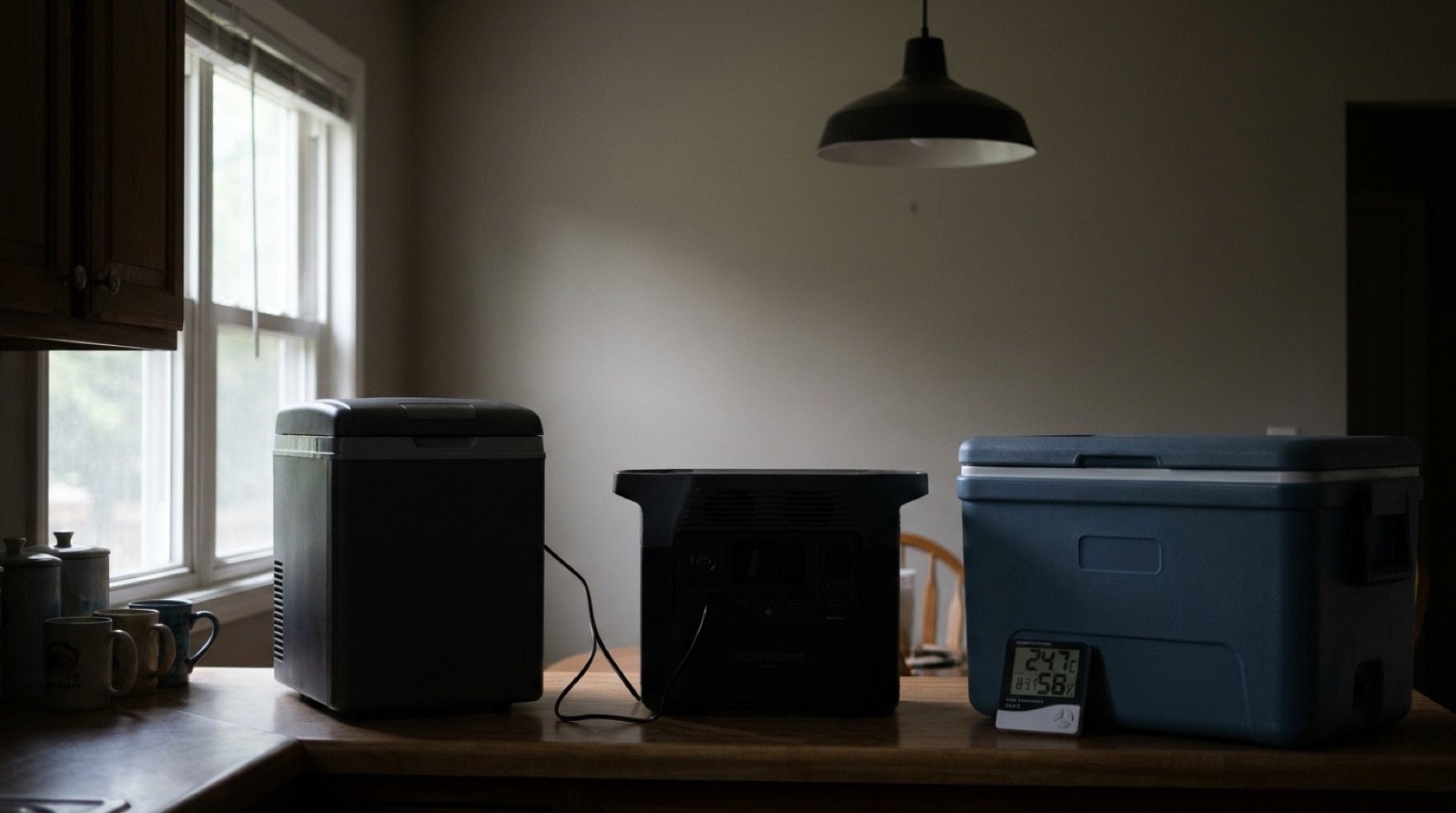
Short answer: Keep unopened insulin between 36°F and 46°F and never let it freeze. Under FDA emergency guidance, insulin can stay unrefrigerated between 59°F and 86°F for up to 28 days and still be used. A closed refrigerator holds a safe temperature for about 4 hours, and after that a cooler with wrapped ice packs or a 12V compressor cooler works well. A compressor cooler averages about 20 W, so a 1,000 Wh power station runs it for roughly 1.5 to 2 days.
The good news is that insulin is tougher than most people fear in the first hours of an outage. The real dangers are heat above 86°F and freezing, and both are easy to prevent if you know the limits and have a plan ready before the lights go out.
The Temperature Limits That Matter
Every insulin product has storage instructions on its package insert, and those instructions always win. The general rules below match the labels of most insulins sold in the US and the FDA’s guidance for emergencies.
| Storage condition | Safe range | How long | Notes |
|---|---|---|---|
| Unopened, refrigerated | 36°F to 46°F | Until the printed expiration date | The normal home storage condition |
| Unopened or in use, room temperature | 59°F to 86°F | Typically 28 days, some products longer | Count from the day it left the fridge, check your label |
| Above 86°F | Too warm | Minimize every hour | Potency drops faster as heat rises |
| 32°F or below | Frozen | Never acceptable | Discard, even after it thaws |
| Direct sun or a closed car | Can exceed 120°F quickly | Never acceptable | Treat as compromised |
Two practical points come out of this table. First, in a mild-weather outage you are not in an emergency at hour five, because insulin at 70°F is fine for weeks. Second, the room-temperature clock starts once and does not reset. If a vial spends 10 days out of the fridge and then goes back in, it has only 18 days of room-temperature life left on a 28-day label.
Write the date on every pen or vial the moment it leaves the refrigerator. A permanent marker and a strip of tape is all you need, and it removes the guesswork later.
What Happens in the First Hours of an Outage
USDA guidance says a closed refrigerator keeps food safe for about 4 hours, and a full freezer holds for about 48 hours. Your medication shelf follows the same physics. If the house is comfortable and the fridge stays shut, your insulin is in no danger during a short outage.
The decision point comes when the outage looks likely to last more than about 4 hours, or when the indoor temperature is heading past 80°F. At that point, move medications to a dedicated cooling setup so you are not opening the main fridge over and over. Each opening dumps cold air and shortens the safe window for both food and medicine. For the food side of that decision, see the fridge and freezer food safety guide.
Winter outages flip the risk. A house without heat can drop near freezing, and a car or unheated garage can go well below it. In cold weather, keep insulin in an interior room, close to your body or in an insulated bag, and never next to a window or exterior wall.
Other Medications That Need Cold Storage
Insulin gets the attention, but many households have other refrigerated medications. Common categories include:
- GLP-1 and other injectable diabetes or weight medications in pen form
- Biologic injections for conditions such as rheumatoid arthritis, psoriasis or Crohn’s disease
- Some fertility medications
- Some liquid antibiotics after the pharmacy mixes them
- Certain eye drops and some vaccines kept at home
Room-temperature limits for these vary widely. Some tolerate several weeks out of the fridge, others only days or hours. Read the package insert now, before an outage, and write the room-temperature limit on a card you keep with your emergency kit. If the insert is unclear, your pharmacist can tell you in a two-minute phone call.
One firm rule: FDA guidance says medications that have touched floodwater should be discarded, because contaminated water can seep into packaging. If a needed medication got wet in a flood and you have no replacement yet, call your pharmacist or doctor right away for advice.
Cooling Options Compared
You have several ways to hold the 36°F to 46°F range without grid power. They differ in how long they last, how much power they need and how likely they are to freeze your medication by accident.
| Option | Power needed | Holds fridge range for | Freeze risk | Best use |
|---|---|---|---|---|
| Closed home refrigerator | None | About 4 hours | Low | Short outages |
| Hard cooler with wrapped ice packs | None | About 1 to 2 days, longer with fresh ice | High if insulin touches ice | 1 to 3 day outages |
| Evaporative cooling wallet | None (soak in water) | Keeps below room temperature, not fridge cold | None | In-use pens, travel, evacuation |
| 12V compressor cooler on a power station | 40 to 60 W running, about 20 W average | As long as power lasts | Low when set to 38°F to 40°F | Multi-day outages |
| Thermoelectric cooler | 40 to 60 W continuous | Only cools about 35°F to 40°F below room temperature | Low | Not reliable in summer heat |
| Compact dorm fridge on an inverter | 70 to 100 W running | As long as power lasts | Moderate near the cooling plate | Larger medication supplies |
The thermoelectric cooler deserves a warning. It has no thermostat in most cases and simply cools relative to the air around it. In a 90°F house, it may only reach 50°F to 55°F, which is above the fridge range. A compressor cooler works like a real refrigerator, holds a set temperature and uses far less energy over a day.
With ice packs, the most common mistake is letting insulin sit directly on the ice. Wrap the packs in a towel, put the insulin in a sealed zip bag, and keep a layer of cloth between them. Frozen insulin is ruined even if it looks normal after thawing.
Sizing a Power Station for a Medication Fridge
A small 12V compressor cooler draws about 40 to 60 W while the compressor runs, but it cycles on and off. In a room around 75°F, a typical average is about 20 W. The daily energy math is simple:
20 W x 24 hours = 480 Wh per day.
A compact dorm-style fridge runs on AC through the power station’s inverter and uses more, typically 500 to 800 Wh per day. This guide uses 700 Wh per day as a conservative figure. Power stations rarely deliver their full rated capacity after conversion losses, so plan on about 85% usable energy. A 1,000 Wh station gives about 1,000 x 0.85 = 850 Wh usable, and 850 / 480 = about 1.8 days on a compressor cooler.
| Station rated capacity | Usable (x 0.85) | 12V compressor cooler (480 Wh/day) | Dorm fridge (700 Wh/day) |
|---|---|---|---|
| 300 Wh | 255 Wh | About 12 hours | About 8 hours |
| 500 Wh | 425 Wh | About 21 hours | About 14 hours |
| 1,000 Wh | 850 Wh | About 1.8 days | About 1.2 days |
| 2,000 Wh | 1,700 Wh | About 3.5 days | About 2.4 days |
| 3,600 Wh | 3,060 Wh | About 6.4 days | About 4.4 days |
Heat changes these numbers. In a 90°F room, the compressor runs much more often, and the daily use can approach double. If you live in a hot climate, size for 800 to 1,000 Wh per day for the cooler alone.
Solar recharging can make the setup last indefinitely. A 200 W panel getting about 4 hours of good sun, at about 75% real-world efficiency, delivers roughly 200 x 4 x 0.75 = 600 Wh per day. That covers a compressor cooler in mild weather with a little to spare. For runtimes with other loads like phones, lights and fans, check the power station runtime chart, and if you are shopping, the best portable power stations for home backup are sized by outage length.
Use the station’s 12V DC car-style outlet for a compressor cooler whenever possible. DC skips the inverter, which wastes energy just by being on, so your runtime improves.
How to Set It Up Correctly
- Buy a digital min/max thermometer. It records the highest and lowest temperatures since you last reset it, which tells you whether the medication ever left the safe range overnight.
- Pre-cool the cooler. Run it for a few hours before moving medication in, so the insulin never rides through a warm-up period.
- Set the thermostat to 38°F to 40°F. This leaves a buffer above freezing and below the 46°F upper limit.
- Keep insulin in the middle. Put it in a sealed container away from the walls and the cooling plate, where temperatures swing the most.
- Leave in-use pens at room temperature if the house stays under 86°F. They are already on the room-temperature clock, and keeping them out means fewer openings of the cooler.
- Keep the cooler out of the sun and in the coolest room of the house, which also cuts power use.
- Do not share it with food. Every time someone opens it for a drink, the medication warms up.
- Plan recharging. Know whether you will recharge from solar, a car, or a generator running outdoors at least 20 feet from the home, as the CDC recommends. Never run a fuel engine indoors or in a garage.
If a household member also relies on powered equipment such as an insulin pump, CGM receiver or CPAP, plan the batteries together. Our guide to backup power options for medical devices covers charging and runtime for those.
When to Replace Insulin or Medication
When in doubt, the safe move is to switch to a fresh supply as soon as you can get one and watch your blood sugar closely. Use this checklist.
| What happened | What to do |
|---|---|
| Frozen, even briefly | Discard it |
| Kept at 59°F to 86°F within its labeled days | Keep using, discard at the end of the labeled period |
| Above 86°F for several hours, or left in a hot car | Assume reduced strength, replace as soon as possible, test glucose more often |
| Clear insulin looks cloudy, has particles or crystals | Discard it |
| Cloudy insulin has clumps or a frosted look on the glass | Discard it |
| Touched floodwater | Discard it, call your pharmacist about a replacement |
| Readings run high for no clear reason after an outage | Suspect the insulin, open a fresh vial or pen and contact your care team |
Insulin that has lost potency often looks completely normal, so blood sugar readings are your best signal. Higher than usual numbers on a normal dose after a heat event are a strong reason to switch to new insulin.
Getting Replacements During an Emergency
Many states allow pharmacists to dispense an emergency supply of essential medications during declared emergencies, even without a new prescription. To make that easy:
- Keep a written list of every medication, dose and prescriber, plus a phone photo of each label
- Ask your doctor whether you can keep a small extra supply on hand
- Know the location of a pharmacy outside your immediate area in case local stores are closed
- Ask your utility whether it has a medical priority or life support registry, which can mean earlier notice of planned shutoffs
If you care for a child or an older adult with diabetes, the backup power checklist for babies and elderly parents covers the rest of the household plan.
Bottom line: Insulin handles room temperature up to 86°F for about 28 days, so short outages are rarely a crisis. Your job is to keep it from freezing, keep it from overheating, and give it a stable cold spot for longer outages. A 12V compressor cooler on a 1,000 Wh power station, a min/max thermometer and a labeled date on every pen covers most households for close to two days, and a solar panel can stretch that much longer.
Frequently Asked Questions
How long can insulin go without refrigeration during a power outage?
Under FDA emergency guidance, insulin can be kept between 59°F and 86°F for up to 28 days and still be used. Some products allow longer, so check your package insert. Count the days from when it first left the fridge, and discard it after the labeled period even if it looks fine.
Can I put insulin directly on ice in a cooler?
No. Direct contact with ice or frozen gel packs can freeze insulin, and frozen insulin must be thrown away. Wrap the ice packs in a towel, seal the insulin in a bag, and keep a cloth layer between them. A thermometer inside the cooler helps you confirm it stays between 36°F and 46°F.
What size power station do I need for a medication fridge?
A small 12V compressor cooler uses about 480 Wh per day in a mild room. A 1,000 Wh station gives about 850 Wh usable, which works out to roughly 1.8 days. In hot weather, plan on up to double the daily use, or add a solar panel to recharge during the day.
Is a thermoelectric cooler good enough for insulin?
Usually not in warm weather. Thermoelectric coolers only cool about 35°F to 40°F below the surrounding air, so in a 90°F house they may sit around 50°F to 55°F, above the safe fridge range. A compressor cooler holds a set temperature and uses less energy over a full day.