
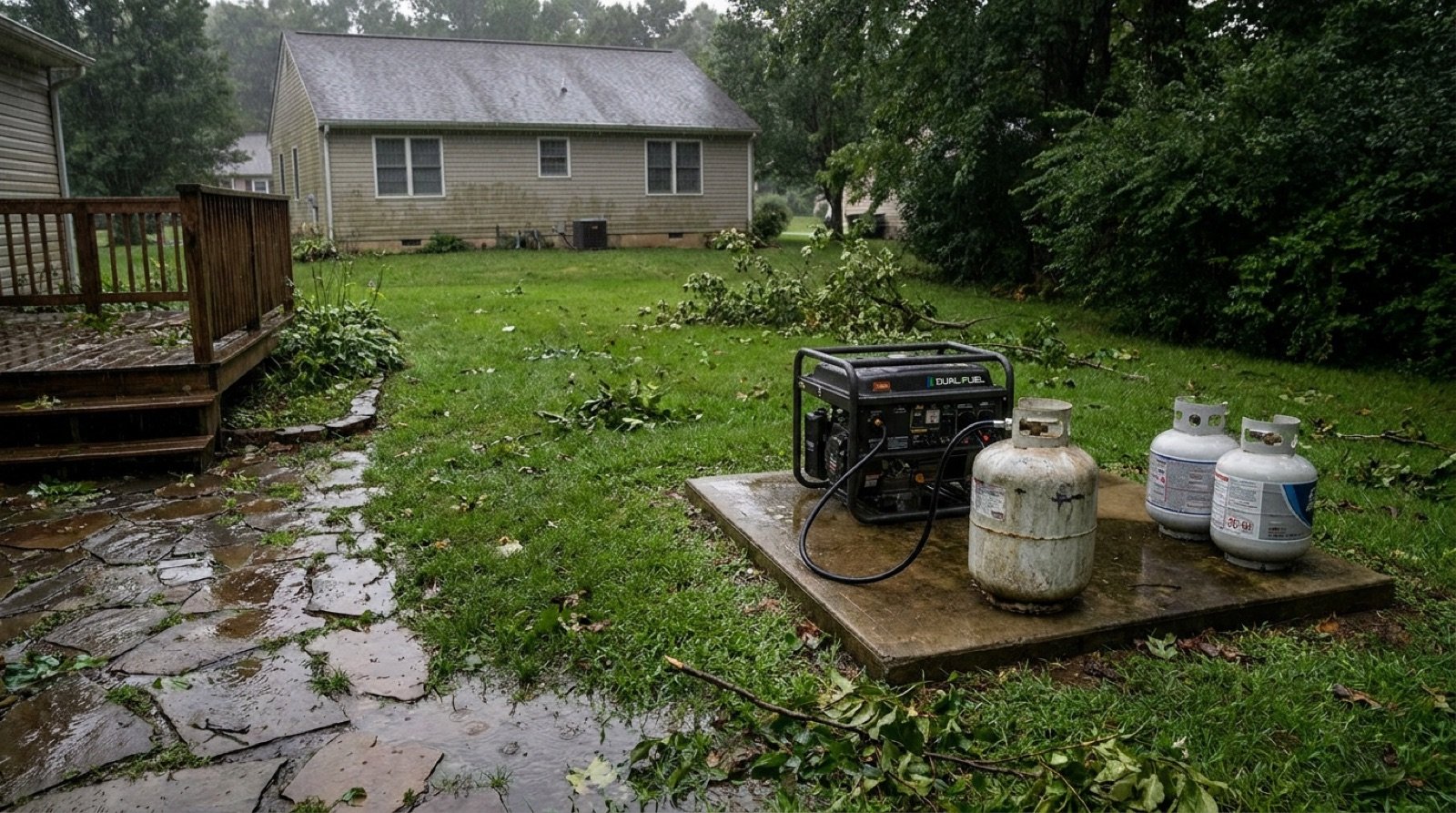
Short answer: A 20 lb propane tank runs a typical 3,500 to 4,500 watt portable generator for about 7 to 12 hours, depending on load. A 100 lb tank stretches that to roughly 35 to 60 hours. A 500 gallon tank (about 400 gallons when the supplier calls it full) runs a 22 kW standby generator for roughly 5 to 10 days at 75% load or less. The math is simple: usable pounds of propane divided by pounds burned per hour.
The figures below are typical, rounded and on the conservative side. Your generator’s manual or spec sheet lists its own propane consumption, and those numbers always win over a general chart. Use this guide to understand the scale of what you need and to plan how many tanks to have on hand before the next outage.
How Much Propane Is Actually in Each Tank
Propane weighs about 4.24 pounds per gallon. Portable cylinders are sold by weight, while large stationary tanks are sold by gallon capacity and only filled to about 80% to leave room for the liquid to expand.
| Tank | Propane when full | Gallons | The arithmetic |
|---|---|---|---|
| 20 lb (grill tank) | 20 lb | About 4.7 gal | 20 lb ÷ 4.24 = 4.7 gal |
| 30 lb | 30 lb | About 7.1 gal | 30 lb ÷ 4.24 = 7.1 gal |
| 100 lb | 100 lb | About 23.6 gal | 100 lb ÷ 4.24 = 23.6 gal |
| 500 gal stationary | About 1,700 lb | About 400 gal | 500 gal x 0.80 = 400 gal; 400 x 4.24 = 1,696 lb |
Two real-world details shrink these numbers. First, many tank exchange programs fill cylinders to about 15 lb rather than 20 lb, so check the label. A 15 lb fill gives you 25% less runtime than the charts below. Second, a generator often starts to sag or surge before a cylinder is completely empty, especially in cold weather. Plan on using about 90% of what the label says.
How Much Propane a Generator Burns at 25, 50 and 75% Load
Load is the share of the generator’s running watts you are actually using. If a generator is rated at 4,000 running watts on propane and you are drawing 1,000 watts, you are at 25% load. At 2,000 watts you are at 50%. If you need help adding up your appliances, the guide on how to calculate what size generator you need walks through it.
Fuel burn does not scale neatly with load. A generator spinning at full speed to make 1,000 watts still burns a lot of fuel just to keep the engine turning. Conventional open-frame generators run at a fixed speed, so they waste the most at light loads. Inverter generators throttle down when demand drops, which is why they come out far ahead at 25% load.
| Generator type (propane rating) | 25% load | 50% load | 75% load |
|---|---|---|---|
| 2,000 to 2,500 W inverter | 0.6 lb/hr | 0.9 lb/hr | 1.2 lb/hr |
| About 4,500 W inverter (dual fuel) | 1.0 lb/hr | 1.6 lb/hr | 2.2 lb/hr |
| 3,500 to 4,500 W conventional (dual fuel) | 1.6 lb/hr | 2.2 lb/hr | 2.8 lb/hr |
| 7,500 to 9,500 W conventional (dual fuel) | 2.8 lb/hr | 3.8 lb/hr | 5.0 lb/hr |
Keep in mind that most dual fuel generators produce roughly 10% fewer watts on propane than on gasoline. If the sticker says 4,000 running watts on gas, assume closer to 3,600 on propane when you calculate your load percentage.
Runtime by Tank Size: The Full Chart
Runtime is just tank contents divided by burn rate. For example, a 3,500 to 4,500 watt conventional generator at 50% load burns about 2.2 lb per hour, so a 20 lb tank lasts 20 ÷ 2.2 = about 9 hours. A 100 lb tank at the same load lasts 100 ÷ 2.2 = about 45 hours.
| Generator and tank | 25% load | 50% load | 75% load |
|---|---|---|---|
| 2,000 to 2,500 W inverter | |||
| 20 lb tank | 33 hr | 22 hr | 17 hr |
| 30 lb tank | 50 hr | 33 hr | 25 hr |
| 100 lb tank | 165 hr | 110 hr | 83 hr |
| About 4,500 W inverter | |||
| 20 lb tank | 20 hr | 12 hr | 9 hr |
| 30 lb tank | 30 hr | 19 hr | 14 hr |
| 100 lb tank | 100 hr | 62 hr | 45 hr |
| 3,500 to 4,500 W conventional | |||
| 20 lb tank | 12 hr | 9 hr | 7 hr |
| 30 lb tank | 19 hr | 14 hr | 11 hr |
| 100 lb tank | 62 hr | 45 hr | 36 hr |
| 7,500 to 9,500 W conventional | |||
| 20 lb tank | 7 hr | 5 hr | 4 hr |
| 30 lb tank | 11 hr | 8 hr | 6 hr |
| 100 lb tank | 36 hr | 26 hr | 20 hr |
These hours assume a full tank by weight. Take off about 10% for the propane you will not be able to use, and 25% more if you are using a 15 lb exchange cylinder. If you want to compare these numbers with gasoline, see how long a portable generator runs on a tank of gas.
Standby Generators and 500 Gallon Tanks
Home standby generators are usually rated in gallons per hour rather than pounds, and they burn much more fuel because they are much bigger. A 22 kW air-cooled standby unit on propane typically burns somewhere around 1.6 gallons per hour at 25% load, 2.5 at 50% and 3.2 at 75%. Check your unit’s spec sheet, since figures vary by brand and engine.
| 22 kW standby load | Typical burn | Hours on 400 gal | Days on 400 gal |
|---|---|---|---|
| 25% | 1.6 gal/hr | 400 ÷ 1.6 = 250 hr | About 10 days |
| 50% | 2.5 gal/hr | 400 ÷ 2.5 = 160 hr | About 6.5 days |
| 75% | 3.2 gal/hr | 400 ÷ 3.2 = 125 hr | About 5 days |
Those numbers start from a full fill, which is rarely where the tank sits when a storm hits. Many propane suppliers recommend refilling before the tank drops to about 20%. If you start at 80% and stop at 20%, you have 300 usable gallons, which cuts each runtime above by a quarter. At 50% load that is 300 ÷ 2.5 = 120 hours, or 5 days.
Most whole-house loads average well under 50% once the air conditioner or well pump stops cycling, so real outages often land toward the longer end. A smaller 10 to 14 kW standby unit burns roughly half to two-thirds as much, so the same tank lasts proportionally longer. Remember that the weekly exercise run also uses a little fuel every month of the year.
Installing or piping a stationary tank to a standby generator is not a DIY job. The gas line must be sized and installed by a licensed plumber or gas fitter, usually coordinated with your propane supplier, and the electrical side and transfer switch must be installed by a licensed electrician with the required permits.
Cold Weather: Why a Small Tank Can Quit Before It Is Empty
A propane tank does not deliver liquid to the generator. It delivers vapor, and liquid propane only boils into vapor as fast as the tank can absorb heat from the surrounding air. In cold weather, or when a large generator pulls hard, a small tank cannot keep up. Pressure falls, the generator loses power or surges, and you may see frost forming on the outside of the cylinder at the liquid level.
A 20 lb tank is the most likely to struggle, especially feeding a 7,500 watt or larger generator in freezing temperatures. A 100 lb cylinder has far more surface area and handles high draw and cold much better. Practical fixes:
- Use a 100 lb cylinder for large generators or long winter outages.
- Keep the tank off snow and frozen ground, out of drifts, and upright.
- Use only the hose and regulator approved by the generator manufacturer.
- Never warm a tank with a flame, heater or heat gun, and never bring a cylinder indoors to warm it up.
Worked Example: Planning Fuel for a 3 Day and 7 Day Outage
Say you want to keep a refrigerator, a chest freezer, lights, phone chargers and internet running. That averages around 1,000 to 1,500 watts with compressors cycling. On a 4,000 watt conventional dual fuel generator, that is roughly 30 to 40% load. Use the 50% figure of 2.2 lb per hour to stay conservative.
Running around the clock: 2.2 lb x 24 hours = about 53 lb per day. Three days is 53 x 3 = 159 lb, which is eight 20 lb tanks or one 100 lb tank plus three 20 lb tanks.
You do not need to run around the clock. The USDA says a closed refrigerator keeps food safe for about 4 hours, and a full freezer holds for about 48 hours. Running the generator in blocks with the doors kept shut cuts fuel in half.
| Schedule (4,000 W conventional, about 2.2 lb/hr) | Hours per day | Propane per day | 3 days | 7 days |
|---|---|---|---|---|
| Continuous | 24 | 53 lb | 159 lb | 370 lb |
| 3 hours on, 3 hours off | 12 | 26 lb | 79 lb | 185 lb |
| Same loads, 2,000 to 2,500 W inverter at 0.9 lb/hr, 12 hr | 12 | 11 lb | 32 lb | 76 lb |
The last row is the lesson. If your essential loads fit on a smaller inverter generator, the same 7 day outage needs about 76 lb of propane instead of 185 lb. That is one 100 lb tank instead of nine or ten 20 lb cylinders. Our roundup of the best dual-fuel generators for home backup covers both inverter and conventional options by size.
How to Make Your Propane Last Longer
- Right-size the generator. A big generator at light load burns far more per useful watt than a smaller one working harder.
- Run in blocks. Cool the fridge and freezer, charge everything, pump water, then shut down.
- Stagger big loads. Avoid running the microwave, well pump and space heater at the same time so you stay in a lower load band.
- Weigh your tanks. The tare weight (TW) is stamped on the collar. Full weight minus tare equals propane left.
- Fill before the season. Propane does not go stale like gasoline, so tanks can sit full for years. Cylinders generally need requalification 12 years after the date stamped on the collar before they can be refilled.
- Store tanks correctly. Keep cylinders outdoors, upright, shaded and away from ignition sources. See how to safely store generator fuel at home.
Safety Rules That Do Not Change With Fuel Type
Propane burns cleaner than gasoline, but it still produces deadly carbon monoxide. The CDC says to run generators at least 20 feet from the home, with the exhaust pointed away from windows, doors and vents. Never run a generator indoors, in a garage, a basement or a crawl space, even with the door open. Install battery-powered CO alarms on every level. Our guide to generator carbon monoxide safety covers placement in detail.
Check every hose connection with soapy water before starting. Bubbles mean a leak: shut the valve and fix it before going further. Close the tank valve when the generator is off. To power house circuits, have a licensed electrician install a transfer switch or interlock. Never backfeed through a dryer outlet or any other receptacle, because it can electrocute utility workers and start fires.
Bottom line: Divide usable pounds by pounds per hour and you have your runtime. A 20 lb tank is good for an evening, a 100 lb tank covers a couple of days, and a 500 gallon tank covers about a week of standby power. The biggest savings come from matching generator size to your real load and running in blocks instead of around the clock.
Frequently Asked Questions
Does a generator run longer on propane or gasoline?
Per gallon, propane has about 25% less energy than gasoline, so a gallon of propane gives you less runtime. Dual fuel generators also typically make about 10% fewer watts on propane. Propane’s advantages are long storage life and the ability to hook up large tanks, which easily outlast a gasoline tank.
Can I connect a 100 lb tank to a portable generator?
Yes, if the generator is built for propane and you use a hose and regulator approved by the manufacturer. A full 100 lb cylinder weighs roughly 170 lb, so plan how you will move it and always keep it upright and secured. Set it up outdoors on level ground, away from the exhaust.
How can I tell how much propane is left in a 20 lb tank?
Weigh it on a bathroom scale and subtract the tare weight stamped on the collar, which is usually around 17 lb. A tank that weighs 27 lb has about 10 lb of propane left, roughly half. Weighing is more reliable than most inline gauges.
How often will I need a refill on a 500 gallon tank during an outage?
Starting from a full fill of about 400 gallons, a 22 kW standby generator at half load uses about 2.5 gallons per hour, which comes to about 6.5 days. Suppliers often cannot deliver during or right after a major storm, so ask for a fill before storm season and consider automatic delivery.