
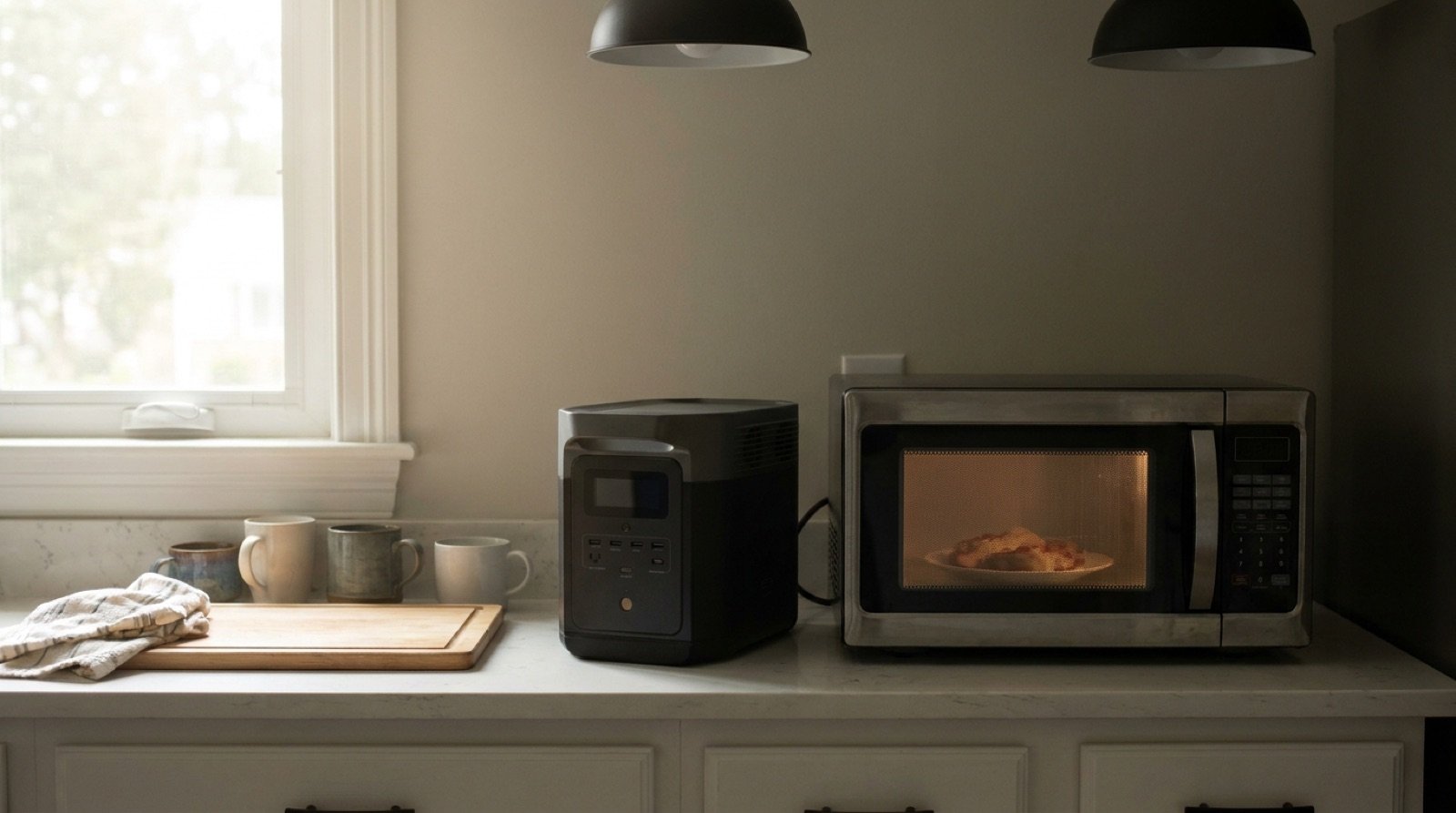
Short answer: Yes, if the inverter is big enough. A microwave sold as 1,000 watts usually pulls about 1,500 watts from the outlet, so most full-size models need a station with at least an 1,800 W continuous inverter, while a compact 700 W unit needs about 1,300 W. Each minute at a 1,500 W draw uses 25 Wh at the plug (about 29 Wh from the battery), so a 1,000 Wh station gives roughly 30 to 35 minutes of total cooking time.
The Number on the Box Is Not the Number That Matters
When a microwave is advertised as 700, 900 or 1,100 watts, that figure is cooking output: the microwave energy that reaches the food. It is not what the appliance pulls from the wall. The magnetron, transformer, cooling fan, turntable motor and light all add overhead, and the conversion from wall power to microwave energy is typically only about 60 to 70 percent efficient.
A simple rule of thumb: divide the cooking output by 0.65 to estimate the real input watts.
- 700 W output / 0.65 = about 1,080 W input
- 1,000 W output / 0.65 = about 1,540 W input
- 1,200 W output / 0.65 = about 1,850 W input
Your power station only cares about input watts. Size it to the number on the box and you will undersize it by roughly half.
How to Find Your Microwave’s Real Input
Open the door and look at the label on the frame, or check the back panel or the owner’s manual. Look for a line that says input power, or a rating such as 120 V AC, 60 Hz, 13 A. If it lists amps instead of watts, multiply:
- 120 V x 13 A = 1,560 W input
- 120 V x 10 A = 1,200 W input
Write the input number down and keep it with your outage notes. For a wider list of appliance draws, see this guide to how many watts common appliances really use.
Typical Output vs Input Watts
| Advertised cooking output | Typical microwave type | Typical input draw |
|---|---|---|
| 600 to 700 W | Compact, dorm or RV size | 950 to 1,100 W |
| 800 to 900 W | Small countertop | 1,200 to 1,400 W |
| 1,000 to 1,100 W | Mid-size and full-size countertop | 1,450 to 1,650 W |
| 1,200 to 1,250 W | Large countertop | 1,700 to 1,850 W |
| 1,000 W (over-the-range) | Built-in with vent fan and lights | 1,500 to 1,700 W |
These are rounded typical figures. Your own label always wins.
What Inverter Size You Need
A power station has two ratings that matter: battery capacity in watt-hours (Wh), which decides how long it runs, and inverter output in watts (W), which decides whether it can run the microwave at all. For a microwave, the inverter is the gatekeeper.
Plan for a continuous inverter rating at least 20 percent above the microwave’s input draw:
- 1,080 W input x 1.2 = about 1,300 W inverter (compact microwave)
- 1,540 W input x 1.2 = about 1,850 W inverter (typical 1,000 W microwave)
- 1,850 W input x 1.2 = about 2,200 W inverter (large 1,200 W microwave)
Why the headroom?
- Startup inrush. A conventional microwave has a heavy transformer that pulls a brief spike when it switches on. A station running near its limit may trip on that spike.
- Heat. An inverter working at 95 percent of its rating for a five-minute cook gets hot and may shut down on thermal protection.
- Voltage sag. As the battery drains, the inverter pulls more current to deliver the same watts. A load that runs fine at 90 percent charge can trip at 15 percent.
Surge, Waveform and Boost Modes
Most stations list a surge or peak figure, often 1.5 to 2 times the continuous rating. Surge helps the microwave through its first fraction of a second, but it cannot carry the cooking load. Size by the continuous number.
Nearly every modern power station uses a pure sine wave inverter, which is what a microwave needs. Older modified sine inverters can make microwaves buzz and heat poorly. Some stations also offer a voltage-reduction mode for running loads above the inverter rating. These modes are designed for simple resistive heaters such as kettles, and a microwave may run slowly or not start in that mode, so do not count on it to rescue an undersized station.
One more detail: a conventional microwave at power level 5 still cycles full power on and off, so the station sees the full 1,500 W peak. Microwaves built with inverter cooking technology actually lower their draw at low settings and start more gently, which is easier on a station near its limit.
Which Station Sizes Work
Cooking minutes below assume a typical 1,500 W draw and about 85 percent of rated capacity available as AC power after inverter losses.
| Station class | Typical inverter | What it can run | Total cooking minutes at 1,500 W |
|---|---|---|---|
| 250 to 500 Wh | 300 to 600 W | No microwave | Not applicable |
| 500 to 800 Wh | 800 to 1,000 W | Not reliable; even small compacts may trip it | Not applicable |
| 1,000 to 1,500 Wh | 1,500 to 1,800 W | Compact and small countertop; a 1,000 W model only with an 1,800 W inverter | About 34 to 51 |
| 2,000 to 2,500 Wh | 2,200 to 2,400 W | Nearly any countertop up to about 1,200 W output | About 68 to 85 |
| 3,000 to 3,600 Wh | 3,000 W or more | Any countertop, with room for a second load | About 102 to 122 |
The math: rated Wh x 0.85 = usable AC Wh, then usable Wh / 25 Wh per minute. For example, 1,000 Wh x 0.85 = 850 Wh, and 850 / 25 = 34 minutes. A 2,000 Wh station gives 1,700 / 25 = 68 minutes.
When shopping, compare inverter ratings first and capacity second. Our picks for the best portable power stations for home backup are grouped by outage length, which makes it easier to spot the ones with headroom for kitchen loads.
How Much Battery Each Microwave Job Uses
At a 1,500 W draw, one minute of cooking uses 1,500 W x 1/60 hour = 25 Wh at the outlet. Divide by 0.85 for inverter losses and you get about 29 Wh from the battery per minute.
| Task | Typical time | Battery used (minutes x 29 Wh) |
|---|---|---|
| Reheat a cup of coffee | 1 minute | About 30 Wh |
| Heat a mug of water for tea or oatmeal | 2 minutes | About 60 Wh |
| Reheat a plate of leftovers | 2.5 minutes | About 75 Wh |
| Bowl of soup or a bag of popcorn | 3 minutes | About 90 Wh |
| Frozen dinner | 5 minutes | About 145 Wh |
| Baked potato | 7 minutes | About 205 Wh |
Times vary with the microwave and the amount of food, so treat these as planning numbers. For other household devices on the same station sizes, see the power station runtime chart for 16 devices.
A Realistic Outage Day
Say you microwave breakfast for 2 minutes, lunch for 3, dinner for 5 and reheat coffee twice at 1 minute each. That is 12 minutes total, and 12 x 29 Wh = about 350 Wh per day.
On a 1,000 Wh station, that is about a third of a full charge. The same battery is probably also keeping your refrigerator cold, and a typical modern fridge often uses roughly 1 to 2 kWh per day. If you plan to do both, read how long a power station will run a refrigerator before deciding how many microwave minutes you can afford.
The microwave is a big load but a short one. A few minutes per meal is very manageable. Cooking whole meals from raw every day is where battery budgets fall apart.
How to Run a Microwave Without Tripping the Station
- Check the label first. Compare input watts with the station’s continuous rating before the outage, not during it.
- Plug directly into the station. Skip power strips. If you need distance, use a short, heavy-gauge extension cord (14 gauge or thicker) rated for the load.
- Turn off other big loads. Do not run a space heater, kettle, coffee maker or window AC on the same station while the microwave runs. Small loads like a router or phone charger are usually fine if the total stays under the inverter rating.
- Cook with a healthy charge. Run the microwave when the battery is above roughly 25 to 30 percent to avoid sag-related trips.
- Give the station air. Keep its vents clear and away from the microwave’s exhaust. Heat is a common reason a station shuts off mid-cook.
- Cook in shorter bursts. Two 2-minute runs with a stir in between are gentler on a borderline inverter than one 4-minute run, and food heats more evenly.
Over-the-Range Microwaves
Over-the-range units usually plug into an outlet inside the cabinet above, so connecting a station by cord is awkward but possible. Powering that kitchen circuit from the station is a different job: it requires a transfer switch or power inlet installed by a licensed electrician. Never backfeed power through a dryer outlet or any other receptacle. It can energize utility lines, endanger line workers and start fires inside your walls. For charging, heat and storage guidance, see our article on portable power station safety.
Is a Microwave a Smart Use of Battery Power?
For quick reheating, yes. A microwave puts its energy directly into the food, so warming leftovers for 2.5 minutes uses far less energy than heating an electric oven or burner. It is one of the better ways to get a hot meal from a battery.
It gets wasteful on long jobs: batches of potatoes, defrosting large cuts of meat or cooking rice from dry. During a multi-day outage, save the microwave for reheats and use other methods for heavier cooking. Our guide on how to cook without electricity during a power outage covers the safe options. Camp stoves and grills belong outdoors only, never indoors or in a garage, and any generator must sit at least 20 feet from the home, as the CDC advises.
Bottom line: Ignore the cooking watts on the box and read the input watts on the label. Most 1,000 W microwaves draw about 1,500 W, so look for an 1,800 W or larger continuous inverter and budget about 29 Wh of battery per minute of cooking. A 1,000 Wh class station handles a few quick reheats a day, and a 2,000 Wh class station runs a full-size microwave comfortably.
Frequently Asked Questions
Can a 500 Wh power station run a microwave?
Usually not. Stations in that class typically have 300 to 600 W inverters, and even a compact 700 W microwave draws about 1,000 W or more. The station will refuse the load or shut down within seconds.
Does using a lower power setting save battery?
Not much. On a conventional microwave, lower settings cycle full power on and off, so food takes longer and total energy is similar. An inverter-type microwave lowers its actual draw, which is easier on the station, but heating the same food still takes roughly the same energy.
Can I run a microwave and a refrigerator at the same time on one station?
Only if the combined draw stays under the continuous inverter rating with some headroom. A 1,500 W microwave plus a fridge running around 150 W, which surges higher at compressor startup, calls for roughly a 2,000 W inverter or more. On smaller stations, unplug the fridge for the few minutes you cook, then plug it back in.
How many times can a 1,000 Wh station reheat a meal?
A typical 2.5-minute reheat at 1,500 W uses about 75 Wh from the battery. With about 850 Wh usable, that is roughly 11 reheats on a full charge if nothing else is plugged in (850 / 75 = about 11). In practice you will share that energy with lights, phones and the fridge, so plan on fewer.