
This post contains affiliate links. If you buy through them, we may earn a commission at no extra cost to you.
Short answer: for a 1 to 2kWh power station, a 200-watt folding panel is the practical sweet spot. It produces 0.8 to 1.2kWh on a sunny day, enough to run a refrigerator, lights, and phones indefinitely during an outage. Buy a panel that matches your power station’s maximum solar input voltage and wattage, choose a rigid or semi-rigid folding design over a flexible one for backup use, and get an MC4 connector with the right adapter for your brand. A 100-watt panel is fine for a 500Wh unit; a 4kWh unit deserves 400 watts or more.
Quick Picks by Power Station Size
| Power Station Capacity | Recommended Panel | Typical Daily Harvest (sunny) | Full Recharge Time |
|---|---|---|---|
| 256-512Wh | 100W folding | 0.4-0.6kWh | 1 day |
| 768-1,200Wh | 200W folding | 0.8-1.2kWh | 1 day |
| 2,000Wh | 2 × 200W or 1 × 400W | 1.6-2.4kWh | 1 day |
| 3,600-4,000Wh | 400-800W (2 to 4 panels) | 2.5-5kWh | 1-2 days |
“Typical daily harvest” assumes 5 to 6 peak-sun hours with the panel manually re-aimed twice a day. Overcast conditions cut output by 50 to 80 percent. We measured how much angle and tracking matter in our test of solar panel positioning for power stations.
What “Solar Generator” Panels Actually Deliver
A panel’s rated wattage is measured in a lab at 1,000 watts per square meter of sunlight and 77°F. In a backyard, expect 60 to 80 percent of that rating at midday in summer, and less in winter or heat. A “200W” panel usually delivers 130 to 160 watts at its best moment and averages far less across the day. This is not a scam; it is physics, and every brand’s panels behave the same way. The takeaway: buy about 25 percent more panel wattage than the math says you need.
Compatibility: The Three Numbers That Have to Match
Before buying any panel, find these three specs on your power station:
- Maximum solar input wattage. The unit will not accept more than this. A 200W panel on a unit with a 100W limit produces 100W. Fine, but wasteful.
- Solar input voltage range. Typically something like 12 to 60V. A panel’s open-circuit voltage (Voc) must stay under the upper limit, including on cold mornings when Voc rises. Two panels wired in series double the voltage; in parallel they double the current. Exceeding the voltage limit can damage the charge controller.
- Connector type. Most panels use MC4 connectors. Power stations use XT60, Anderson, DC8020 barrel, or proprietary plugs. Adapters exist for all of them, but buy the right one with the panel.
A quick reference for popular units:
| Power Station | Max Solar Input | Voltage Range | Input Connector |
|---|---|---|---|
| EcoFlow River 2 Pro | 220W | 11-50V | XT60 |
| Jackery Explorer 1000 v2 | 400W | 12-60V | DC8020 |
| Bluetti AC180 | 500W | 12-60V | DC7909 / Aviation |
| Anker SOLIX C1000 | 600W | 11-60V | XT60 |
| EcoFlow Delta 2 Max | 1,000W (dual ports) | 11-60V | XT60 × 2 |
| EcoFlow Delta Pro 3 | 2,600W | 30-150V (high) / 11-60V (low) | MC4 / XT60 |
Specs change between revisions; confirm against the manual for your exact model before wiring panels in series.
The Best Solar Panels for Portable Power Stations
1. 200W Folding Panel: The Best All-Round Choice
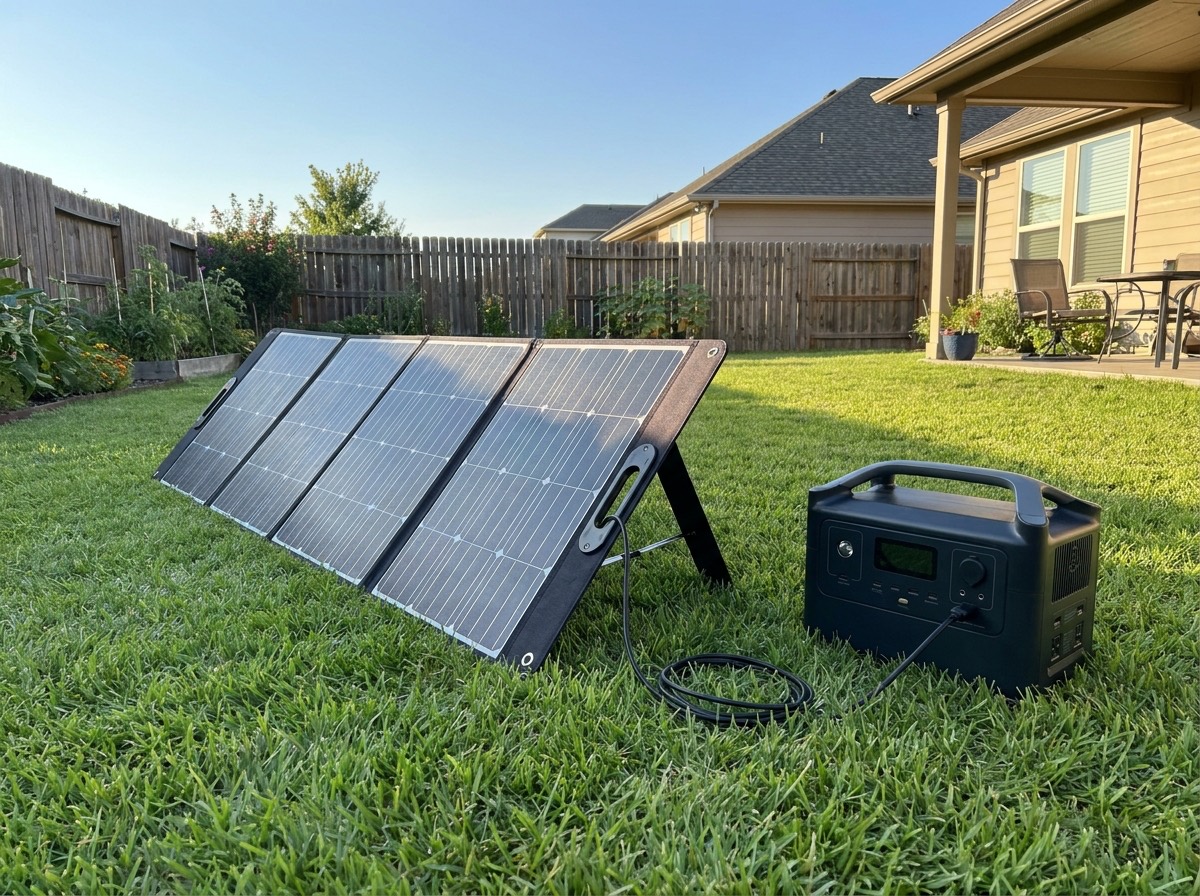
A 200-watt folding panel with a kickstand is the panel most households should own. Folded, it is the size of a large briefcase and weighs 15 to 20 pounds. Unfolded, it is four panels wide and produces enough on a sunny day to keep a 1 to 2kWh power station topped up while running the essentials. Look for monocrystalline cells (higher efficiency than polycrystalline), an IP67 or IP68 rating for the panel face, an ETFE surface coating (more durable than PET), and a built-in charge-tracking display on newer models. Brand-name panels from EcoFlow, Bluetti, Jackery, and Anker cost more than generic ones, mostly for the connector convenience and warranty; the cells inside are often from the same handful of manufacturers.
Check the current price of 200W folding solar panels on Amazon
2. 100W Folding Panel: Best for Small Units and Portability
For a 256 to 512Wh unit, 100 watts is the right match. It weighs under 10 pounds, fits in a backpack, and fully recharges a small station in a day of sun. It is also the panel to keep in a car for charging phones and a small battery on the road. For home backup with a 1kWh or larger station, it is too small; you would spend all day waiting.
Check the current price of 100W folding solar panels on Amazon
3. 400W Folding Panel: Best for 2kWh and Larger Units
A single 400-watt folding panel is heavy (30 to 40 pounds) and large (over 7 feet wide unfolded), but it produces 2kWh or more on a good day, which is what a Delta 2 Max class unit needs to stay full while running a household. Two 200-watt panels in parallel do the same job and are easier to move and aim, at a similar total price. Buy the 400 if you have a permanent sunny spot; buy two 200s if you will be carrying and repositioning them.
Check the current price of 400W portable solar panels on Amazon
4. Rigid Residential Panels: Best Value per Watt for a Fixed Setup
If the panels will live on a shed roof or a ground rack and never move, standard rigid residential panels cost a third as much per watt as folding ones. A used or surplus 300 to 400-watt panel can be found for well under $200. They are heavy, glass-faced, and not portable, but for a large power station like the Delta Pro 3 with a high-voltage input, two to four rigid panels in series is by far the cheapest way to get 1,000 watts or more of solar. You will need MC4 extension cables and a correctly rated adapter.
Check the current price of rigid 400W solar panels on Amazon
Flexible Panels: Why We Do Not Recommend Them for Backup
Thin flexible panels are appealing because they weigh almost nothing and can be taped to an RV roof. For home backup, three problems: they degrade faster (the cells crack from flexing), they overheat when laid flat on a surface with no airflow and lose 20 to 30 percent of output, and they are usually less efficient per square foot. A folding panel with a kickstand costs a bit more, lasts years longer, and produces more power in the same sun.
Getting the Most From Any Panel
- Aim it. Tilt the panel so the sun hits it square. A panel lying flat in October produces half of what a properly tilted one does. Re-aim at mid-morning, noon, and mid-afternoon.
- Keep it cool. Output drops about 0.4 percent per degree Fahrenheit above 77°F at the cell. Airflow behind the panel helps.
- Avoid partial shade. A shadow across one corner can cut output by half or more, because the cells are wired in series.
- Use short, heavy cables. A 30-foot thin extension cable loses real watts. Buy 10 AWG extensions if you must run far.
- Clean it. Dust and pollen cost 5 to 10 percent. A damp cloth fixes it.
Is Solar Worth It for Home Backup at All?
For outages of a few hours, no. Put the money into a bigger battery. For outages of a day or more, or if you live where hurricanes and ice storms take the grid down for a week, yes. A 200-watt panel and a 2kWh station keep a refrigerator, lights, phones, and a CPAP running for as long as the sun rises, with no fuel, no noise, and no trips to a closed gas station. Our roundup of the best portable power stations for home backup notes the solar input on every unit, and best solar generators for off-grid cabins covers larger permanent setups.
Frequently Asked Questions
Can I use any solar panel with my power station?
Any panel whose open-circuit voltage falls inside the station’s input range and which you can connect with the right adapter. Match voltage first, then wattage, then connector.
How long does a 200W solar panel take to charge a 1,000Wh power station?
About 7 to 9 hours of good sun in practice, since a 200W panel delivers 130 to 160 watts at its best. Plan on one full sunny day.
Do solar panels work on cloudy days?
Yes, at 20 to 50 percent of rated output depending on cloud thickness. A 200W panel might deliver 40 to 80 watts under overcast skies, which still covers a refrigerator’s average draw.
Can I connect two solar panels to one power station?
Yes. In parallel (positive to positive, negative to negative with a Y connector), the voltage stays the same and current doubles. In series, voltage doubles; make sure the combined voltage stays under the station’s limit.
Are brand-name panels better than generic ones?
The cells are often similar. Brand-name panels come with the correct connector and a warranty that matches the power station. Generic panels are cheaper but require the right adapter and a bit more attention to the voltage spec.