
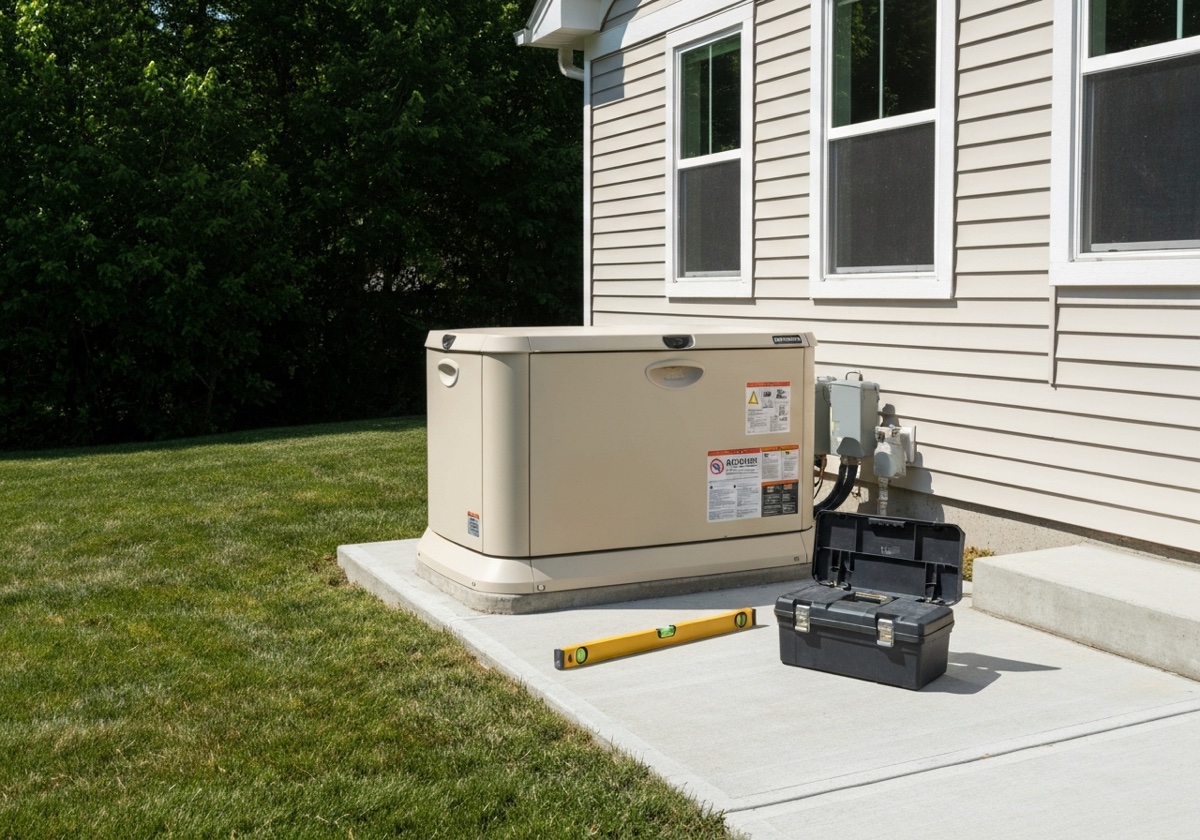
Ask three neighbors what they paid for a whole house generator and you will hear three wildly different numbers: $8,000, $12,000, maybe $16,000. All three can be telling the truth. The generator itself is only about half the bill, and the other half depends on details most homeowners never think about until the estimate lands in their inbox.
This guide breaks down every line item that goes into whole house generator cost in 2026: the unit, the installation, the permits, the fuel, and the maintenance that keeps it running for the next 15 years. By the end, you will be able to read a contractor’s quote and know exactly where the money is going.
Quick Answer: What a Whole House Generator Costs in 2026
- Generator unit alone: roughly $3,000 to $4,000 for a 10kW model, $5,000 to $7,000 for the popular 18-22kW class, and $7,000 to $10,000+ for 26kW and larger.
- Installation: roughly $3,000 to $8,000 on top of the unit, covering the concrete pad, gas line, transfer switch, permits, and electrician labor.
- Total installed cost: most homeowners land between $8,000 and $15,000. Small homes with easy gas access can come in under $8,000; large homes with long gas runs or panel upgrades can exceed $18,000.
- Ongoing costs: around $200 to $500 per year in maintenance, plus fuel during outages (roughly $20 to $60 per day on natural gas for a mid-size unit).
Generator Unit Prices by Size
Standby generators are sized in kilowatts (kW), and price scales with capacity. Here is where the market sits in 2026 for air-cooled home standby units from the major brands (Generac, Kohler, Cummins, Briggs & Stratton, Champion):
| Generator Size | Typical Unit Price | What It Runs |
|---|---|---|
| 10-13kW | roughly $3,000-$4,500 | Essential circuits: fridge, furnace, well pump, lights, and outlets, but usually not central AC |
| 14-16kW | roughly $4,000-$5,500 | Most of a small home, including one smaller AC unit |
| 18-22kW | roughly $5,000-$7,000 | A typical 2,000-3,000 sq ft home, including central AC with load management |
| 24-26kW | roughly $6,500-$9,000 | Larger homes, dual AC systems, fewer compromises |
| 30kW+ (liquid-cooled) | roughly $10,000-$20,000+ | Estate homes, full simultaneous loads, commercial-grade duty |
The 18-22kW class is the sweet spot for a reason. It is the smallest tier that comfortably handles central air conditioning in an average American home, and competition between brands keeps pricing sharp. Most units in this range now ship with a smart load management option, which lets a smaller generator behave like a bigger one (more on that in the cost-saving section below).
Installation Costs: The Half of the Bill Nobody Budgets For
A standby generator is a permanently installed appliance connected to your gas supply and your electrical panel. Installation is skilled, permitted work, and it typically runs $3,000 to $8,000. Here is where that money goes:
- Concrete pad or composite base: roughly $200 to $600. The generator needs a level, code-compliant surface. Many installers use a pre-cast pad; a poured concrete pad costs more.
- Gas line installation: roughly $500 to $2,500. A licensed plumber runs a properly sized natural gas or propane line from your meter or tank to the generator. Distance is the big variable here.
- Automatic transfer switch (ATS): roughly $500 to $1,500 for the hardware if it is not bundled with the generator, plus labor. The ATS is what disconnects your home from the grid and switches to generator power automatically.
- Electrician labor: roughly $1,500 to $3,500. Wiring the ATS into your service panel, running conduit, and connecting the generator is a one to two day job for a licensed electrician.
- Permits and inspections: roughly $100 to $500 depending on your municipality, sometimes more in strict jurisdictions.
- Site prep extras: trenching for gas and electrical runs, landscaping repair, or a propane tank install (roughly $1,500 to $3,500 for a buried 500-gallon tank) if you do not have natural gas service.
Total Installed Cost by Home Size
Putting units and installation together, here are realistic all-in ranges for 2026:
| Home Size | Typical Generator | Total Installed Range |
|---|---|---|
| Under 1,500 sq ft | 10-14kW | roughly $7,000-$10,000 |
| 1,500-2,500 sq ft | 16-20kW | roughly $9,000-$13,000 |
| 2,500-3,500 sq ft | 20-26kW | roughly $11,000-$16,000 |
| 3,500+ sq ft | 26kW+ or liquid-cooled | roughly $15,000-$25,000+ |
These ranges assume a straightforward installation with natural gas available at the house. If your project involves a propane tank, a long trench, or an electrical panel upgrade, expect to land at or above the top of the range. If those totals are more than you planned to spend, our guide to home backup power for every budget lays out cheaper ways to keep the lights on.
Fuel Costs During an Outage
Once installed, a standby generator costs almost nothing to own until the power goes out. Then it starts burning fuel, and the numbers add up faster on propane than on natural gas.
- Natural gas: A 20kW unit at half load burns roughly 200 to 280 cubic feet per hour. At typical 2026 residential rates (around $1.20 to $1.60 per therm in much of the country), that works out to roughly $25 to $45 per 24 hours of runtime. Natural gas has the huge advantage of never running out mid-outage.
- Propane: The same 20kW unit at half load burns roughly 2 to 3 gallons per hour. At around $2.50 to $3.50 per gallon, a full day of runtime costs roughly $120 to $250. A 500-gallon tank (filled to 400 gallons) provides roughly 5 to 7 days of continuous power.
A practical note: your generator rarely runs at full load. Overnight, when the AC cycles off and the house sleeps, fuel burn can drop by half. For budgeting, figure roughly $30 to $60 per day on natural gas and $150 to $250 per day on propane for a mid-size unit powering a whole home. If ongoing fuel costs are a dealbreaker, a whole house battery backup avoids them entirely.
Annual Maintenance: The Cost of Staying Ready
A standby generator is an engine that sits outside in the weather for years, then has to start on the first try at 2 a.m. in an ice storm. Maintenance is not optional.
- Annual service: roughly $200 to $500 per visit. This covers oil and filter changes, spark plugs, valve checks, battery testing, and a load test.
- Service plans: Many dealers offer annual contracts in the $300 to $700 range that bundle scheduled maintenance with priority emergency service. After a major storm, when every generator tech in the county is booked solid, that priority status is worth real money.
- Battery replacement: roughly $100 to $200 every 3 to 4 years. A dead starting battery is the number one reason standby generators fail to start.
- Self-testing: Modern units run a weekly or biweekly self-test automatically, burning a small amount of fuel (a few dollars per month on natural gas).
Over a 15-year life, plan on roughly $4,000 to $8,000 in total maintenance. That sounds like a lot until you compare it against replacing a $12,000 system early because it was neglected.
Permits, Codes, and Why You Cannot Skip Them
Every standby generator installation requires permits, typically an electrical permit, a plumbing or mechanical permit for the gas line, and sometimes a zoning review. Codes govern where the unit can sit: most jurisdictions follow the manufacturer’s listing, which generally requires around 18 inches of clearance from the house wall and 5 feet from windows, doors, and vents (carbon monoxide safety drives these rules). Some HOAs add noise and sightline restrictions on top.
Skipping permits to save $300 is a false economy. Unpermitted generator installs can void your homeowner’s insurance coverage for related damage, complicate a home sale, and in the worst case create a genuine carbon monoxide or backfeed hazard. A generator connected without a proper transfer switch can send power back into utility lines and endanger line workers. Reputable installers pull permits as a matter of course; treat any contractor who suggests otherwise as a red flag.
The Factors That Swing Your Price by Thousands
- Gas line distance: The single biggest wildcard. A generator placed 10 feet from the gas meter might need $500 of gas work. The same generator 80 feet away, across a driveway, might need $2,500 or more in pipe and trenching.
- Gas meter capacity: Many homes have a meter sized for the furnace and water heater only. Adding a 20kW generator may require the utility to upgrade your meter, which is often free but can add weeks to the timeline.
- Electrical panel condition: If your home still has an older 100-amp panel or an outdated fuse box, the electrician may require a panel upgrade first, adding roughly $2,000 to $4,000.
- Placement constraints: Tight lot lines, window clearances, and HOA rules can force the generator into a spot far from both the meter and the panel, raising both gas and electrical costs.
- Regional labor rates: The same installation can cost 30 to 50 percent more in high-cost metro areas than in rural markets.
- Demand timing: Quotes issued the week after a hurricane or ice storm run high, and lead times stretch to months.
Financing Options
Few homeowners write a $12,000 check outright, and there are several sensible ways to spread the cost:
- Dealer financing: Generac, Kohler, and their dealer networks offer installment plans, often 12 to 60 months. Promotional zero-interest periods appear regularly; read the fine print on deferred interest.
- Home equity loan or HELOC: Usually the lowest rate available, and a standby generator is a legitimate home improvement that adds resale value (appraisers commonly credit a meaningful portion of the installed cost).
- Personal loans: Faster to arrange but pricier. Sensible only for smaller balances you can retire quickly.
- Insurance and assistance angles: A generator itself is rarely covered, but some insurers offer premium discounts for homes with standby power, and households with documented medical needs may qualify for state or utility assistance programs. Worth a phone call.
How to Cut the Cost Without Cutting Corners
- Power essential circuits instead of the whole house. A 14kW unit feeding a dedicated subpanel with your furnace, fridge, well pump, and key rooms can shave $3,000 to $5,000 off the project versus full coverage.
- Use load management instead of a bigger generator. Smart load-shedding modules (roughly $100 to $300 per managed circuit) let an 18kW unit handle a home that would otherwise need 24kW, by briefly pausing the water heater or second AC when demand peaks.
- Install in the off-season. Late fall through early spring is slow season in most markets. Dealers discount, and lead times shrink from months to weeks.
- Get three quotes. Installation pricing varies enormously between contractors for identical scope. Make sure every quote itemizes the unit, gas work, electrical, pad, and permits so you can compare honestly.
- Place the unit thoughtfully. If code allows a location near both the gas meter and the electrical panel, you can save over $1,000 in trenching and materials.
Worked Example: 2,500 sq ft Home with an 18kW Generac
Here is a realistic full budget for a common scenario: a 2,500 square foot suburban home with natural gas service, a 200-amp panel in good condition, and the generator placed about 25 feet from the gas meter.
| Line Item | Cost |
|---|---|
| Generac 18kW air-cooled unit | $5,600 |
| 200-amp automatic transfer switch | $1,000 |
| Composite mounting pad | $300 |
| Gas line (25 ft run, licensed plumber) | $1,100 |
| Electrician labor and materials | $2,400 |
| Two load management modules (AC + water heater) | $400 |
| Permits and inspections | $350 |
| Total installed | $11,150 |
Now the ownership math. Add an annual service plan at $350. Over 15 years, that is $5,250 in maintenance, plus roughly $500 in starting batteries. If this home sees an average of three outage days per year at roughly $40 per day in natural gas, fuel adds about $120 per year, or $1,800 over 15 years.
Total 15-year cost of ownership: roughly $18,700, or about $104 per month. That is the honest number to weigh: not the sticker price, but roughly $100 a month for a house that never loses heat, refrigeration, or air conditioning again.
Frequently Asked Questions
Is a whole house generator worth the cost?
It depends on your outage exposure. If you lose power a few times a year for extended stretches, have a well pump, a sump pump, medical equipment, or work from home, the math usually favors it, especially since a standby generator typically returns a meaningful share of its cost at resale. If your outages are rare and brief, a $1,000 portable generator or power station covers the risk for a fraction of the price. Our guide to the best portable generators for home outages covers that route.
Why do installation quotes vary so much for the same generator?
Because the generator is the only fixed cost. Gas line length, trenching, panel condition, permit fees, and local labor rates all differ house to house and market to market. Always request itemized quotes so you can see whether a high bid reflects real site conditions or just padding.
How long does a whole house generator last?
Air-cooled residential units are generally rated for roughly 10,000 to 30,000 engine hours, which translates to 15 to 25 years of typical standby use with proper maintenance. Since most homes log under 100 generator hours per year, maintenance quality and weather exposure usually determine lifespan more than engine wear does.
Can I install a whole house generator myself to save money?
Setting the pad and placing the unit is within reach of a capable DIYer, but the gas connection and transfer switch wiring legally require licensed professionals in virtually every U.S. jurisdiction, and manufacturers commonly void warranties on self-installed units. The realistic DIY savings are small; the risks are not.
Prices in this article are national estimates for planning purposes and vary by region, brand, and site conditions. Generator installation involves gas and electrical work that must be performed by licensed professionals and inspected under local code. Always get itemized quotes from qualified installers before budgeting your project.