
This post contains affiliate links. If you buy through them, we may earn a commission at no extra cost to you.
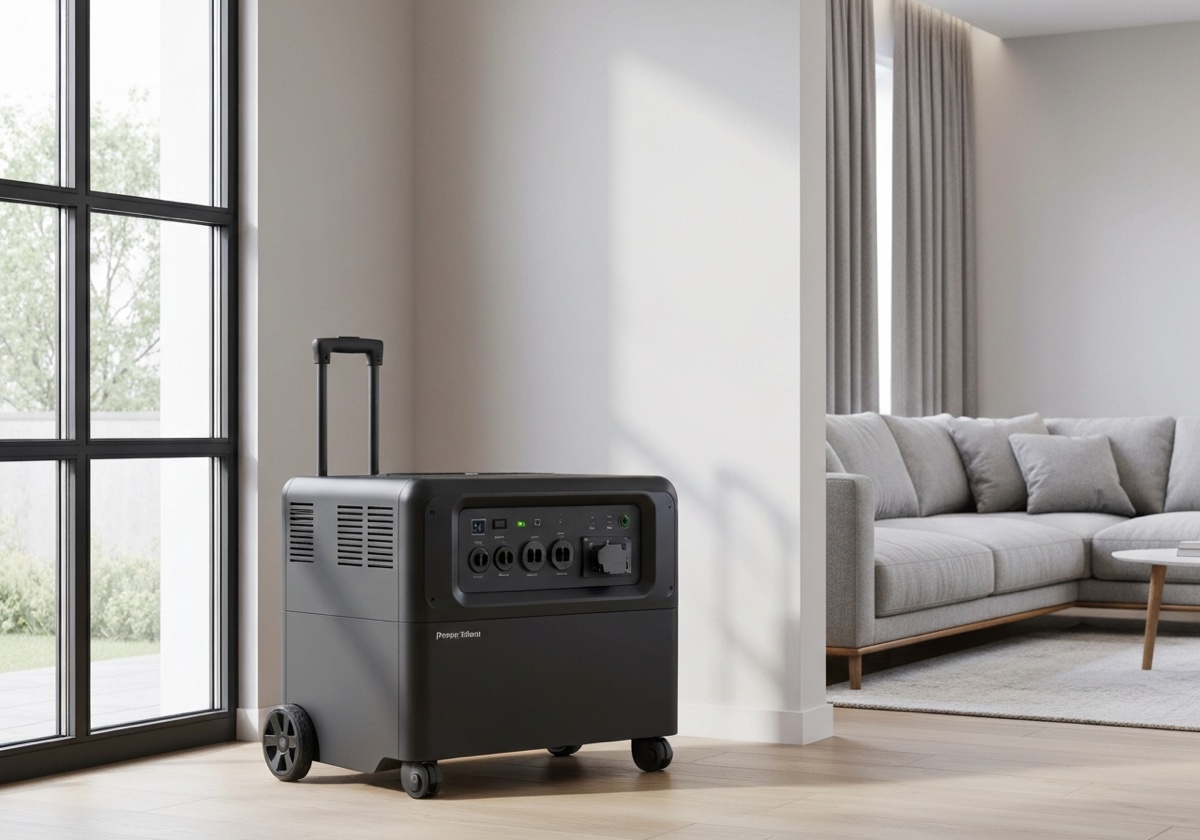
Somewhere between the $500 camping power station and the $15,000 wall-mounted home battery sits a strange and interesting middle ground: machines big enough to run your whole kitchen through a blackout, small enough to wheel into a closet when the lights come back on. The EcoFlow DELTA Pro 3 is the current king of that middle ground, and it is the unit most people land on when they search for serious home backup without an electrician’s business card in hand.
On paper it makes a bold claim: roughly 4kWh of battery, 4,000 watts of output, both 120V and 240V from a single box, and expansion to around 12kWh with extra batteries. That is genuine home-backup territory, the kind of spec sheet that used to require a permanently installed system or a gas generator roaring on the patio.
But it also costs as much as a decent used car engine, weighs as much as a mid-size dog crate with the dog inside, and competes against both cheaper portable units and permanently installed batteries that do more at the whole-home scale. This review pulls together the specs, the owner feedback patterns, and the honest math to answer one question: is the DELTA Pro 3 the best home backup power station you can buy in 2026?
See the current price of the EcoFlow Delta Pro 3 on Amazon.
Quick Answer
- What it is: A roughly 4kWh LiFePO4 power station with 4,000W continuous output (higher with X-Boost), dual 120V/240V output, and expansion to around 12kWh with two extra batteries.
- Best for: Homeowners who want real, multi-day essential-load backup without permits, installation, or fuel, plus anyone who needs 240V for a well pump or mini-split.
- What it runs: A fridge, lights, Wi-Fi, phones, and a CPAP for roughly 2 to 3 days on the base unit alone. Add batteries or solar and it stretches close to a week.
- Biggest downsides: Price (roughly $3,200 to $4,000), weight (around 115 lbs), and diminishing returns if your real goal is whole-home backup, where a standby generator or installed battery wins.
- Verdict: Yes, it is the best all-around home backup power station in 2026 for essential-load backup. It is not a whole-home solution, and it does not pretend to be.
Who the DELTA Pro 3 Is For
This machine targets a specific person: the homeowner (or renter) who loses power a few times a year for hours to days at a time, wants the fridge, internet, and a few critical devices to shrug it off, and does not want to deal with gasoline, carbon monoxide, permits, or a five-figure installation.
It is also a quiet favorite among three other groups. CPAP and medical device households love it because it runs silently indoors, where a generator can never go. Well-water households need its 240V output, which most portable power stations simply do not offer, to run the well pump. And RV owners with 50-amp rigs have adopted it as a plug-in power plant.
Who is it not for? Anyone whose goal is running central air conditioning and the whole electrical panel for days. That is standby generator or installed home battery territory, and the math later in this review shows why.
Key Specs at a Glance
| Spec | EcoFlow DELTA Pro 3 |
|---|---|
| Battery capacity | Roughly 4,096Wh (4kWh), LiFePO4 |
| AC output | 4,000W continuous; X-Boost handles some resistive loads up to around 6,000W |
| Voltage | 120V and 240V simultaneously from one unit |
| Expansion | Up to around 12kWh with two extra batteries; multiple units combine further via panel integration |
| Solar input | Up to roughly 2,600W total (dual ports) |
| AC charging | Roughly 0 to 80 percent in about 50-80 minutes on a standard outlet at full rate |
| Cycle life | Rated around 4,000 cycles to 80 percent capacity |
| UPS switchover | Under 20 milliseconds |
| Noise | As low as roughly 30dB in quiet operation |
| Weight | Around 115 lbs, with wheels and a telescoping handle |
| Typical price | Roughly $3,200 to $4,000 depending on sales |
Two specs deserve a spotlight. First, the LiFePO4 chemistry: rated for around 4,000 charge cycles before dropping to 80 percent capacity, which works out to a decade or more of regular use. Older lithium-ion stations were often rated at 500 to 800 cycles. Second, the dual-voltage output: the Pro 3 produces 120V and 240V from a single unit, where the previous generation required two units chained together with an extra accessory to get 240V. For anyone with a well pump, that one change is the whole ballgame.
What It Actually Powers in a Real Outage
Spec sheets are abstract, so here is the worked example that matters: a storm knocks out your power for three days. You care about the refrigerator, some lights, Wi-Fi, phone charging, and a CPAP at night. What happens?
- Refrigerator: draws roughly 100-200W while cycling, averaging around 1,000-1,500Wh per day
- LED lights (4-6 lamps, evenings): roughly 200Wh per day
- Wi-Fi router and modem: roughly 15-25W continuous, around 400-500Wh per day
- Phone and laptop charging: roughly 100-150Wh per day
- CPAP (humidifier off): roughly 30-50W for 8 hours, around 300-400Wh per night
Total: roughly 2,000 to 2,700Wh per day. Against a usable capacity of around 4,000Wh, the base unit alone carries this load for roughly a day and a half to two days. Run the fridge intermittently (it holds temperature fine on 15-20 minutes of power per hour) and disciplined households stretch the base unit to a genuine 2 to 3 days.
Add one 400W solar panel recovering 1,500-2,000Wh on a decent day and the math changes completely: solar covers most of the daily burn, and the setup runs essentials more or less indefinitely. That is the quiet superpower of battery backup that generator owners never get to experience: no fuel runs, no refills at 6 a.m., no engine noise announcing to the neighborhood that you have power.
What about heavier loads? The 4,000W inverter starts and runs a sump pump, a microwave, a space heater, a full-size induction burner, or a well pump (the 240V output handles typical 1-1.5 HP pumps). What it cannot do is run several of those at once for long, because at 1,500W of continuous draw, 4kWh disappears in under three hours. Big batteries do not repeal the laws of arithmetic; electric resistance heating and central HVAC eat power stations for breakfast.
Charging Options: The Fast and the Flexible
The Pro 3 charges about as fast as physics and a household outlet allow. On a standard 120V outlet it pulls up to around 1,800W, taking the battery from empty to 80 percent in roughly an hour and a half. Combine AC with solar and the input climbs to roughly 4,000W, filling the tank in around an hour. There is also a dedicated port for EV-style charging piles and a fast-charge mode from a 240V outlet.
Solar input is the standout: up to roughly 2,600W across two ports with a wide voltage range, which means it accepts everything from portable folding panels to a small array of rigid rooftop-style panels wired in series. Owner feedback consistently praises how forgiving the solar input range is compared to competitors that reject higher-voltage configurations.
One practical note that shows up in owner reports: at maximum AC charging rate the fans are loud, more hair dryer than hum. The app lets you slow the charge rate, which quiets things down dramatically and is gentler on the battery anyway. Fast when you need it, quiet when you do not.
Home Integration: Plug-and-Play or Panel-Wired
There are three ways to use the Pro 3 in an outage, in ascending order of commitment.
Extension cord mode: wheel it out, plug the fridge and a power strip into it. Zero installation, works day one, and honestly covers most people’s real needs.
Transfer switch mode: an electrician installs a manual transfer switch (roughly $400-900 installed) feeding 6-10 critical circuits. When the power dies, you plug the Pro 3 into an inlet and flip the switches, and your actual wall outlets, furnace fan, and well pump come alive. This is the sweet spot for most homeowners.
Smart Home Panel 2 mode: EcoFlow’s own subpanel (roughly $1,500-1,900 plus installation) manages up to 12 circuits, switches over automatically in milliseconds when the grid drops, and lets the app juggle circuits by priority. It turns the Pro 3 into something that behaves remarkably like an installed home battery, including time-of-use optimization to charge cheap and discharge during peak rates.
The UPS behavior deserves a mention: with under 20 milliseconds of switchover, desktop computers, routers, and CPAPs ride through an outage without a blink when plugged through the unit.
Noise and Indoor Use
This is where battery backup humiliates generators. A portable inverter generator produces roughly 60-70dB at load and must sit outside, at least 20 feet from the house, in whatever weather caused the outage. The Pro 3 idles nearly silent, runs typical loads at a low fan hum around 30-45dB, and sits in the hallway. It emits no carbon monoxide, needs no fuel stabilizer, and starts every single time because there is nothing to start.
For households with sleeping kids, medical equipment, or apartment-style living where a generator is simply impossible, this category is not a compromise. It is the only option that works.
The Downsides, Honestly
Price. At roughly $3,200 to $4,000 for the base unit, you are paying around $0.80-1.00 per watt-hour. Extra batteries run roughly $2,000-2,600 each. A fully expanded 12kWh setup lands around $8,000-9,000, and at that point you are within shouting distance of professionally installed home batteries that offer higher output and whole-home automation.
Weight. Around 115 lbs is technically portable thanks to good wheels and a telescoping handle, and it rolls fine across a garage floor. Stairs are another story. This is a one-person roll, two-person carry.
Diminishing returns at whole-home scale. If your real goal is running everything, including central air, through multi-day outages, a standby generator (roughly $8,000-15,000 installed) or an installed battery system simply does that job better. The Pro 3’s sweet spot is essential loads, and stacking batteries to chase whole-home capacity gets expensive fast.
Ecosystem accessories add up. The headline price never includes the Smart Home Panel, extra batteries, or solar panels. Budget honestly for the configuration you actually want before comparing against alternatives.
Alternatives Worth Considering
EcoFlow DELTA 2 Max: If your outage plan is really about the fridge, phones, and a few lights for a day, this roughly 2kWh, 2,400W sibling costs about a third as much and weighs half. Most apartment dwellers and short-outage regions should start here.
Anker SOLIX F3800: The closest direct rival, with roughly 3.8kWh, 6,000W output, and 120V/240V capability, often priced aggressively below the Pro 3. Its inverter output is stronger; EcoFlow counters with faster charging and a deeper home-integration ecosystem. Both are excellent, and sale pricing should probably decide it.
Bluetti AC300 + B300K: A modular approach where the inverter and battery are separate pieces, so no single 115 lb lift. Around 3,000W output and 2.8kWh per battery, expandable large. Strong value per kilowatt-hour, though 240V requires a second inverter unit.
A standby generator: If you live where week-long outages happen and you want the whole house running, roughly $10,000 installed buys a natural gas standby unit that does what no power station can. Different tool, different job.
Verdict: Is the DELTA Pro 3 the Best Home Backup Power Station in 2026?
For its intended job, yes. The combination of 4,000W output, dual 120V/240V from a single box, LiFePO4 longevity, roughly 2,600W of solar input, and a genuine expansion path to 12kWh makes the DELTA Pro 3 the most complete home backup power station on the market in 2026. The Anker F3800 beats it on raw inverter power and often on price, and Bluetti wins on modular value, but as a total package (hardware, app, home panel integration, and charging flexibility) the Pro 3 is the one to beat.
Buy it if you want serious essential-load backup with zero fuel and zero installation drama, especially if you need 240V. Buy the DELTA 2 Max instead if your needs are modest, and budget for a standby generator or installed battery if your ambition is whole-home power for a week. The Pro 3 earns its price by doing the middle job better than anything else, and the middle job is the one most households actually need done.
Frequently Asked Questions
How long will the DELTA Pro 3 run a refrigerator?
A typical full-size fridge averages roughly 1,000-1,500Wh per day, so the base 4kWh unit runs it for roughly 2.5 to 4 days on that load alone. Add lights, Wi-Fi, and device charging and expect around 1.5 to 2 days total, or noticeably more if you cycle the fridge intermittently.
Can the DELTA Pro 3 run a well pump or central AC?
Well pump, yes: the 240V output and 4,000W inverter handle typical residential pumps up to around 1.5 HP. Central air conditioning is generally a no; a 3-ton condenser’s start surge and 3,000W+ running draw would drain the battery in about an hour even if it starts. A small mini-split or window unit is realistic, whole-home cooling is not.
Is the DELTA Pro 3 safe to use indoors?
Yes. It is a battery, so it produces no exhaust and no carbon monoxide, and it runs quietly enough for a bedroom hallway. Give it a little ventilation space for the cooling fans and keep it out of standing water, but indoor use is exactly what it is designed for, unlike any fuel generator.
Does the DELTA Pro 3 qualify for the 30% federal tax credit?
Sometimes. The Residential Clean Energy Credit covers battery storage of 3kWh or more that is installed as part of your home, and the Pro 3’s 4kWh capacity clears the threshold. Used as a purely portable device it does not qualify, but wired into your home through a transfer switch or Smart Home Panel it generally does. Keep installation documentation and confirm with a tax professional.
Related: Trying to pick a brand first? Start with our EcoFlow, Bluetti and Jackery comparison.