
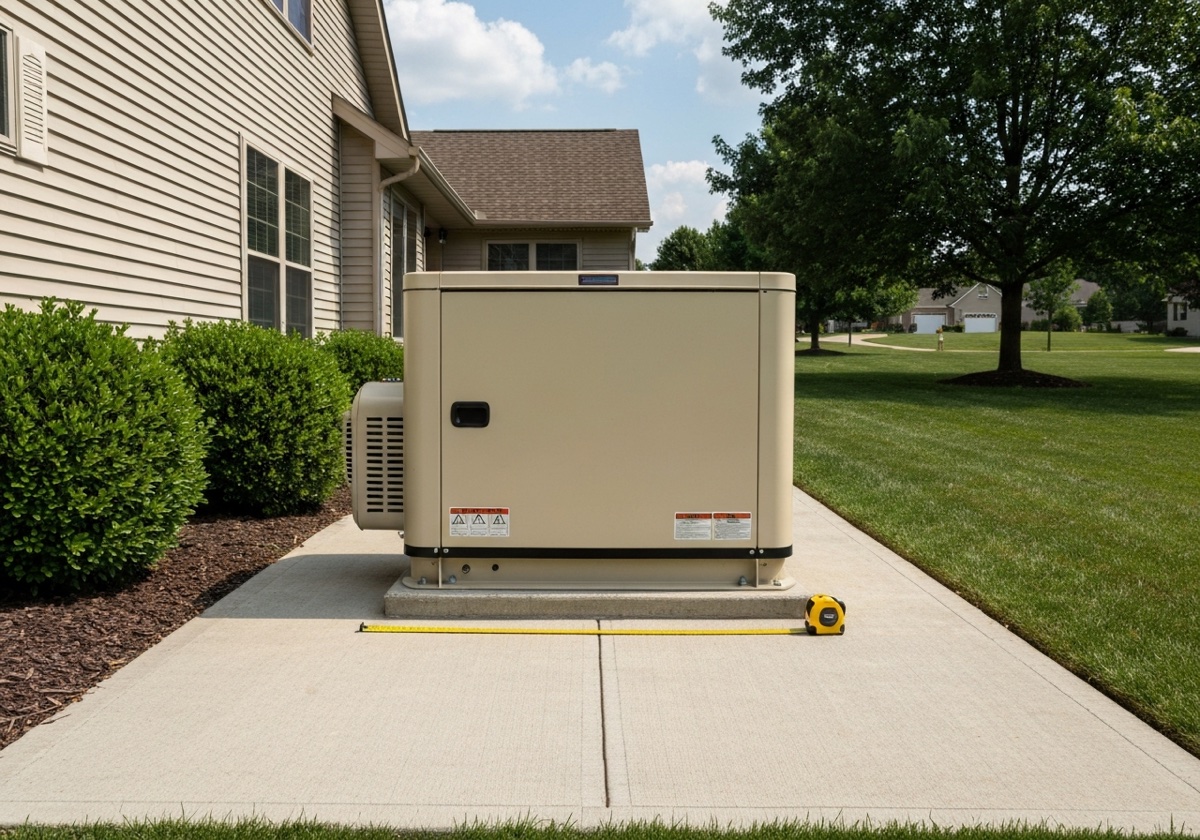
Buy a whole house generator one size too small and it will trip offline the first time your air conditioner kicks on during a heat wave. Buy two sizes too big and you have burned $3,000 to $5,000 on capacity you will never use, plus higher fuel bills every hour it runs. Sizing is the single most consequential decision in the entire project, and it comes down to arithmetic you can do at your kitchen table in an hour.
Skip the math: try our free interactive Generator Size Calculator to get a recommended wattage in seconds.
This guide walks you through the exact method installers use: inventory your loads, separate running watts from starting watts, and match the total to a generator tier. There is a wattage table, a square footage chart for quick estimates, and a full worked example for a 4-bedroom home so you can see every step of the math.
Quick Answer: Generator Size by Coverage Level
- Essentials only (fridge, furnace, well pump, lights, outlets): roughly 8-12kW. No central air conditioning.
- Managed whole home (everything, with load management shuffling big appliances): roughly 14-20kW. The best value for most homes; an 18kW unit with load shedding covers a typical 2,000-3,000 sq ft house.
- Full whole home (everything running at once, no compromises): roughly 22-26kW or more, especially for homes with two AC systems or electric heat.
- The method that matters: add up the running watts of everything you want powered, then add the single largest starting surge on top. That total, plus a 20-25 percent buffer, is your minimum generator size.
Why Sizing Matters More Than Brand
An undersized generator does not just underperform, it fails at the worst moment. When demand exceeds capacity, the unit trips its breaker or stalls, and you are standing in a dark house resetting equipment while the outage rolls on. Chronic overloading also shortens engine life.
Oversizing has quieter costs. Each step up in capacity adds roughly $1,000 to $2,500 to the unit price, and larger engines burn more fuel even at light loads. A generator loafing along at 20 percent load also runs less efficiently and, on some engines, builds carbon deposits over time. The goal is a unit that typically runs at roughly 50 to 75 percent of its rating: big enough to never trip, small enough that you did not pay for phantom capacity.
Running Watts vs. Starting Watts: The Concept That Trips Everyone Up
Every appliance with a motor or compressor has two numbers, and confusing them is the number one sizing mistake.
Running watts are what the appliance draws once it is going. A refrigerator hums along at roughly 150 to 300 watts. A central AC condenser cruises at roughly 3,500 watts.
Starting watts (also called surge or LRA-driven inrush) are the burst a motor needs in the first second or two to spin up from a dead stop. That same refrigerator can briefly demand 1,000 to 1,200 watts. A 4-ton AC without a soft starter can spike to roughly 10,000 watts or more for a moment.
Resistive loads (light bulbs, toasters, electric water heater elements, space heaters) have no surge; their starting and running watts are the same. Motor loads (AC, well pump, sump pump, fridge, freezer, garage door) surge at 2 to 3 times their running draw.
The good news: surges rarely stack. Your well pump, fridge, and AC almost never all start in the same second, and modern generators tolerate brief overlaps. Standard practice is to add the single largest starting surge to your running total, not every surge in the house.
The Wattage Inventory Method, Step by Step
Step 1: List what must stay on. Walk the house and write down everything you genuinely want powered in an outage. Be honest about wants versus needs; this list determines the size of the check you write.
Step 2: Find the running watts for each item. Check the nameplate label, the manual, or use the table below. For 240V appliances, watts = volts times amps (a 30-amp, 240V water heater element is 240 x 30 = 7,200W max, though most heat at 4,500W).
Step 3: Identify starting watts for motor loads. Multiply running watts by roughly 2 to 3 for compressors and pumps if no spec is available.
Step 4: Add up all running watts. This is your base load.
Step 5: Add the single largest starting surge on top. Usually the central AC or the well pump.
Step 6: Add a 20-25 percent buffer. This covers measurement optimism, future appliances, and natural gas derating (explained below).
Typical Appliance Wattage Table
Manufacturers print worst-case numbers, so real draws are often a bit lower. These are typical ranges for American homes:
| Appliance | Running Watts | Starting Watts |
|---|---|---|
| Central AC, 3 ton | roughly 3,500 | roughly 8,000-9,000 |
| Central AC, 4 ton | roughly 4,500-5,000 | roughly 10,000-12,000 |
| Central AC, 5 ton | roughly 6,000 | roughly 13,000-15,000 |
| Heat pump (heating mode, 3 ton) | roughly 3,500-5,000 | roughly 8,000-10,000 |
| Gas furnace blower | roughly 400-800 | roughly 1,200-2,400 |
| Well pump, 1 HP | roughly 1,000-1,500 | roughly 3,000-4,500 |
| Sump pump, 1/2 HP | roughly 800-1,000 | roughly 1,800-3,000 |
| Refrigerator/freezer | roughly 150-400 | roughly 800-1,200 |
| Electric water heater (tank) | roughly 4,500 | same (no surge) |
| Tankless electric water heater | roughly 18,000-36,000 | same (usually excluded from generator plans) |
| Electric range (2 burners + oven) | roughly 5,000-7,000 | same (no surge) |
| Microwave | roughly 1,000-1,500 | same |
| Dishwasher | roughly 1,200-1,500 | roughly 1,800 |
| Washing machine | roughly 500-1,000 | roughly 1,500-2,200 |
| Electric dryer | roughly 5,000-5,500 | roughly 6,500 |
| Lights, TV, internet, chargers (whole house) | roughly 500-1,200 | same |
Two items deserve special mention. A tankless electric water heater is a generator killer; almost nobody sizes a residential standby unit to carry one, and it simply stays off during outages. And a well pump matters doubly in rural homes: no generator capacity for the pump means no water, not just no lights.
The Three Sizing Tiers
Tier 1: Essentials, roughly 8-12kW. Refrigerator, gas furnace, well or sump pump, lights, internet, and a few outlets. Comfortable in winter (if you heat with gas), sweaty in summer, since central AC is off the table. Installed cost is the lowest of the three tiers, often $7,000 to $9,000. If essentials are all you need, it is worth comparing the best portable generators for home outages before committing to a standby install.
Tier 2: Managed whole home, roughly 14-20kW. Every circuit in the house is connected, but load management modules keep the biggest appliances from running simultaneously. This is where most homeowners should look, and 18kW has become the default recommendation for typical single-AC homes.
Tier 3: Full whole home, roughly 22-26kW and up. Everything runs at once with no management: dual AC systems, electric water heating, a hot tub. Larger estates or all-electric homes may need liquid-cooled units of 30kW or more.
Load Management: The Cheapest Kilowatts You Can Buy
A load management module (Generac calls them Smart Management Modules; Kohler and Cummins have equivalents) sits on a high-draw circuit and pauses it for a few minutes when the generator approaches its limit. Your water heater waits while the AC starts, then resumes. You never notice.
The economics are hard to argue with. Each module costs roughly $100 to $300 installed, and two or three of them routinely let an 18kW generator (roughly $5,500) do the job of a 24kW unit (roughly $8,000) plus its larger gas line. That is roughly $2,000 to $3,000 saved for a compromise most families literally cannot perceive. Air conditioners can also get a soft starter (roughly $300 to $500 installed) that cuts their starting surge by 60 to 70 percent, which sometimes drops you a full generator size on its own.
Sizing by Square Footage: The Rough Guide
Square footage is a crude proxy (it says nothing about your water heater fuel or how many AC tons you have), but it is a useful sanity check against your wattage math:
| Home Size | Typical Recommendation | Assumes |
|---|---|---|
| Under 1,500 sq ft | 10-14kW | Gas heat and hot water, one small AC |
| 1,500-2,500 sq ft | 14-18kW | Gas heat, one central AC up to 4 tons |
| 2,500-3,500 sq ft | 18-22kW | One large or two smaller AC systems, load management |
| 3,500-5,000 sq ft | 22-26kW | Dual AC, some electric appliances |
| 5,000+ sq ft | 26-48kW (liquid-cooled) | Multiple HVAC systems, pool equipment |
The caveats are real. An all-electric 1,800 sq ft home (electric water heater, electric range, heat pump) can out-demand a 3,000 sq ft home with gas everything. Treat this chart as a starting point, never as the answer. All-electric homes may also want to weigh a whole house battery backup as an alternative to a larger engine.
The natural gas derating note
Generator nameplate ratings are usually quoted on propane. Run the same unit on natural gas and output drops by roughly 5 to 10 percent because natural gas carries less energy per cubic foot. A “22kW” generator may deliver roughly 19.5 to 21kW on natural gas. If your math lands within a few hundred watts of a unit’s rating and you are on natural gas, step up a size or add load management. Altitude derates output too, roughly 1 to 3 percent per 1,000 feet above the first 500 feet.
Worked Example: Sizing a 4-Bedroom Home with Central AC
The house: a 2,600 sq ft, 4-bedroom home with a 4-ton central AC, gas furnace, electric tank water heater, well pump, sump pump, and a normal kitchen. The owners want the whole house to feel normal during an outage.
Step 1 and 2, the running watt inventory:
- Central AC (4 ton): 4,800W running
- Gas furnace blower: 600W
- Electric water heater: 4,500W
- Well pump (1 HP): 1,200W
- Sump pump (1/2 HP): 900W
- Refrigerator: 300W
- Chest freezer: 250W
- Kitchen use (microwave or a couple of small appliances): 1,500W
- Lights, TVs, internet, chargers: 1,000W
Step 4, total running watts: 4,800 + 600 + 4,500 + 1,200 + 900 + 300 + 250 + 1,500 + 1,000 = 15,050W.
Step 5, largest starting surge: the 4-ton AC at roughly 11,000W starting, which is 6,200W above its running draw. Worst case peak: 15,050 + 6,200 = 21,250W.
Sized for everything at once, this house needs a 24-26kW generator, especially after natural gas derating. Installed, that is roughly $13,000 to $15,000.
Now apply load management. Put modules on the water heater and the electric dryer circuit, and add a soft starter to the AC. The water heater (4,500W) pauses whenever the generator is near capacity, cutting the managed running load to roughly 10,550W. The soft starter drops the AC surge from 11,000W to roughly 4,500W, so the peak becomes roughly 10,550 + 4,500 = 15,050W, with brief excursions when everything overlaps.
An 18kW unit delivering roughly 16.5kW on natural gas covers that peak with margin to spare, and it runs at a healthy 60 to 70 percent load on a hot afternoon. Total hardware savings versus the 26kW route: roughly $2,500 to $3,500, for the cost of two modules and a soft starter (under $1,000). This is exactly why 18kW with load shedding has become the workhorse answer for homes like this one. And if even the managed setup stretches the budget, our guide to home backup power for every budget covers lower-cost routes.
When to Get a Professional Load Calculation
Your kitchen table math will land you in the right tier, but bring in a licensed electrician for a formal load calculation (based on NEC Article 220) before you sign a contract if any of these apply: you have two or more AC systems, any electric heating, a home with 100-amp service, an EV charger you want powered, a pool or hot tub, or a workshop with 240V tools. Installers do this as part of a quote, and code officials in many jurisdictions require the calculation with the permit application anyway. The calculation costs little or nothing and it is the difference between a generator that is sized and one that is guessed.
Frequently Asked Questions
Will an undersized generator damage my appliances?
It can. An overloaded generator sags in voltage and frequency before it trips, and repeated brownouts are hard on compressor motors and sensitive electronics. Modern standby units protect themselves by shedding or shutting down, but the appliances riding through the sag do not enjoy it. Size correctly and the issue never comes up.
Is it better to slightly oversize or slightly undersize?
When the math puts you between two sizes, go up, especially on natural gas where derating eats 5 to 10 percent of the nameplate. The step up typically costs $800 to $1,500 at the unit level, which is cheap insurance compared to living with a generator that trips every heat wave. Better yet, stay at the smaller size and add load management, which usually costs less than the step up.
Can a 22kW generator run my whole house?
For most homes under roughly 3,500 sq ft with gas heat and a single AC system, yes, comfortably. Where 22kW falls short is all-electric homes, dual large AC systems running simultaneously, or tankless electric water heaters. Run the inventory method above; if your running total plus largest surge stays under roughly 19,000W (after natural gas derating), a 22kW unit has you covered.
Do I need to include my EV charger in the calculation?
Only if you insist on charging during an outage. A Level 2 charger draws roughly 7,200 to 11,500W, which is like adding a second central AC to your load. Most owners exclude the charger (or put it on a managed circuit that only charges overnight when other loads are low) and keep the generator a full size smaller.
This article is for general planning purposes only. Generator sizing, wiring, and fuel connections are governed by the National Electrical Code and local regulations, and final sizing should be confirmed with a formal load calculation by a licensed electrician or certified installer.