
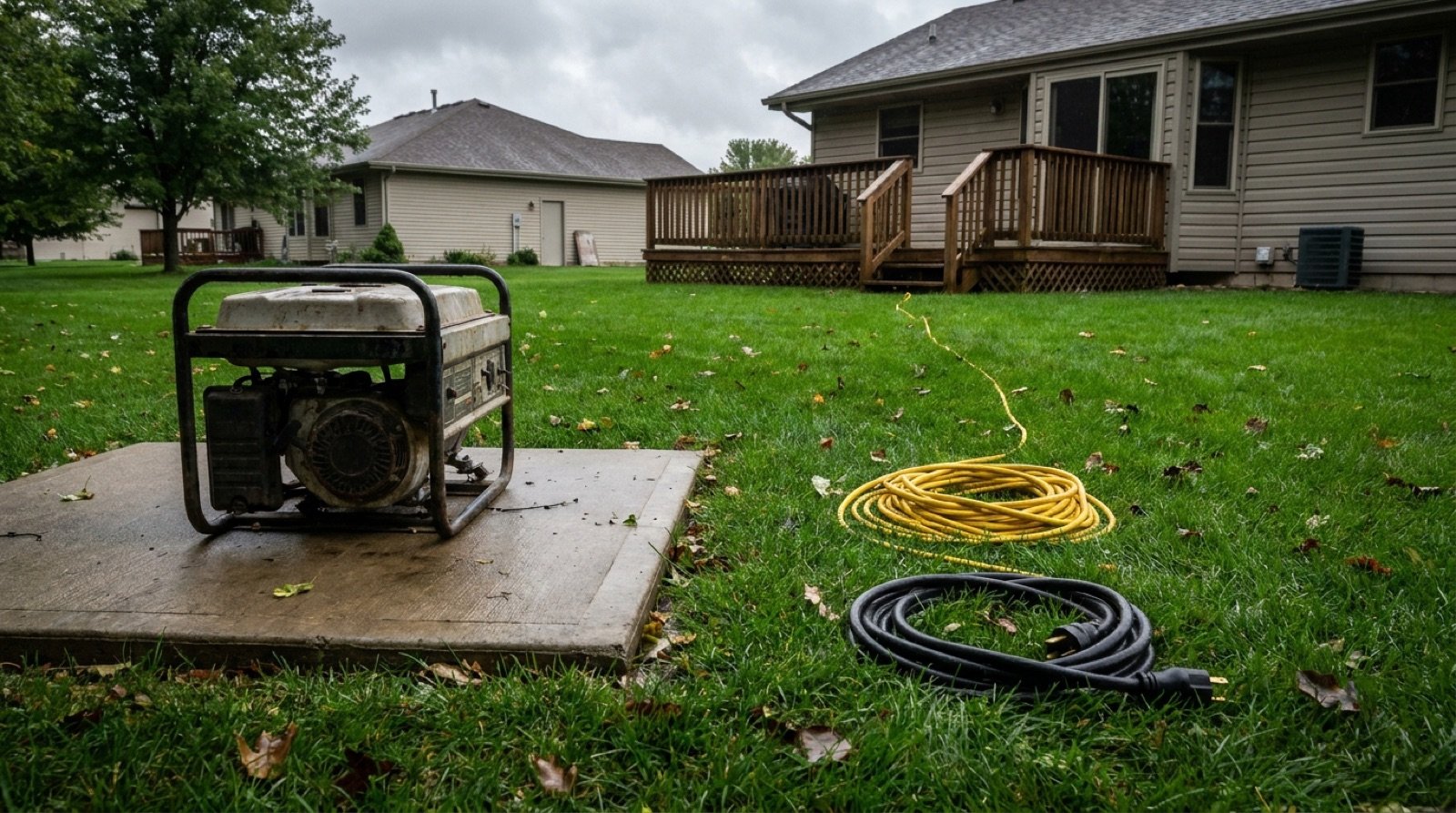
Short answer: For most generator setups, a 12-gauge outdoor cord (labeled 12/3, SJTW or better) carries up to 15 amps (about 1,800 watts) over 50 feet with only about 2% voltage drop. Step up to 10-gauge for 100-foot runs or loads near 20 amps, and use a 10-gauge, 4-wire twist-lock cord for a 30-amp L14-30 connection. Save thin 16-gauge cords for small loads under about 5 amps, like lamps and phone chargers.
An extension cord is the weakest link in most portable generator setups. The generator can be sized perfectly and the appliances can be fine, but a cord that is too thin or too long wastes power as heat, starves motors of voltage, and can get hot enough to damage its own insulation. This guide shows how to match gauge, length and load, with the arithmetic laid out so you can check any cord you already own.
Why Cord Size Matters More With a Generator
Indoors, most extension cords run a few feet to a lamp. With a generator, the cord has to cover real distance. The CDC says to run a generator at least 20 feet from the home, with the exhaust pointed away from doors, windows and vents. Once you route around steps, decks and shrubs, that 20 feet often becomes 40 or 50 feet of cord. Our guide to generator carbon monoxide placement rules explains why that distance is not negotiable.
Longer cords mean more resistance, and generator loads tend to be the hard ones: refrigerators, freezers, sump pumps, window air conditioners and space heaters. Motors are sensitive to low voltage. When voltage sags, a compressor draws more current, runs hotter, and may struggle to start at all. Heaters simply put out less heat. Electronics with modern power supplies usually tolerate it, but motors do not.
How to Read an Extension Cord Label
Every quality cord prints its specs on the jacket. Here is what the common markings mean.
- Gauge (AWG): The first number, such as 12 in “12/3.” Smaller numbers mean thicker copper. A 10-gauge cord is heavier and carries more current than a 14-gauge cord.
- Conductor count: The second number. “/3” means hot, neutral and ground. A “/4” cord has two hots, a neutral and a ground, which is what 120/240-volt twist-lock cords use.
- Jacket letters: S means service grade, J means junior service (rated 300 volts, the usual choice), W means rated for outdoor and wet locations, T means thermoplastic vinyl, E means a more flexible elastomer, and O or OO means oil resistant. SJTW is the common outdoor cord. SJEOW or SJOOW stays more flexible in freezing weather.
- Amp rating: Usually printed on the cord or packaging, often 13 amps for 16-gauge, 15 amps for 14-gauge, and 15 to 20 amps for 12-gauge. The printed rating is the ceiling. Never exceed it, even for a short run.
- Listing mark: Look for a UL, ETL or CSA mark. Unlisted bargain cords sometimes use thinner copper than the label claims.
Step 1: Add Up the Amps on the Cord
Amps at 120 volts equals watts divided by 120. Add every device that will plug into that one cord, including anything on a power strip at the far end.
Example: a refrigerator running at about 700 watts plus a chest freezer at about 300 watts and a few LED lights at 60 watts. That is 700 + 300 + 60 = 1,060 watts. Then 1,060 / 120 = about 8.8 amps running.
Startup surge on a refrigerator compressor can briefly reach two to three times running watts, but it lasts only a second or two. Size the cord for running current with comfortable margin, and do not run a cord near its limit if motors are involved. If you need running and starting numbers for common appliances, see our generator wattage guide for appliances.
Step 2: Measure the Real Length
Measure the actual path from the generator outlet to the device, not the straight-line distance. Add slack so the cord is not pulled tight across walkways or around corners. Plan on at least 25 feet just to satisfy the 20-foot distance rule, and 50 feet is a more realistic minimum for most yards.
Use one cord of the right length rather than linking short cords together. Every connection adds resistance and is a spot where water can get in. If you must join two cords, the connection should be off the ground and protected with a weatherproof connector cover.
Step 3: Check Voltage Drop
Voltage drop is the voltage lost along the cord. A common target is 3% or less, and 5% as an outer limit. At 120 volts, 3% is 3.6 volts and 5% is 6 volts.
The formula: voltage drop = 2 x cord length (feet) x amps x resistance per foot. The 2 is there because current travels out on the hot wire and back on the neutral, so the electrical path is twice the cord length.
Approximate resistance of copper wire per 1,000 feet: 16 AWG about 4.0 ohms, 14 AWG about 2.5 ohms, 12 AWG about 1.6 ohms, 10 AWG about 1.0 ohm, 8 AWG about 0.63 ohms, and 6 AWG about 0.40 ohms.
Worked example: a 10-amp load on a 100-foot cord.
| Cord gauge | Math (2 x 100 ft x 10 A x ohms per ft) | Voltage drop | Percent of 120 V |
|---|---|---|---|
| 16 AWG | 2 x 100 x 10 x 0.0040 | 8.0 V | 6.7% (too much) |
| 14 AWG | 2 x 100 x 10 x 0.0025 | 5.0 V | 4.2% (marginal) |
| 12 AWG | 2 x 100 x 10 x 0.0016 | 3.2 V | 2.7% (good) |
| 10 AWG | 2 x 100 x 10 x 0.0010 | 2.0 V | 1.7% (very good) |
The 16-gauge cord in that example also turns about 80 watts into heat along its length (8 volts x 10 amps). That is wasted fuel and a warm cord. The 10-gauge cord wastes about 20 watts.
Generator Extension Cord Size Chart
This chart combines the cord’s amp rating with a voltage drop target of about 3%. When a load sits between rows, use the next row down. When in doubt, go one gauge thicker; it costs nothing in performance.
| Load at 120 V | Up to 25 ft | 50 ft | 100 ft |
|---|---|---|---|
| 5 A (600 W) | 16 AWG | 16 AWG | 14 AWG |
| 10 A (1,200 W) | 16 AWG | 14 AWG | 12 AWG |
| 13 A (1,560 W) | 14 AWG | 12 AWG | 10 AWG |
| 15 A (1,800 W) | 14 AWG | 12 AWG | 10 AWG |
| 20 A (2,400 W) | 12 AWG | 10 AWG | 8 AWG |
| 30 A at 120 V, L5-30 (3,600 W) | 10 AWG | 10 AWG | 8 AWG |
| 30 A at 120/240 V, L14-30 (7,200 W) | 10 AWG | 10 AWG | 10 AWG |
| 50 A at 120/240 V, 14-50 (12,000 W) | 6 AWG | 6 AWG | 6 AWG |
Spot check on one row: 15 amps on a 50-foot 12-gauge cord is 2 x 50 x 15 x 0.0016 = 2.4 volts, or 2.0% of 120 volts. On a 100-foot 10-gauge cord it is 2 x 100 x 15 x 0.0010 = 3.0 volts, or 2.5%.
The 240-volt rows look generous because 240-volt loads draw half the current for the same watts, and the same voltage loss is a smaller share of 240 volts. A 30-amp, 100-foot 10-gauge cord drops 2 x 100 x 30 x 0.0010 = 6 volts, which is 2.5% of 240 volts.
Twist-Lock and High-Amp Generator Cords
The standard household plug (NEMA 5-15) is limited to 15 amps. Most portable generators also have a locking outlet that delivers much more power through a single heavy cord. Locking plugs twist into place so they cannot pull loose in the wind or when someone trips on the cord.
| Outlet type | Voltage | Max amps | Max watts | Typical cord | Common use |
|---|---|---|---|---|---|
| 5-20 (household 20 A duplex) | 120 V | 20 A | 2,400 W | 12/3 | Individual appliances |
| L5-30 (3-prong locking) | 120 V | 30 A | 3,600 W | 10/3 | Splitter boxes, 120 V only inlets |
| TT-30 (RV) | 120 V | 30 A | 3,600 W | 10/3 | Travel trailers |
| L14-30 (4-prong locking) | 120/240 V | 30 A | 7,200 W | 10/4 | Power inlet box to an interlock or transfer switch |
| 14-50 (50 A) | 120/240 V | 50 A | 12,000 W | 6/4 (some use 6/3 plus 8 AWG ground) | Large generators feeding a 50 A inlet |
An L14-30 cord is the backbone of most home generator hookups. It runs from the generator to a weatherproof power inlet box on the outside wall, which feeds a transfer switch or an interlock kit at the panel. The inlet, the interlock or transfer switch, and any panel work must be installed by a licensed electrician. Our guide on how to connect a portable generator to your house safely compares the options.
Never make or buy a “suicide cord” with male plugs on both ends, and never backfeed through a dryer outlet or any wall receptacle. Backfeeding can energize utility lines and kill line workers, and it can start fires inside your walls.
Generator outlets are protected by breakers on the generator itself, and most 120-volt duplex outlets share one 20-amp breaker. Putting two 15-amp loads on one duplex will trip it. A higher-capacity cord does not give you more generator; it only delivers what the outlet and the engine can supply. If you are still choosing a unit and want an L14-30 or 50-amp outlet, our roundup of the best portable generators for home power outages covers outlet panels by size.
Outdoor Rating, Rain and Cold Weather
Indoor cords (marked SPT or without a W) have thin jackets that crack in sunlight and are not rated for wet conditions. For generator use, buy only cords marked W, such as SJTW or SJOOW.
- Wet ground: Keep connections off puddles and grass. A connector cover or an elevated spot on a block helps.
- GFCI: Many generator outlets include GFCI protection. If yours does not, an outdoor-rated portable GFCI adds a layer of shock protection for 120-volt cords.
- Cold: Vinyl (T) jackets stiffen and can crack below freezing. Rubber or elastomer jackets (E or OO) stay flexible and are easier to coil in a winter outage.
- Rain: The generator itself needs a proper cover or open-sided shelter, never an enclosed space. See can you run a portable generator in the rain for setup details.
Safe Cord Layout Checklist
- Uncoil the cord completely before loading it. A coiled cord under heavy load traps heat in the middle of the coil.
- Route cords where nobody will trip on them and vehicles will not drive over them.
- Do not run cords under rugs, through pinched doors or windows, or across sharp edges. A slightly open window used for a cord can let exhaust in, so keep the generator end far away and downwind.
- Feel the cord and plug after 30 minutes under load. Warm is acceptable; hot means the cord is undersized or a connection is loose.
- Inspect before every use: no cuts, no exposed copper, no missing ground prong, no melted or discolored plug blades.
- Plug appliances directly into the cord or a heavy-duty, grounded power strip rated for the total load. Do not chain power strips.
- Turn off or unplug loads before starting the generator, then add them one at a time, largest motor first.
Common Mistakes to Avoid
- Buying by length alone. A 100-foot 16-gauge cord looks convenient but is only suitable for very small loads.
- Ignoring the weakest link. A 12-gauge cord plugged into a 16-gauge power strip is limited by the strip.
- Cutting off the ground prong to fit an old outlet. The ground protects you if an appliance develops a fault.
- Running a window air conditioner or space heater on a light cord. These pull 10 to 15 amps continuously and need at least 12-gauge on a 50-foot run.
- Pulling the generator closer to use a shorter cord. Distance is a life safety rule. Buy a heavier, longer cord instead.
Bottom line: Count amps (watts divided by 120), measure the real path, and pick the gauge that keeps voltage drop near 3%. For most homeowners that means one or two 50-foot 12-gauge outdoor cords for individual appliances, plus a 10-gauge L14-30 cord if a licensed electrician has installed an inlet and interlock or transfer switch.
Frequently Asked Questions
Is a 14-gauge extension cord enough for a generator?
For moderate loads on short runs, yes. A 14-gauge cord handles 10 amps (1,200 watts) at 50 feet with about 2% voltage drop (2 x 50 x 10 x 0.0025 = 2.5 volts). For refrigerators plus a freezer, window air conditioners or any run of 100 feet, 12-gauge is the safer choice.
What size cord do I need for an L14-30 generator outlet?
Use a 10-gauge, 4-conductor cord (10/4) with L14-30 locking plugs, rated for outdoor use. It carries the full 30 amps at 120/240 volts, and at 100 feet the voltage drop stays around 2.5%. The cord should connect to a power inlet box installed by a licensed electrician, never to a wall outlet or dryer receptacle.
Can I connect two extension cords together to reach my generator?
It works electrically if both cords are the same gauge and rated for the load, but it is not ideal. Each connection adds resistance and is a point where water can cause a fault. If you must join cords, keep the connection off the ground and inside a weatherproof cover, and plan to replace the pair with one cord of the right length.
Why does my extension cord get hot on the generator?
A hot cord usually means it is too thin for the current, too long for the load, still coiled, or has a loose or damaged plug. Check the total amps against the printed rating and the size chart above. If the cord is correctly sized and still hot, stop using it, because a worn plug or internal damage can lead to melting or fire.