
This post contains affiliate links. If you buy through them, we may earn a commission at no extra cost to you.
Short answer: a sump pump fails exactly when you need it most, during the storm that knocks out the power. There are three ways to back it up. A battery backup sump pump ($300 to $800 installed) runs automatically for 6 to 24 hours and is the right choice for most homes. A water-powered backup pump ($200 to $500) uses municipal water pressure, never needs a battery, and runs indefinitely, but only works on city water. A generator runs your existing primary pump at full capacity but only if someone is home to start it. Many flood-prone basements use two of the three.
Why Sump Pumps and Power Outages Go Together
The same thunderstorm that drops three inches of rain also brings down the power lines. Groundwater rises fastest 2 to 12 hours after heavy rain, which is right when a typical outage is still in progress. A primary sump pump moves 2,000 to 4,000 gallons per hour. With no power, the pit fills in minutes and the basement floor is wet within an hour in a high-water-table home. Insurance data consistently puts sump pump failure among the leading causes of basement water damage, with average claims in the thousands of dollars. Backup power for the pump is one of the highest-return preparations a homeowner can make.
Option 1: Battery Backup Sump Pump
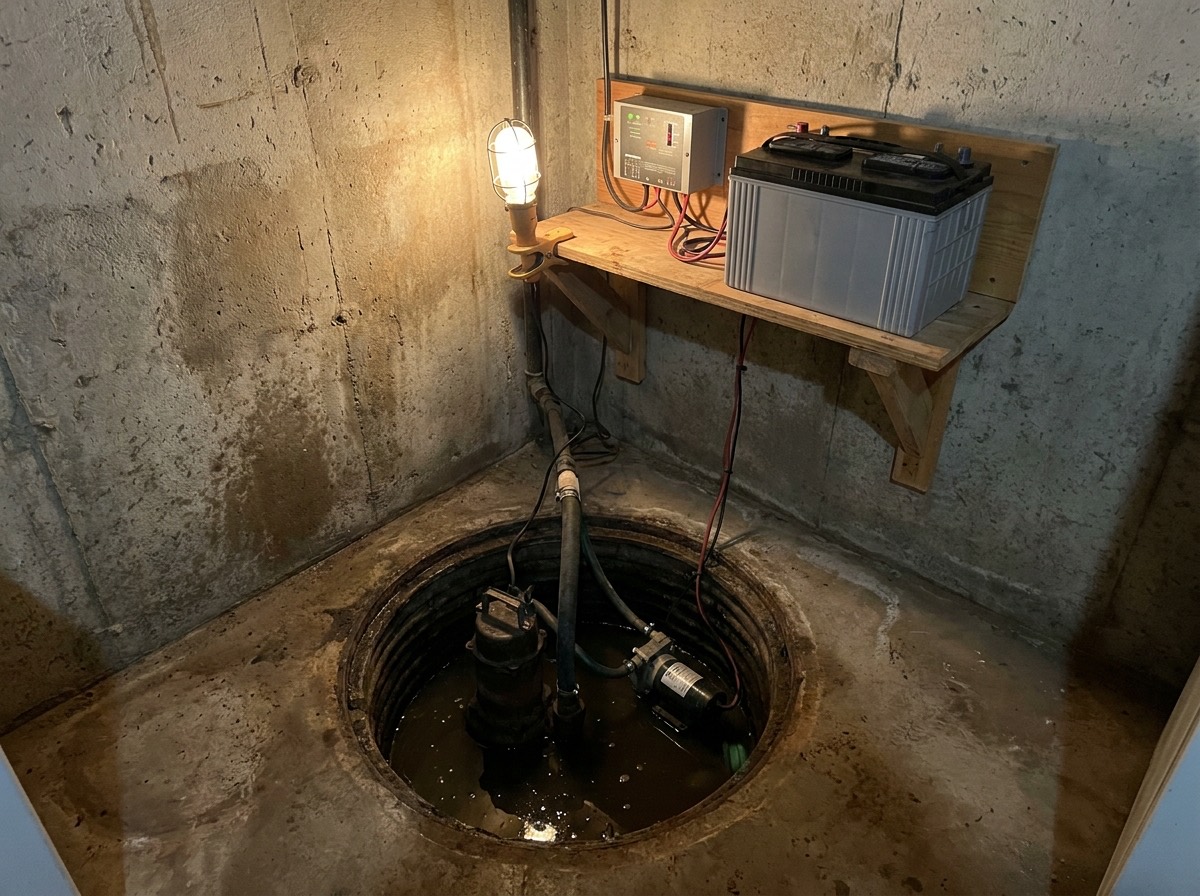
A battery backup system is a second, smaller pump installed in the same pit above the primary, wired to a deep-cycle battery and a charger/controller. When the primary stops (power outage, float switch failure, or the primary simply cannot keep up), the water rises to the backup’s float and it kicks on. The charger keeps the battery topped up from the wall the rest of the year.
| Spec | Typical Range |
|---|---|
| Pump capacity at 10 ft lift | 1,200-2,500 gallons/hour |
| Battery | 75-120Ah deep-cycle AGM or flooded lead-acid, or LiFePO4 on newer systems |
| Runtime, continuous pumping | 5-8 hours |
| Runtime, typical cycling (pump on 20-30% of the time) | 18-40 hours |
| Cost, system | $200-$600 |
| Cost, battery (separate on most kits) | $100-$250 lead-acid, $300-$500 LiFePO4 |
| Battery life | 3-5 years lead-acid, 8-10 years LiFePO4 |
| Alarm | Most models sound when the backup runs and when the battery is low |
Why it is the default choice: it is automatic, it protects against pump failure as well as power failure, and it needs no one home. The weak point is the battery. Lead-acid batteries lose capacity every year and die quietly; test the system every three months by lifting the backup float and listening for the pump, and replace the battery on schedule regardless of whether it “seems fine.”
Check the current price of battery backup sump pump systems on Amazon
Check the current price of deep-cycle AGM sump pump batteries on Amazon
Option 2: Water-Powered Backup Sump Pump
A water-powered pump uses the pressure in your municipal water line to create suction through a venturi. Roughly one gallon of city water moves two gallons of sump water. It has no motor, no battery, and no electronics, so there is nothing to wear out and nothing to charge. When the pit rises to its float, it opens the water valve and starts pumping, and it runs as long as the city has water pressure, which is usually days into any outage.
Limits: it requires city water at 40 PSI or more (a well pump stops with the power, so well-water homes cannot use it), it needs a 3/4-inch supply line and a backflow preventer, which most plumbing codes require, and it moves less water than a battery pump, typically 1,000 to 1,500 gallons per hour. Your water bill goes up during a long outage, but a few hundred gallons of water is cheap compared to a flooded basement.
Check the current price of water-powered backup sump pumps on Amazon
Option 3: Generator or Power Station Running the Primary Pump
A sump pump is a motor load. A 1/3 HP pump draws about 800 watts running and surges to 1,300 to 2,000 watts at start; a 1/2 HP pump draws 1,000 watts running and surges to 2,000 to 3,000. Any generator of 2,200 watts or more runs a single 1/3 HP pump; 3,500 watts covers a 1/2 HP pump plus the refrigerator and lights. Our generator size calculator adds up the full list.
The advantage is capacity: the primary pump keeps moving 3,000-plus gallons per hour, which matters in a real flood. The disadvantage is that a generator needs a person. If the storm hits at 3 am or while you are at work, nobody starts it. Generators are the right layer for long outages once someone is home, not a substitute for an automatic backup.
A portable power station with UPS mode fixes the “nobody home” problem for short outages. A 2kWh unit plugged into the wall with the pump plugged into it switches over automatically and runs a 1/3 HP pump for about 2 hours of continuous pumping, or 6 to 10 hours of normal cycling. Confirm the unit’s surge rating covers the pump’s start (most 2,000-watt-class units do). Our roundup of the best portable power stations for home backup lists surge figures.
Which Backup for Your Situation
| Your Situation | Best Backup | Add Later |
|---|---|---|
| City water, occasional outages, want zero maintenance | Water-powered pump | Generator for long outages |
| Well water (no city pressure) | Battery backup pump | Generator to run primary pump and recharge |
| High water table, basement floods fast | Battery backup pump with a large battery | Water-powered pump as second layer; generator |
| Frequent multi-day outages | Battery backup pump | Generator with inlet box so the primary runs on generator power |
| Finished basement, high-value contents | Battery backup plus water-powered | Wi-Fi water alarm, generator |
Installation Notes
- A battery backup pump sits above the primary in the same pit, on its own discharge line with its own check valve. Tying both pumps into one discharge line without check valves lets the backup push water back into the primary.
- Battery and controller go on a shelf above any possible flood level, not on the floor beside the pit.
- Water-powered pumps mount on the ceiling joists or wall above the pit and need a dedicated cold water line with a shutoff valve and a code-compliant backflow preventer. Many jurisdictions require a plumber for that connection.
- If you add a generator inlet and transfer switch, put the sump circuit on it. See how to connect a portable generator to your house.
- Add a Wi-Fi water sensor on the floor beside the pit. It costs less than a pizza and tells your phone the moment the backup has lost the fight.
Check the current price of Wi-Fi water leak sensors on Amazon
Testing Schedule
- Every 3 months: pour a bucket of water in the pit with the primary unplugged; confirm the backup starts, pumps, and stops. Plug the primary back in.
- Every 6 months: check battery terminals for corrosion, top off water in flooded batteries, confirm the charger light shows full.
- Every spring: test the water-powered pump by lifting its float; confirm the discharge line outside is clear and not frozen or buried.
- Every 3 to 5 years: replace the lead-acid battery. Write the install date on it in marker.
The sump pump is one item on a longer list. Our power outage checklist covers the rest of the house, and if your area sees extended outages, preparing for extended power outages goes deeper.
Frequently Asked Questions
How long will a battery backup sump pump run?
About 5 to 8 hours of continuous pumping on a typical 75 to 100Ah battery, which stretches to 18 to 40 hours under normal cycling where the pump runs a quarter of the time.
Can a generator run a sump pump?
Yes. A 2,200-watt inverter generator runs a 1/3 HP pump; a 3,500-watt unit runs a 1/2 HP pump with room for the fridge and lights. The generator has to be started by a person, so pair it with an automatic backup.
Is a water-powered backup sump pump worth it?
If you have municipal water at adequate pressure, yes. It is the only backup that never runs out of energy and needs no battery replacement. Check local code for backflow prevention requirements.
Will a portable power station run a sump pump?
A 2,000-watt-class power station with UPS mode runs a 1/3 HP pump for roughly 6 to 10 hours of normal cycling and switches on automatically. Confirm its surge rating exceeds the pump’s starting draw.
How often should I replace my sump pump backup battery?
Every 3 to 5 years for lead-acid, whether or not it has been used. Lithium iron phosphate batteries last 8 to 10 years.