
Power Backup Lab is reader supported. When you buy through links on this page we may earn an affiliate commission, at no extra cost to you.
Short answer: A Black Friday power station deal is only real if the price beats the model’s own recent low and the cost per watt-hour (price divided by Wh) beats similar-capacity rivals. Pick the class first: about 300 to 800 Wh covers a CPAP and router for a night, 1,000 to 1,500 Wh keeps a fridge running roughly 12 to 18 hours, and 2,000 to 4,000 Wh or more is for critical circuits through a transfer switch an electrician installs. Buy LiFePO4 chemistry, and skip bundles that pair a big battery with a tiny solar panel.
Black Friday and Cyber Monday week runs from Thanksgiving, Thursday, November 26, through Cyber Monday, November 30, 2026, with Black Friday itself on November 27. Power stations are among the most heavily promoted items of the week, and also among the easiest to overpay for. Prices change by the hour, so this guide doesn’t list any prices or claim anything is on sale. It covers how to judge a deal yourself and which models are worth buying if they show up at a good price.
Step 1: Decide What Job the Power Station Has to Do
Most bad Black Friday purchases are the wrong size, not the wrong brand. A small unit at a great price can’t run a fridge. A huge unit at a great price is wasted money if all you need is to keep a CPAP and a Wi-Fi router alive overnight.
Start with energy, not peak watts. Multiply what each device draws by the hours you need it, then add 15 percent for inverter losses. Most power stations deliver about 85 percent of their rated capacity as AC power.
Class 1: CPAP, router and phones (300 to 800 Wh)
A CPAP without the heated humidifier typically draws 30 to 60 watts. At 40 watts for 8 hours, that’s 40 x 8 = 320 Wh. A router plus a fiber or cable modem usually pulls 15 to 25 watts combined, so 20 W x 12 hours = 240 Wh. Together that’s 560 Wh, and 560 / 0.85 = about 660 Wh of rated capacity. For CPAP math by machine and humidifier setting, see our guide on how long a power station can run a CPAP.
Class 2: Refrigerator plus essentials (1,000 to 1,500 Wh)
A modern full-size refrigerator cycles on and off. Its average draw over a day is often 50 to 80 watts, even though the compressor runs at 120 to 200 watts and spikes higher at startup. At a 60-watt average, 60 x 24 = 1,440 Wh per day. A 1,024 Wh unit delivers about 1,024 x 0.85 = 870 Wh usable, which is roughly 870 / 60 = 14 hours of fridge. Our refrigerator runtime guide walks through surge, door openings and older fridges.
Class 3: Critical circuits or multi-day outages (2,000 to 4,000 Wh and up)
This class runs a fridge, freezer, lights, internet and a furnace blower, or a well pump on a 240-volt capable unit. A 4,096 Wh unit gives about 4,096 x 0.85 = 3,480 Wh usable. If your critical loads average 250 watts, that’s 3,480 / 250 = about 14 hours. Connecting a power station to your home’s circuits requires a transfer switch or inlet installed by a licensed electrician. Never backfeed through a dryer outlet or any wall outlet.
| Class | Rated capacity | Typical job | Example math | Continuous output to look for |
|---|---|---|---|---|
| Small | 300 to 800 Wh | CPAP, router, phones, lights | 40 W x 8 h + 20 W x 12 h = 560 Wh | 300 to 800 W |
| Mid | 1,000 to 1,500 Wh | Fridge for about half a day plus small loads | 1,024 Wh x 0.85 / 60 W = about 14 h | 1,500 to 1,800 W |
| Large | 2,000 to 2,500 Wh | Fridge for a full day, or fridge plus freezer | 2,048 Wh x 0.85 / 120 W = about 14 h | 2,400 W or more |
| Home-scale | 3,800 Wh and up, expandable | Critical circuits via transfer switch | 4,096 Wh x 0.85 / 250 W = about 14 h | 4,000 W or more, 120/240 V |
Step 2: Tell a Real Deal From a Fake Markdown
Holiday listings often show a struck-through list price that the product rarely sold at. The big percentage badge is marketing, not proof. Use these four checks instead.
Check the price history, not the list price
Use a price-tracking tool or browser extension that shows the past several months of pricing at major retailers. Power station makers run sales often, around Prime Day, Labor Day, hurricane season and their own brand events. If this week’s price matches a low the model already hit in the summer, it’s a fair price, not a once-a-year deal. If it beats every prior low, that’s a real deal.
Compare cost per watt-hour within the same class
Divide the price by the rated capacity in Wh. That one number lets you compare a 1,056 Wh unit with a 1,152 Wh unit fairly. Only compare within the same chemistry and class, though. Small units always cost more per Wh than large ones, and an older NMC unit at a low cost per Wh can be the worse buy because it lasts far fewer cycles. Our LiFePO4 vs NMC comparison explains why cycle life matters more than sticker price over the years you’ll own it.
Watch for clearance of last generation
Some of the deepest discounts are on models being replaced. That can be a smart buy if the older unit uses LiFePO4 and still gets firmware and warranty support. It’s a poor buy if it’s an NMC model rated for a few hundred cycles to 80 percent capacity, or if replacement parts and expansion batteries are being discontinued.
Read the warranty and return window
Look for a warranty of at least 5 years on current LiFePO4 models from the major brands, and confirm the seller is an authorized retailer. Third-party marketplace sellers sometimes offer a lower price with no manufacturer warranty. Many retailers extend holiday returns into January, which gives you time to test the unit at home.
Step 3: Be Careful With Solar Bundles
Bundles that add a solar panel look like a bonus, but the panel is often undersized for the battery. Here’s why that matters.
A 100-watt portable panel in real conditions often produces about 70 percent of its rating, so about 70 watts. With roughly 4 to 5 peak sun hours in much of the US (and less in late fall and winter), that’s 70 x 4 = 280 Wh per day. A 2,048 Wh station would need 2,048 / 280 = more than 7 sunny days to refill from empty. That isn’t useful backup charging.
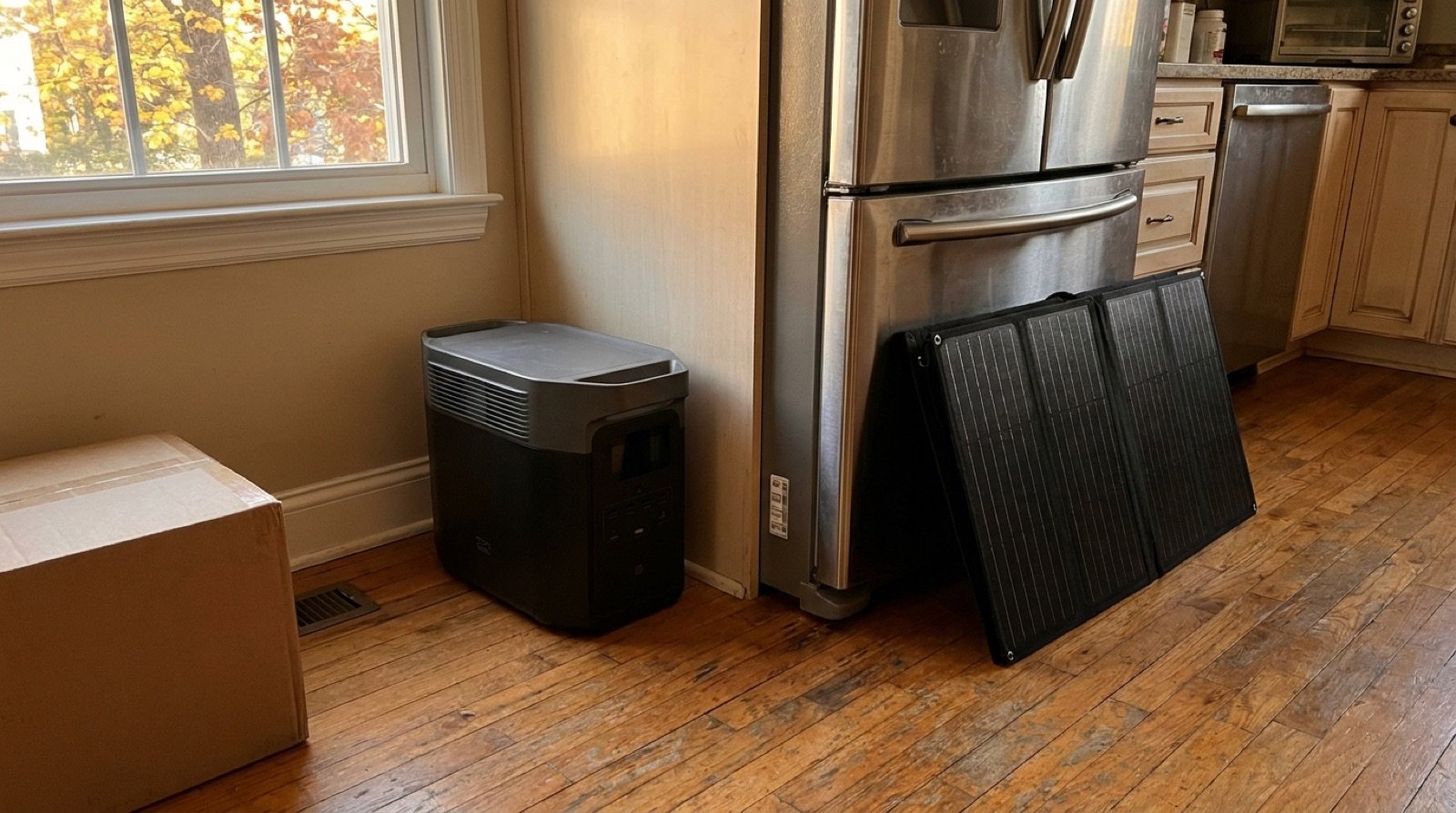
A sensible rule: aim for solar wattage of at least 20 to 25 percent of the battery’s Wh rating if you plan to recharge during multi-day outages. For a 2,048 Wh unit, that’s about 400 to 500 watts of panels. Also check that the bundle panel’s voltage and connector match the station’s solar input limits. Our guide to the best solar panels for portable power stations covers matching panels to inputs, and you may get better value buying the station alone and the panels separately.
Models Worth Watching This Week, by Class
These are established, currently sold models with LiFePO4 batteries from major brands. None is guaranteed to be discounted this week. Check the current price and run it through the checks above before buying. For our full ranked list, see the best portable power stations for home backup.
Small class: CPAP and router
- EcoFlow River 2 Pro (check current price): 768 Wh and 800 W continuous. Enough for a CPAP without humidifier for two nights or a router for well over a day. Light enough to carry to a bedside.
Mid class: fridge for half a day
- Anker SOLIX C1000 (check current price): about 1,056 Wh and 1,800 W continuous, with fast wall recharging. A good fit when you want to refill quickly during rolling outages.
- Bluetti AC180 (check current price): about 1,152 Wh and 1,800 W continuous. Slightly more capacity in the same class, which helps fridge runtime.
- Jackery Explorer 1000 v2 (check current price): about 1,070 Wh and 1,500 W continuous. Compact and simple, a good choice for households that want plug-and-go.
Large class: fridge for a full day or fridge plus freezer
- EcoFlow DELTA 2 Max (check current price): 2,048 Wh and 2,400 W continuous, expandable with an extra battery. Runs a fridge and a chest freezer together for most of a day.
- Bluetti AC200L (check current price): 2,048 Wh and 2,400 W continuous, also expandable. A direct rival, so compare cost per Wh between the two this week.
Home-scale: critical circuits
- EcoFlow DELTA Pro 3 (check current price): 4,096 Wh and 4,000 W continuous with 120/240 V output, expandable with add-on batteries. It can feed a transfer switch an electrician installs.
- Anker SOLIX F3800 (check current price): about 3,840 Wh and 6,000 W continuous with 120/240 V output, expandable. The higher output helps with 240 V loads like a well pump.
For home-scale units, budget for the installation too. A licensed electrician has to install the transfer switch or power inlet, and that cost isn’t part of any Black Friday deal.
Pre-Purchase Checklist
| Check | What to look for | Red flag |
|---|---|---|
| Capacity vs job | Your Wh math divided by 0.85 fits the rated capacity | Buying by peak watts alone |
| Continuous output | Covers your largest device plus everything running with it | Only a surge rating is advertised |
| Chemistry | LiFePO4, rated for 3,000 or more cycles | NMC with no cycle rating listed |
| Price history | At or below the model’s lowest recent price | Discount measured against an inflated list price |
| Cost per Wh | Competitive with same-class LiFePO4 rivals | Low per-Wh price on an outdated model |
| Solar bundle | Panel watts at least 20 percent of battery Wh | 100 W panel bundled with a 2,000 Wh station |
| Inverter | Pure sine wave output | Modified sine wave on a unit for medical devices |
| Safety listing | Listed to a recognized standard such as UL 2743 | No safety certification shown |
| Seller and warranty | Authorized retailer, 5 years or more on LiFePO4 | Marketplace seller with no manufacturer warranty |
| Returns | Holiday return window into January | Final-sale or restocking fee |
After It Arrives
Don’t let a new unit sit in its box until the first storm. Within the return window, charge it to 100 percent, run your real loads (fridge, CPAP, router) and confirm the runtime roughly matches your math. Update the firmware through the app, register the warranty, and note the recharge time from a wall outlet. If you plan to store it, keep it at about 50 to 80 percent charge in a cool, dry room and top it up every few months.
Bottom line
The best Black Friday power station buy is the one that matches your job, uses LiFePO4, beats its own price history and has a fair cost per Wh. Size it with simple watts x hours math, be skeptical of percentage badges and tiny bundled panels, and if nothing on your list hits a good price this week, there will be another sale. Buying the wrong size at a discount is still the wrong buy.
Frequently Asked Questions
Is Black Friday the best time of year to buy a power station?
It’s one of the best, but not the only one. Major brands also run deep sales around Prime Day, Labor Day and their own anniversary events. Compare this week’s price with the model’s recent low before treating it as a one-time chance.
Should I buy an older model on clearance?
Only if it uses LiFePO4, still carries a full manufacturer warranty and comes from an authorized seller. An older NMC unit can look cheap per Wh but wear out several times faster, so it often costs more per year of use.
What size power station do I need for a refrigerator?
For most full-size fridges, plan on 1,000 to 1,500 Wh for roughly 12 to 18 hours, or about 2,000 Wh for a full day. The math is average watts x hours, divided by 0.85 for inverter losses. Continuous output should be at least 1,500 W to handle the compressor’s startup surge comfortably.
Can I connect a Black Friday power station to my home’s panel?
Only home-scale units with the right output, and only through a transfer switch or power inlet installed by a licensed electrician. Never plug a power station into a wall or dryer outlet to backfeed the house. That can kill utility workers and damage your equipment.