
This post contains affiliate links. If you buy through them, we may earn a commission at no extra cost to you.
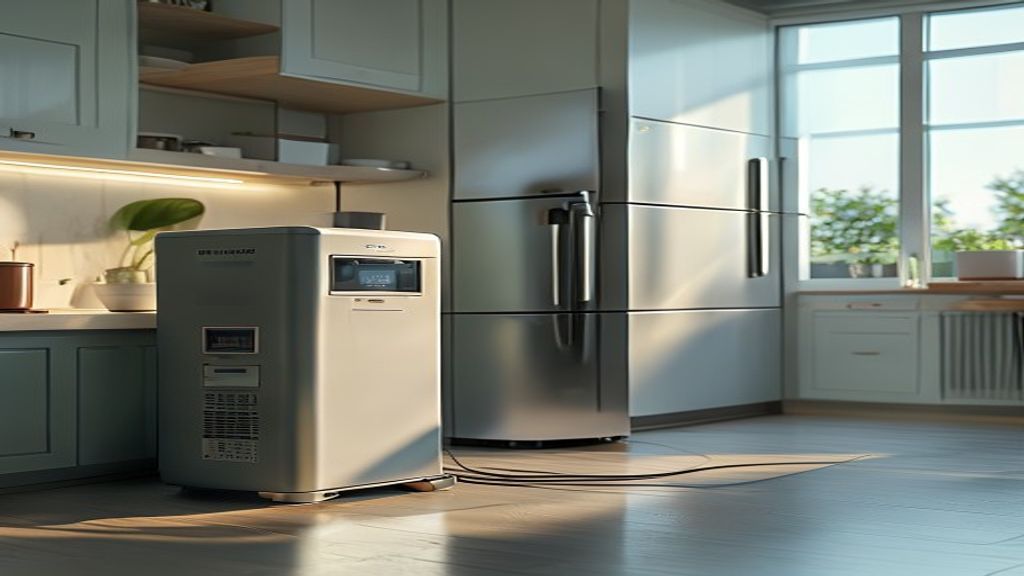
The refrigerator is the appliance everyone worries about first when the power goes out. A fridge full of groceries is $200–$500 of food racing against a clock, and a freezer full of meat raises the stakes further. So the question comes up constantly: can a portable power station actually keep a refrigerator running, and for how long?
The honest answer is yes, easily, and probably for longer than you think. A mid-size power station that struggles to run a space heater for an hour can keep a full-size refrigerator cold for the better part of a day, because refrigerators use far less energy than their labels suggest.
This guide gives you the real numbers: runtime estimates by battery size, the simple math to calculate your own fridge’s runtime, and the tricks that can stretch one battery across a multi-day outage.
Quick Answer: Runtime by Power Station Size
For a typical modern full-size refrigerator (18–20 cubic feet, averaging around 40–60 watts over time once compressor cycling is included):
- 300Wh station (roughly $200–$300): about 3–6 hours. An emergency bridge, not an outage plan.
- 500–600Wh station (roughly $350–$500): about 6–10 hours. Gets you through an evening.
- 1,000Wh station (roughly $600–$1,000): about 10–18 hours. The realistic minimum for overnight coverage.
- 2,000Wh station (roughly $1,000–$1,800): about 1–2 days. The sweet spot for storm-prone areas.
- 3,600Wh and up (roughly $2,000–$3,500): about 2–4 days, and effectively indefinite with solar panels.
Older, larger, or badly sealed refrigerators can cut these numbers roughly in half. Compact dorm-style fridges and dedicated freezers often run 1.5–2 times longer.
Why Refrigerators Are Trickier Than Other Appliances
Two things make fridge runtime confusing, and both work in opposite directions.
First, the compressor cycles on and off. A refrigerator does not draw power continuously. The compressor runs until the box reaches temperature, then shuts off until the temperature drifts up again. In a typical kitchen, the compressor runs roughly 30–50% of the time. So a fridge that draws 150 watts while running only averages around 40–70 watts across an hour. This is why runtime is so much better than the nameplate wattage suggests, you size the battery for the average, not the label.
Second, the compressor surges at startup. For a fraction of a second when the compressor kicks on, it can draw 2–3 times its running wattage. A fridge that runs at 150 watts may briefly demand 400–1,200 watts at startup. Your power station’s inverter has to handle that spike or the fridge simply will not start. This is why a tiny 300W-output power bank cannot run a full-size fridge even though the average draw is well within its capacity.
The practical rule: for a typical full-size refrigerator, choose a power station with at least 800–1,500 watts of surge (peak) output. Most stations rated at 1,000W continuous or higher clear this bar comfortably; check the “surge” or “peak” spec, which manufacturers list alongside continuous output.
Check the current price of the Bluetti AC180 portable power station on Amazon.
How to Find Your Fridge’s Real Consumption
Skip the label on the back, it shows worst-case amperage, not real usage. Two better methods:
- The EnergyGuide shortcut. Every fridge sold in the US has a yellow EnergyGuide label (also findable online by model number) listing estimated annual kilowatt-hours. Divide by 365 to get daily consumption, then by 24 for the average hourly draw. A fridge rated at 400 kWh/year uses about 1,100 Wh per day, or an average of roughly 46 watts. That single number is the key to all your runtime math.
- A plug-in watt meter. Inexpensive electricity usage monitors (the Kill A Watt is the classic example of the category, typically around $20–$40) plug in between the fridge and the wall and log actual consumption over 24 hours. This captures your real kitchen temperature, your door-opening habits, and your fridge’s age, the most accurate answer you can get.
Typical real-world numbers: a modern Energy Star full-size fridge averages roughly 30–60 watts; a 10–15 year old model averages roughly 60–100 watts; a garage fridge in summer or a side-by-side with an ice maker can average 100 watts or more.
The Runtime Formula (One Line of Math)
Once you know your fridge’s average draw, runtime is simple:
Runtime (hours) = Battery capacity (Wh) × 0.85 ÷ average fridge draw (W)
The 0.85 accounts for inverter losses, converting DC battery power to AC wall power wastes roughly 10–20% as heat, and running near-empty is never quite as clean as the spec sheet. Some stations do a bit better, some worse, but 85% is a fair planning number.
Worked example: an 18 cu ft fridge on a 1,024Wh station
Take a common pairing: a modern 18 cubic foot refrigerator and a 1,024Wh power station (a popular size class from brands like EcoFlow, Bluetti, Jackery, and Anker).
See current pricing for the EcoFlow Delta 2 on Amazon.
- The fridge draws about 150 watts while the compressor runs.
- The compressor runs roughly 30% of the time in a closed, unopened state during an outage, plus a small constant draw for electronics. Call the true average 40–45 watts. (This matches an EnergyGuide rating of roughly 350–400 kWh/year.)
- Usable energy: 1,024Wh × 0.85 = roughly 870Wh.
- Runtime: 870Wh ÷ 42W ≈ roughly 20 hours.
So a mid-size 1kWh station realistically carries a modern fridge through a full overnight outage with margin to spare. If your fridge is older and averages 70 watts, the same battery delivers roughly 12 hours, still respectable, and still enough for the large majority of US outages, which are restored within a day.
Duty Cycle: Why Your Fridge Helps You During an Outage
Here is the counterintuitive good news: a fridge in outage conditions often uses less power than normal, not more.
During an outage you are (hopefully) not opening the door every twenty minutes, not loading in warm groceries, and not running the ice maker. With the door closed, a well-sealed fridge that starts cold may cycle its compressor only 25–35% of the time. The single biggest variable in your runtime is not the battery, it is how many times someone opens that door.
Every door opening dumps the cold air out and forces a compressor run of several minutes to recover. Ten unnecessary door openings can cost you an hour or two of total runtime.
Tricks to Stretch Runtime Across a Multi-Day Outage
- Pre-chill before the storm. If an outage is forecast, set the fridge and freezer to their coldest settings a few hours ahead. That stored cold is free runtime, the box can drift up through the normal range for hours before food safety is at risk.
- Freeze water bottles now. A freezer packed with frozen water bottles holds temperature dramatically longer, and you can move bottles into the fridge compartment as giant ice packs. A full freezer holds safe temperatures for roughly 48 hours unpowered; a half-empty one, roughly 24.
- Keep the door closed. An unopened fridge keeps food safe for about 4 hours with no power at all. Decide what you need before you open it, grab everything at once, and close it.
- Power it intermittently. The biggest stretch of all: a fridge does not need continuous power to stay safe, it needs periodic cooling. Running the fridge roughly 15–20 minutes per hour, or 30 minutes every two hours, holds safe temperatures while cutting battery consumption dramatically. This is how a modest 500Wh station can protect a fridge for a day or more. Use a thermometer inside the fridge and keep it below 40°F.
- Skip the ice maker and defrost cycles if you can. Some fridges let you disable the ice maker; its heater and motor are pure waste during an outage.
- Move the priorities. If it turns into a long outage, consolidate the expensive and perishable items (meat, dairy, medication) into the freezer or a high-quality cooler with your frozen bottles, and let the rest go.
Solar Recharging: The Multi-Day Answer
Batteries alone are a race against the clock; batteries plus solar panels reset the clock every day. Most power stations accept folding solar panels, and the math works out surprisingly well for refrigerator duty.
A fridge averaging 45 watts needs roughly 1,100Wh per day. A 200W folding panel in decent summer sun realistically produces roughly 800–1,200Wh per day (panels rarely hit their rated output, plan on 50–75% in good conditions, less in winter or clouds). That means a single 200W panel roughly offsets a modern fridge’s daily consumption, and a 400W array does it with comfortable margin for cloudy stretches, phone charging, and lights.
A 2,000Wh station plus 400W of panels is effectively an indefinite refrigerator solution for summer storm season: the battery bridges the nights, and the panels refill it each day.
What About the Freezer, or Both at Once?
A standalone chest freezer is actually an easier load than a fridge, it averages roughly 30–50 watts, cycles less when unopened, and holds cold far longer. Running a full-size fridge and a chest freezer together roughly doubles your average draw to around 80–120 watts, which means a 2,000Wh station covers both for roughly 14–21 hours, and the intermittent-powering trick works on both boxes.
Watch the surge, though: if both compressors happen to start at the same instant, the combined spike can exceed 2,000 watts. A station with a 2,400W+ surge rating, or simply staggering which unit is plugged in, avoids the problem.
Frequently Asked Questions
Will a 300Wh power station run a full-size refrigerator?
Usually yes, briefly, if its inverter handles the startup surge. Many 300Wh stations output only 300–600W continuous with roughly 600–1,200W surge, which is right at the edge for a full-size fridge. If it starts, expect roughly 3–6 hours of continuous runtime, or a day of protection using the 15-minutes-per-hour intermittent approach. It is an emergency bridge, not a storm plan.
How many watts does a refrigerator really use?
A typical modern full-size fridge draws roughly 100–250 watts while the compressor runs, surges to roughly 400–1,200 watts for an instant at startup, and averages roughly 30–60 watts over time because the compressor only runs 30–50% of the time. Check your yellow EnergyGuide label: annual kWh ÷ 365 ÷ 24 × 1,000 gives your true average wattage.
Can I plug my fridge straight into the power station, or do I need anything else?
Just plug it in, a standard household extension cord rated 14-gauge or better is fine for the short distance. There is no transfer switch or electrician involved, which is exactly why power stations are the simplest fridge backup. Keep the station in a ventilated indoor spot; unlike generators, they produce no fumes and are safe in the kitchen.
Is a power station or a gas generator better for keeping a fridge running?
For outages under about a day, the power station wins on every axis except price per watt-hour: silent, indoor-safe, zero maintenance, instant start. For multi-day outages, either add solar panels to the power station or use a small inverter generator to recharge the station once or twice a day, the battery runs the fridge silently overnight, and the generator does an hour of noisy work at lunchtime.
Related: Shopping for the right unit? Compare the top brands in our EcoFlow vs Bluetti vs Jackery guide.
Runtime figures are estimates based on typical appliance consumption and manufacturer specifications; your refrigerator’s age, size, settings, and ambient temperature will move the numbers. When in doubt, measure your own fridge with a watt meter before the next storm.