
This post contains affiliate links. If you buy through them, we may earn a commission at no extra cost to you.
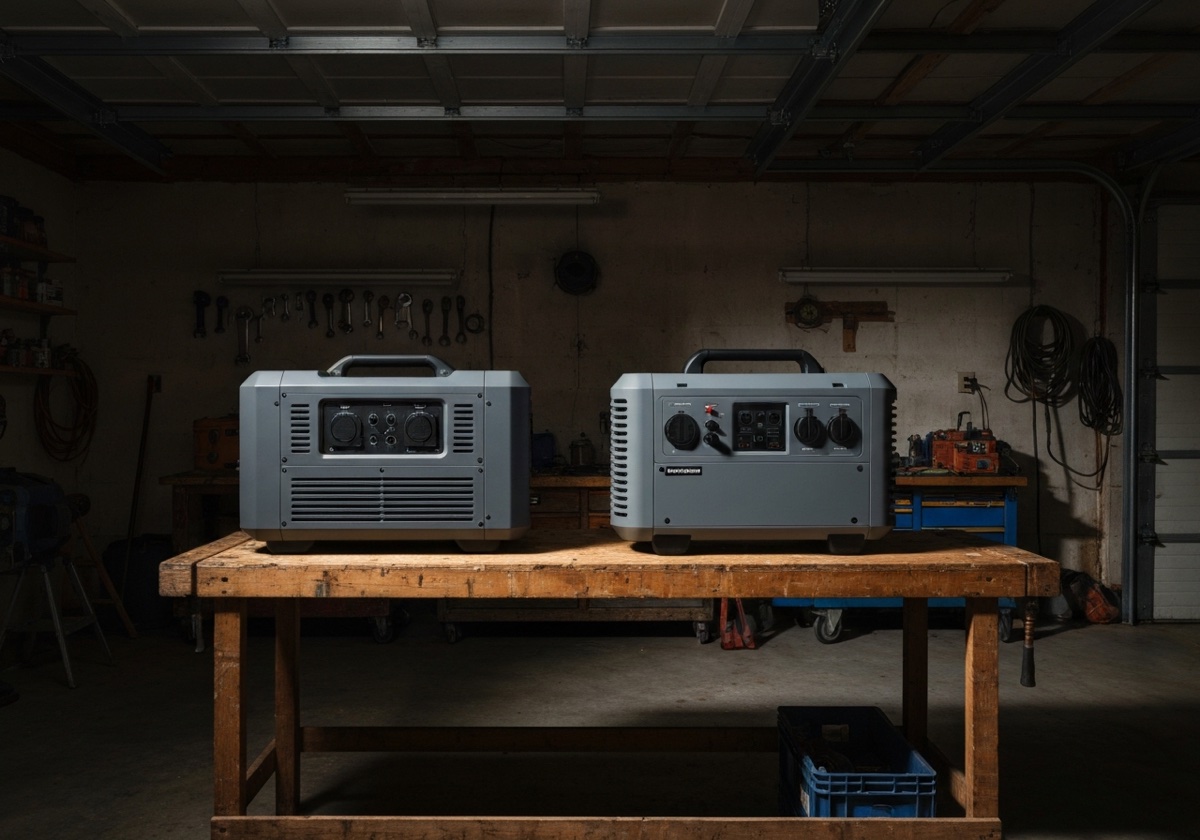
If you have narrowed your power station search to the 2kWh class, you have almost certainly landed on these two: the Bluetti AC200L and the EcoFlow Delta 2 Max. They are the flagship mid-range units from the two most aggressive brands in the industry, they sit at nearly identical price points, and on paper they look like twins: roughly 2,048Wh of LiFePO4 storage and roughly 2,400W of continuous output each.
Look closer, though, and they are built around different bets. Bluetti bet on raw solar input, expansion headroom, and an RV-ready outlet. EcoFlow bet on lighter weight, a smarter app, and a more mature home-integration ecosystem. Which bet pays off depends entirely on what you are backing up.
This is a research-based comparison drawn from manufacturer specifications and consistent patterns in owner feedback, not hands-on lab testing. Here is how the two stack up, round by round.
See current prices: Bluetti AC200L on Amazon | EcoFlow Delta 2 Max on Amazon.
Quick Answer: Which One Should You Buy?
- Buy the Bluetti AC200L if you want maximum solar charging (~1,200W input), the biggest expansion ceiling, or you own an RV and want the 30-amp TT-30 outlet built in. It is the better off-grid and RV machine.
- Buy the EcoFlow Delta 2 Max if the unit will mostly live in your house as outage insurance, you value the roughly 12 pounds of weight savings, or you want the more polished app and the option to grow into EcoFlow’s broader home-backup ecosystem. It is the better home-backup machine.
Both are excellent. Neither is a mistake. The rest of this article is about matching the right one to your situation.
Spec Comparison at a Glance
Specs below are approximate, based on manufacturer documentation; verify current listings before buying.
| Spec (approx.) | Bluetti AC200L | EcoFlow Delta 2 Max |
|---|---|---|
| Capacity | ~2,048Wh | ~2,048Wh |
| Chemistry | LiFePO4 | LiFePO4 |
| Continuous AC output | ~2,400W | ~2,400W |
| Overload feature | Power Lifting to ~3,600W | X-Boost to ~3,100W |
| Max AC charging | ~2,400W (adjustable) | ~1,800W AC (~2,400W with solar combined) |
| AC recharge to ~80% | Roughly 45 minutes | Roughly 1 hour |
| Max solar input | ~1,200W | ~1,000W |
| Expansion | External batteries (B300K and others), to roughly 8kWh+ | Up to 2 extra batteries, to ~6,144Wh |
| Weight | ~62 lbs | ~50 lbs |
| Notable ports | 4 AC outlets, 30A TT-30 RV outlet, USB-C ~100W, 12V/30A DC | 6 AC outlets, 2 USB-C ~100W, 4 USB-A, 12V car port |
| UPS-style switchover | Yes, ~20–30ms | Yes, ~30ms |
| Cycle rating | ~3,000+ cycles to 80% | ~3,000 cycles to 80% |
| Warranty | 5 years | 5 years |
| Typical street price | Around $1,100–$1,500 | Around $1,400–$1,700 |
Round 1: Capacity and Output
On the headline numbers, this round is a dead heat: both units store roughly 2,048Wh and push roughly 2,400W continuous. Either one will run a full-size refrigerator for around 20 hours, a CPAP for a week of nights, or a window AC unit for 2–3 hours. Either one will start and run nearly any household appliance short of central air or an electric range.
The separation comes in overload behavior. Bluetti’s Power Lifting Mode stretches the AC200L to roughly 3,600W for simple resistive loads like space heaters and kettles, while EcoFlow’s X-Boost tops out around 3,100W. Both features reduce voltage to the load, so neither should be used with sensitive electronics or motor-driven appliances, but Bluetti’s higher ceiling gives it slightly more flexibility with big resistive loads.
Round winner: Bluetti AC200L, narrowly, on overload headroom. For normal loads, it is a tie.
Round 2: Charging Speed
This is usually EcoFlow’s home turf, which makes the AC200L’s performance here surprising. Bluetti specs the AC200L at up to roughly 2,400W of AC input, reaching about 80% in roughly 45 minutes. The Delta 2 Max takes around 1,800W from a wall outlet, hitting 80% in roughly an hour, and reaches its ~2,400W maximum only when you combine AC with solar simultaneously.
In practice, both are extraordinarily fast by any historical standard; five years ago, this class of unit took 8 hours to fill. Both apps also let you dial charging speed down, which reduces fan noise and heat and extends long-term battery health. But on pure wall-outlet speed, Bluetti holds the edge.
On solar, the gap widens. The AC200L accepts roughly 1,200W of panel input against roughly 1,000W for the Delta 2 Max. With a full array, that is the difference between a roughly 2-hour and a roughly 2.5-hour solar recharge, and over a multi-day outage those margins compound.
Round winner: Bluetti AC200L.
Round 3: Expandability
Both units accept external batteries, and this is where your five-year plan matters more than your day-one needs.
The AC200L pairs with Bluetti’s expansion packs, most notably the B300K (roughly 2,764Wh each), and supports configurations reaching roughly 8kWh or more of total storage. Bluetti’s expansion catalog is broad, and the company has kept older packs compatible across generations more often than not.
The Delta 2 Max accepts up to two Delta 2 Max extra batteries (roughly 2,048Wh each), capping the system at roughly 6,144Wh. That is plenty for most households, and the click-in cable design is clean, but the ceiling is lower and the path beyond it means moving up to EcoFlow’s larger Delta Pro ecosystem.
One nuance from owner feedback: EcoFlow’s extra batteries integrate seamlessly with the app’s state-of-charge reporting, while Bluetti’s larger menagerie of packs can involve more cable and compatibility homework. Do that homework before buying, not after.
Round winner: Bluetti AC200L on ceiling; EcoFlow on simplicity. If you will realistically never exceed 6kWh, call it even.
Round 4: Portability
Neither of these is a camping tote. But the difference is real: the AC200L weighs roughly 62 pounds against roughly 50 pounds for the Delta 2 Max. Twelve pounds does not sound like much until you are lifting the unit into a truck bed, carrying it up basement stairs during an outage, or repositioning it between the garage and the kitchen.
The Delta 2 Max is also slightly more compact, with the familiar EcoFlow suitcase-style form factor and well-placed handles. The AC200L is a bulkier box. Owner feedback consistently flags the AC200L’s weight as its most common complaint, and just as consistently praises the Delta 2 Max as “manageable for one person.”
Round winner: EcoFlow Delta 2 Max, clearly.
Round 5: Noise
Both units are silent when idle or under light load; fan noise appears during fast charging and heavy discharge. Manufacturer figures and owner reports put both in the same general band, roughly 40–50dB under load, about the level of a quiet conversation.
The practical difference is control. Both apps let you slow the charge rate to keep fans quiet, but EcoFlow’s implementation is more granular, and patterns in owner feedback suggest the Delta 2 Max runs its fans somewhat less aggressively at moderate loads. The AC200L’s fans work harder during its very fast 2,400W charging, which is the price of that speed; slow it down in the app and it quiets right back down.
Round winner: EcoFlow Delta 2 Max, narrowly. If bedroom-level silence matters, charge either unit at reduced speed.
Round 6: App, Software, and UPS Mode
EcoFlow’s app is the best in the industry, and the Delta 2 Max benefits fully: charge-speed sliders, charge limits (capping at 85% to stretch cycle life), timers, energy statistics, and reliable firmware updates over Wi-Fi. Bluetti’s app has improved substantially and covers the same core functions, but the interface is less refined and owner feedback reports more occasional connectivity quirks.
Both units offer UPS-style pass-through: plug the unit into the wall, plug your devices into the unit, and when grid power fails, the battery takes over in roughly 20–30 milliseconds. That is fast enough for routers, TVs, CPAPs, and most desktop computers, though neither brand markets these as true online UPS units for mission-critical servers. Owner feedback on both is positive for household use: fridges and Wi-Fi ride through outages without a blink.
Round winner: EcoFlow Delta 2 Max on app quality; UPS capability is effectively a tie.
Round 7: Price and Value
List prices hover close together, with the AC200L around $1,699 and the Delta 2 Max around $1,899, but street prices are what matter, and both brands discount aggressively and often. In 2026, the AC200L routinely sells around $1,100–$1,500, while the Delta 2 Max typically lands around $1,400–$1,700. Sale timing can flip any individual week, but the pattern is consistent: the Bluetti is usually a few hundred dollars cheaper for the same capacity.
Per watt-hour, that makes the AC200L one of the strongest values in the entire 2kWh class. The Delta 2 Max asks you to pay a premium for lower weight, a better app, and the EcoFlow ecosystem, which is a fair trade if those are the things you will actually use.
Round winner: Bluetti AC200L.
The Verdict: It Hinges on Where This Battery Will Live
Score it on rounds and the AC200L takes four to EcoFlow’s three, but round-counting misses the point. These units win in different homes.
For home backup: EcoFlow Delta 2 Max
If this unit will spend its life plugged into a wall as outage insurance, running the fridge, Wi-Fi, and a bedroom during storms, take the Delta 2 Max. The weight savings matter every time you move it, the UPS behavior and app are more polished, and EcoFlow’s home ecosystem (smart panels, larger Delta Pro systems) gives you a growth path if backup power becomes a bigger priority later.
For off-grid and solar-heavy use: Bluetti AC200L
If this battery will earn its living off panels, at a cabin, a homestead, or extended boondocking, the AC200L’s roughly 1,200W solar input and larger expansion ceiling make it the stronger foundation. Faster solar recharge is the single most valuable spec when the sun is your only fuel.
For RV life: Bluetti AC200L
The built-in 30-amp TT-30 outlet is the quiet killer feature here: you can plug an RV’s shore power cord directly into the AC200L with no adapters. Combined with the solar input advantage and lower price, it is the natural pick for RV owners, provided you have a fixed spot for it, because you will not enjoy carrying it far.
The honest bottom line
These are two of the best-engineered power stations ever sold at this price, and the specs that overlap, which is most of them, are excellent on both. You are not choosing between a good unit and a bad one. You are choosing between two ecosystems, and the deciding questions are simple: How much solar will you feed it? How big might your system grow? And how often will you physically carry it? Answer those three questions and the winner picks itself.
Frequently Asked Questions
Can either unit run a full-size refrigerator during an outage?
Yes, easily. A modern full-size fridge averages 100–200 watts over time, well within both units’ output, and roughly 2,048Wh of storage translates to somewhere around 15–25 hours of fridge runtime depending on the model and how often the door opens. Add solar panels and either unit can keep a fridge cold indefinitely in decent weather.
Which one holds its capacity longer?
Both use LiFePO4 cells rated around 3,000+ cycles to 80% capacity, so expected degradation is similar: even with daily cycling, both should retain most of their capacity for roughly eight years, and far longer under occasional backup use. Neither has a meaningful longevity advantage on paper.
Do I need the expansion battery on day one?
No, and most buyers should not buy one on day one. Run the base unit through a real outage or a real trip first; many households discover 2kWh covers their essentials. Both systems let you add batteries later, though it is wise to confirm the expansion pack you want is still in production before waiting years.
Is the UPS mode on these units safe for a desktop computer?
For typical home desktops, yes. Both switch over in roughly 20–30 milliseconds, fast enough that most computer power supplies ride through without a reboot. For mission-critical workstations or servers, a dedicated online UPS is still the correct tool, with the power station as the longer-duration second layer behind it.
Related: Zooming out from these two models, see our full EcoFlow vs Bluetti vs Jackery brand comparison.
Specifications and prices in this article are approximate, based on manufacturer documentation at the time of writing, and both brands revise models and pricing frequently. Always verify current specs and pricing before purchasing.