
This post contains affiliate links. If you buy through them, we may earn a commission at no extra cost to you.
A generator without fuel is a very expensive lawn ornament. Yet fuel storage is the part of backup power planning most people get wrong, and the mistakes range from annoying (a carburetor gummed up by stale gasoline) to genuinely dangerous (gas cans stored next to a water heater in the basement).
The good news is that safe fuel storage is not complicated. It comes down to four decisions: how much to store, what to store it in, where to put it, and how often to rotate it. Get those four right and your generator will start when the storm hits, and your home will not become the local fire department’s next case study.
This guide covers gasoline, propane, and diesel, because the rules are very different for each. By the end you will know exactly how many gallons to keep, which containers pass code, and why propane users get to skip most of this article entirely.
Quick Answer: Storing Generator Fuel Safely
- How much: Plan for roughly 12–20 gallons of gasoline for a 3-day outage with a typical portable generator, or two to four 20 lb propane tanks for a dual-fuel model run conservatively.
- Gasoline shelf life: Roughly 3–6 months untreated; 1–3 years with a fuel stabilizer added at fill-up.
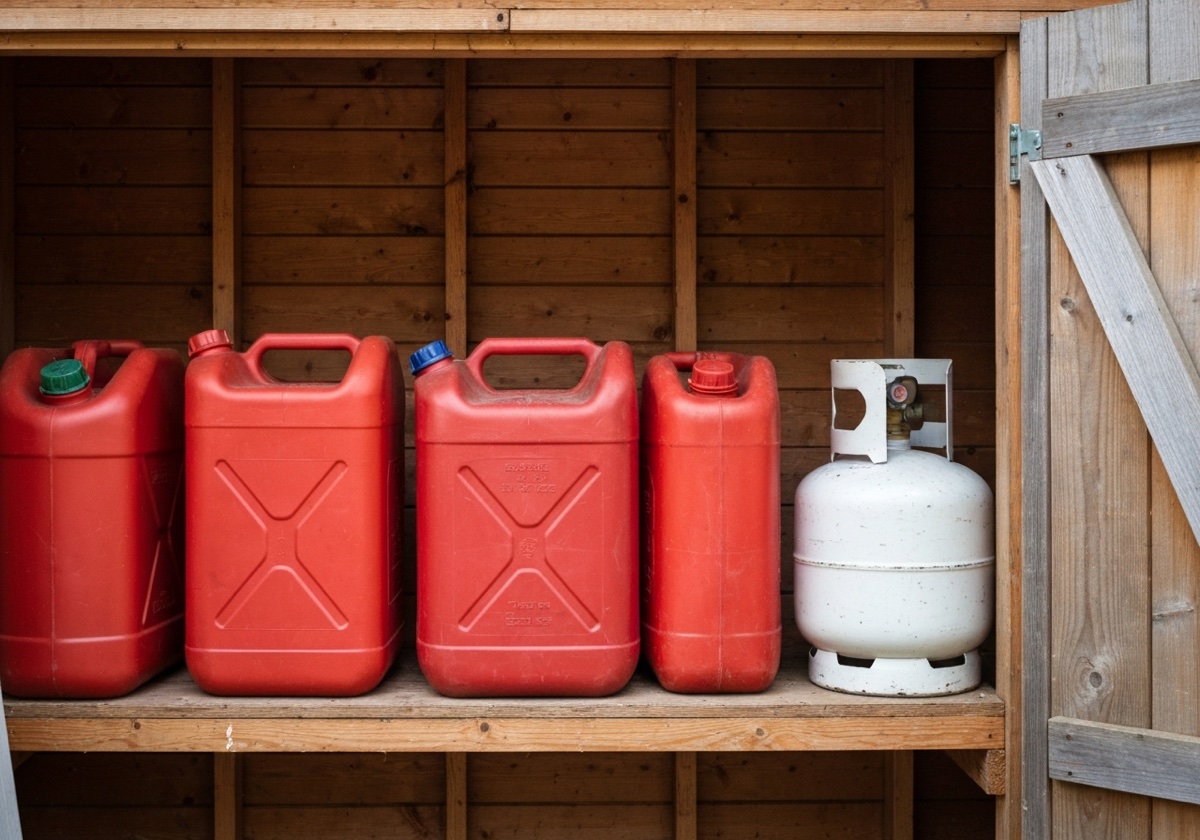
- Containers: Only approved containers, either red DOT-approved plastic cans (usually 5 gallons max each) or metal safety cans with flame arrestors. Never milk jugs, water containers, or anything improvised.
- Location: A detached shed or garage away from the house. Never inside the home, never in a basement, never near a water heater, furnace, or anything with a pilot light or spark.
- Limits: Many U.S. fire codes cap residential gasoline storage at roughly 25 gallons outside an approved cabinet. Check your local code and your homeowner’s insurance policy.
- Easiest option: Propane. It stores indefinitely, does not spill, and a stack of 20 lb tanks in a shaded outdoor spot is both legal and low-risk almost everywhere.
How Much Fuel Do You Actually Need to Store?
Start with your generator’s real-world consumption, not the label. A typical 3,500–4,500 watt portable generator burns roughly 0.3–0.5 gallons of gasoline per hour at half load. A big 7,500 watt unit can burn 0.75 gallons per hour or more when working hard.
But almost nobody needs to run a generator 24 hours a day. The smarter pattern is intermittent running: two or three blocks of 3–4 hours daily to cool the refrigerator, charge devices, and run essentials. That cuts consumption to roughly 4–6 gallons per day for a mid-size generator.
Working targets for gasoline storage:
- Weekend outage (1–2 days): roughly 10 gallons, two 5-gallon cans
- Storm-season standard (3 days): roughly 15–20 gallons, three to four cans
- Hurricane-zone serious (5–7 days): roughly 25–30 gallons, which starts bumping into code limits and is a strong argument for switching to propane or a dual-fuel generator
For propane, a 20 lb grill tank holds about 4.6 gallons of propane and runs a mid-size dual-fuel generator for roughly 8–10 hours at half load. Three or four tanks cover a 3-day outage with intermittent running, and unlike gasoline, they will still be full and fresh five years from now.
Check the current price of a 20 lb propane tank on Amazon.
Gasoline: Powerful, Cheap, and the Hardest to Store
Shelf life is shorter than you think
Modern pump gasoline, especially E10 with 10% ethanol, starts degrading in roughly 3–6 months. The ethanol absorbs moisture from the air, the lighter compounds evaporate, and the fuel oxidizes into varnish that clogs carburetors. A generator that sat all year with old gas in the tank is the single most common reason backup generators fail to start.
Two fixes:
- Add fuel stabilizer at fill-up. Products in the stabilizer category (Sta-Bil, Sea Foam, PRI-G, and similar) extend usable life to roughly 1–3 years depending on the product and dose. Add it the day you buy the fuel, not months later; stabilizer preserves fresh gas, it does not resurrect stale gas.
- Buy ethanol-free gasoline if you can. Sold at some stations and most marinas as “recreation fuel,” it stores noticeably longer and is kinder to small engines. It costs roughly $0.50–$1.50 more per gallon.
Check the current price of STA-BIL fuel stabilizer on Amazon.
Approved containers only
Store gasoline only in containers designed and certified for it:
- Red plastic DOT/ASTM-approved cans, usually 1–5 gallons. Since 2009, new cans sold in the U.S. must have flame mitigation devices and self-closing spouts. Red is the standard color code for gasoline (yellow is diesel, blue is kerosene); keep the colors honest so nobody pours the wrong fuel.
- Metal safety cans (Justrite, Eagle, and similar) with spring-loaded lids and flame arrestors. They cost roughly $40–$80 each but are the gold standard, and some local codes require them above certain quantities.
See current pricing for a No-Spill 5 gallon gas can on Amazon.
Never use milk jugs, water jugs, or generic containers. Gasoline softens ordinary plastics, vapor pressure can burst sealed containers in the heat, and a static spark while pouring from an unapproved container is a real ignition risk. Fill cans only to about 95% to leave room for expansion, and always fill them on the ground, never in a truck bed or on a carpeted surface, to avoid static buildup.
Where to store gasoline
This is where mistakes turn dangerous. Gasoline vapors are heavier than air, drift along the floor, and can be ignited by a water heater pilot light or a furnace igniter across the room.
- Never inside the house. Never in a basement. No exceptions, no quantities small enough to be safe.
- Best option: a detached shed at least 10 feet or more from the house, ventilated, out of direct sun, and away from anything that sparks. A small dedicated fuel locker or metal deck box works well.
- Attached garage: acceptable in small quantities if there is no gas appliance in the garage, the cans are approved and tightly closed, and they sit on the floor away from the door to the house. Many fire officials still discourage it; a detached location is always better.
- Keep it cool and shaded. Heat accelerates degradation and raises vapor pressure. Aim for a spot that stays under roughly 80°F most of the time.
- Keep it locked or out of reach of children.
Know your local limits
Most U.S. jurisdictions base residential limits on the International Fire Code or NFPA guidance. A common ceiling is roughly 25 gallons of gasoline stored at a residence in approved containers, with larger amounts requiring approved flammable-liquid storage cabinets or permits. Some states and cities set lower limits, HOAs sometimes add their own rules, and homeowner’s insurance policies can deny fire claims involving improperly stored fuel. Ten minutes on your city or county fire marshal’s website is worth it before you build a 50-gallon stockpile.
Propane: The Storage Winner
If storing gasoline sounds like a part-time job, that is because it is, and it is the main reason dual-fuel generators have become so popular. Propane solves almost every storage problem:
- It never goes stale. Propane stored in a sealed tank is chemically stable indefinitely. The tank’s certification expires (12 years for a new 20 lb tank, then recertification), not the fuel.
- No spills, no vapors while stored. Tanks are sealed pressure vessels with relief valves. There is nothing to slosh, evaporate, or varnish.
- No rotation schedule. Buy four tanks, check the valves once a year, done.
- It is kinder to the engine. Propane burns clean, so no gummed carburetors after months of sitting.
The trade-offs: propane delivers roughly 10% less power than gasoline in the same generator, tanks are bulkier per unit of energy, and regulators can struggle in extreme cold (below roughly -20°F propane stops vaporizing well, though that is rarely an issue with 20 lb tanks kept above ground).
Storage rules for propane are simpler but strict on one point: always outdoors or in a detached, well-ventilated structure, always upright, never inside the house, basement, or an attached garage. A shaded spot outside, a ventilated deck box, or a milk-crate rack against the shed wall is ideal. Propane tanks handle rain and cold fine; what they should not get is direct summer sun against a dark wall or any enclosed indoor space where a leak could pool.
Diesel: For Big Generators and Long Storage
Diesel mostly matters for larger portable and standby units. It stores better than gasoline, roughly 6–12 months untreated and 2 years or more with a diesel-specific stabilizer and biocide, because diesel’s enemies are different: water condensation and microbial growth (“diesel bug”) rather than evaporation.
Diesel rules of thumb:
- Use yellow approved containers to keep it separate from gasoline.
- Keep containers as full as practical to reduce the air space where condensation forms.
- Add a biocide plus stabilizer for storage beyond 6 months.
- In cold climates, use winterized diesel or an anti-gel additive; untreated diesel starts clouding around 15–20°F.
- The same location rules apply: detached, ventilated, shaded, away from ignition sources. Diesel is less volatile than gasoline, but it is still a combustible liquid and codes still limit quantities.
The Rotation Schedule That Actually Works
Stored fuel is only useful if it is fresh, and the easiest rotation system is the one that requires no discipline: burn your storage fuel in vehicles and equipment you already use.
Here is a realistic example. Suppose you keep four 5-gallon cans of stabilized gasoline for a 4,000 watt generator in a hurricane-prone area. Number the cans 1 through 4 with a paint marker and write the fill date on a strip of masking tape. Every three months, pour the two oldest cans into your car or truck (20 gallons of gas is simply two fill-ups you were going to buy anyway), then refill those cans with fresh gas and fresh stabilizer on the way home. Each can is never more than about 6 months old, the stabilizer provides margin beyond that, and your total fuel cost for the entire rotation program is roughly $5–$10 per quarter, the price of the stabilizer alone.
Pair the fuel rotation with a generator exercise: run the generator for 15–20 minutes under some load once a month or at least once a quarter, and run the carburetor dry (or shut the fuel valve and let it stall) before putting it away. Stale gas in the can is a problem; stale gas inside the carburetor is the problem.
Safety Rules That Are Not Optional
- Never fuel a hot or running generator. Shut it down and let it cool for 10–15 minutes. Gasoline spilled on a hot muffler is the classic generator fire.
- Keep fuel at least 20–25 feet from the running generator and away from any open flame, grill, or smoking area.
- Vapors travel. Open flames or spark sources within roughly 25 feet of fuel transfer are a risk, even outdoors.
- Keep a fire extinguisher rated for flammable liquids (Class B, typically an ABC unit) near, but not inside, your fuel storage area.
- Do not stockpile in a heat wave rush. Filling a trunk full of loose cans and driving home in 95°F heat is one of the higher-risk moments in all of this. Secure cans upright, crack the windows, and unload immediately.
- Label everything with contents and fill date. Future you, in the dark, in the rain, will be grateful.
Frequently Asked Questions
How long can I store gasoline for my generator?
Untreated pump gasoline stays reliably usable for roughly 3–6 months. With a quality fuel stabilizer added when the fuel is fresh, plan on 1–2 years, and some products claim up to 3. Ethanol-free gasoline plus stabilizer stores the longest. When in doubt, rotate it into a vehicle; old fuel that seems “probably fine” is how carburetors die.
Can I store gas cans in my attached garage?
Small quantities in approved, tightly closed containers are generally tolerated by code, but it is the least-preferred legal option. Never do it if the garage houses a water heater, furnace, or dryer, and never store more than one or two cans there. A detached shed 10 or more feet from the house is dramatically safer and usually costs less than the fuel it protects.
Is propane really better than gasoline for backup fuel?
For storage, yes, and it is not close. Propane lasts indefinitely, cannot spill, and stores legally outdoors with almost no rules to manage. The costs are roughly 10% less generator output and bulkier tanks. For most homeowners, a dual-fuel generator with three or four 20 lb tanks plus one or two cans of stabilized gasoline for surge needs is the best of both worlds.
How many gas cans am I legally allowed to keep at home?
It varies by state and city, but a common fire-code ceiling is roughly 25 gallons of gasoline in approved containers per residence, with more requiring an approved storage cabinet or permit. Some jurisdictions are stricter, and insurers may have their own language. Check with your local fire marshal’s office, especially before storing more than four or five standard cans.
This article is for general information only. Fuel storage regulations vary by state, county, and municipality, and improper storage can create serious fire hazards. Always follow your local fire code, your container and generator manufacturers’ instructions, and consult your local fire marshal or insurance provider if you are unsure about the rules where you live.