
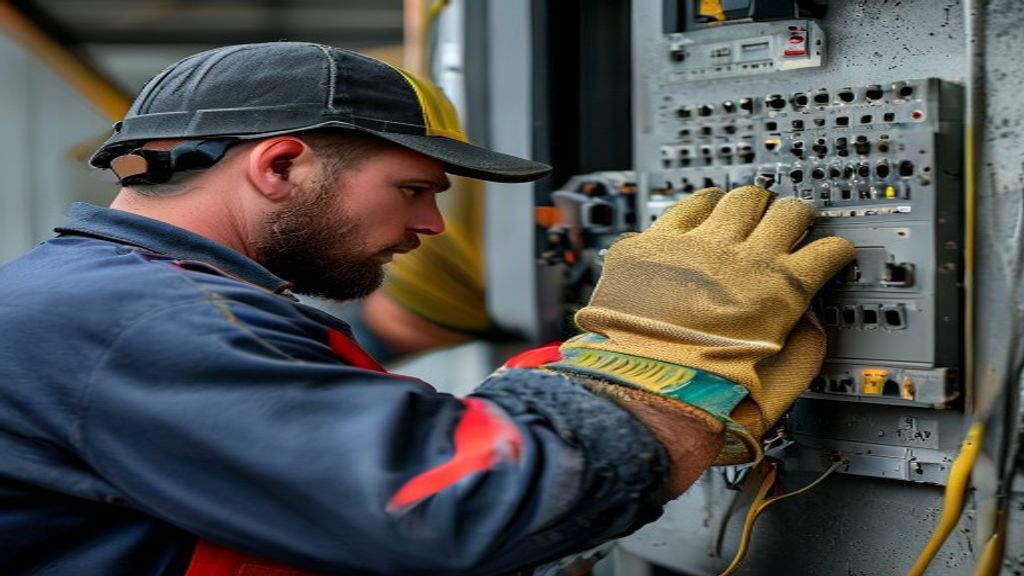
You bought a generator, the storm knocked out your power, and now you are staring at your electrical panel wondering how to actually get that generator power into your house. Extension cords snaked through cracked windows will run a fridge and a few lamps, but they will not run your furnace blower, your well pump, or anything hardwired into your walls. For that, you need a transfer switch. And the choice between manual and automatic shapes everything else: what generator you can use, what you will spend, and what happens when the lights go out while you are not home.
This guide breaks down both options (plus a budget third choice), with realistic costs, code requirements, and a worked example to help you decide.
Quick Answer: Manual vs Automatic Transfer Switch
- Manual transfer switch: Roughly $300 to $500 for the hardware plus $500 to $1,000 for professional installation. Feeds 6 to 10 chosen circuits from a portable generator. You must be home to start the generator and flip the switch. Best value for most portable generator owners.
- Automatic transfer switch (ATS): Roughly $800 to $2,000 plus installation, paired with a standby generator (a $6,000 to $15,000 total project). Restores power in seconds with nobody home. Best for medical needs, frequent outages, and second homes.
- Interlock kit: Roughly $50 to $150 plus a generator inlet and breaker. Gives a portable generator access to your whole panel, but you manage the loads yourself.
- Never backfeed through a dryer outlet. The so-called suicide cord is illegal in every U.S. jurisdiction and can electrocute utility line workers blocks away.
What a Transfer Switch Actually Does
A transfer switch is a device installed at or near your main electrical panel that does one job with absolute certainty: it connects your home’s circuits to either the utility grid or your generator, and never to both at the same time.
That “never both” part is the whole point. If a generator pushes power into your panel while the grid connection is still live, two dangerous things happen.
First, the danger to line workers. Generator power flowing backward through your meter hits the utility transformer outside, which works in both directions. That transformer steps your 240 volts back up to several thousand volts and energizes the “dead” lines that utility crews are climbing poles to repair. Line workers are killed this way in the United States. This is exactly what happens with the infamous backfeeding trick: plugging a generator into a dryer or welder outlet with a double-male cord. It is illegal everywhere, it voids your homeowner’s insurance, and if a lineman is hurt, you can face criminal liability.
Second, the danger to you. When the grid comes back while your generator is still connected, the two power sources collide out of phase. The usual result is a destroyed generator, and sometimes a panel fire.
A transfer switch makes both scenarios physically impossible. The question is not whether you need one; it is which kind.
Manual Transfer Switch: The Portable Generator Workhorse
A manual transfer switch is a small secondary panel mounted next to your main panel. During installation, an electrician moves your most important circuits (typically 6 to 10 of them) into this panel: think furnace, refrigerator, well pump, sump pump, a few lighting circuits, and maybe the kitchen counter outlets.
When the power goes out, your routine looks like this:
- Roll the portable generator outside, at least 20 feet from the house, and start it.
- Connect a single heavy cord from the generator to an inlet box mounted on your exterior wall.
- Flip each circuit on the transfer switch from “Line” to “Gen.”
Total time: about five minutes, and every circuit you preselected comes alive. Most models include built-in wattage meters so you can watch your load and avoid overloading the generator.
Cost: The switch itself runs roughly $300 to $500 for common 6-circuit and 10-circuit models from brands like Reliance and Generac, and professional installation typically adds $500 to $1,000. Figure $800 to $1,500 all-in, not counting the generator. If you still need that part, see our picks of the best portable generators for home outages.
The limitations: You only get the circuits you chose on installation day (central AC and electric ranges usually stay off the list because portables cannot handle them anyway). And the switch does nothing until a human flips it, so if you are at work or on vacation, your house stays dark and your freezer stays warm.
Automatic Transfer Switch: Power Restored While You Sleep
An automatic transfer switch is a different animal. It sits between your meter and your main panel (or feeds the whole panel directly) and constantly monitors utility voltage. When the grid drops, the ATS signals your standby generator to start, waits a few seconds for the engine to stabilize, then transfers the house to generator power. Typical time from outage to restored power: 10 to 30 seconds. When the utility returns, it transfers back and shuts the generator down, all without anyone touching a thing.
This is why an ATS pairs almost exclusively with permanently installed standby generators, the natural gas or propane units on a concrete pad beside the house. The generator is hardwired, fueled by a line that never runs empty, and controlled by the switch itself. A portable generator cannot practically work with an ATS because someone still has to wheel it out, fuel it, and start it, which defeats the automation.
Cost: The ATS hardware alone runs roughly $800 to $2,000 depending on amperage, but it is rarely bought alone. As part of a standby generator project, the complete installed package (generator, switch, pad, gas line, wiring, permits) commonly lands between $6,000 and $15,000, with $10,000 to $12,000 typical for a whole-house setup on a 2,000 square foot home.
The payoff: Power that restores itself whether you are home, asleep, or in another state. For households with medical equipment, sump pumps protecting finished basements, or vacation homes in freeze-prone climates, the automation is the product. A whole-house battery backup offers the same self-restoring protection without an engine, and is worth comparing before you commit.
The Third Option: Interlock Kits
There is a budget path many homeowners overlook. An interlock kit is a sliding metal plate on the face of your main panel that physically prevents your main breaker and a dedicated generator breaker from being on at the same time. To use generator power, you shut off the main, slide the plate, and turn on the generator breaker. Your entire panel is now fed through an exterior inlet box.
Cost: The kit itself is roughly $50 to $150, plus a 30-amp or 50-amp breaker and an inlet box. Professionally installed, the whole job often comes in between $400 and $900, noticeably cheaper than a dedicated manual transfer switch.
The tradeoff: With an interlock, every breaker in your panel is live, but your portable generator can only supply maybe 3,000 to 9,000 watts. Load discipline falls entirely on you. You have to walk the panel and turn off high-draw breakers (central AC, electric water heater, range, dryer) before energizing, or the generator will stall or trip. A manual transfer switch enforces those limits by design; an interlock trusts you to manage them.
Two cautions: the kit must be listed for your exact panel make and model to be code-legal, and some inspectors and utilities are stricter about interlocks than transfer switches. Check locally before buying.
Side-by-Side Comparison
| Manual Transfer Switch | Automatic Transfer Switch | Interlock Kit | |
|---|---|---|---|
| Hardware cost | $300 to $500 | $800 to $2,000 | $50 to $150 (plus breaker and inlet) |
| Typical installed cost | $800 to $1,500 | Part of a $6,000 to $15,000 standby project | $400 to $900 |
| Response to outage | Minutes, requires you home | 10 to 30 seconds, unattended | Minutes, requires you home |
| Generator type | Portable | Standby (permanent) | Portable |
| Coverage | 6 to 10 preselected circuits | Whole panel (or managed whole house) | Whole panel, user-managed loads |
| Permit usually required | Yes | Yes, plus gas and utility sign-offs | Yes, kit must match panel |
| Best for | Portable generator owners wanting simplicity | Medical needs, frequent outages, absent owners | Budget DIY-minded owners with an electrician |
Codes, Permits, and Your Utility
All three options involve modifying your home’s electrical service, which means the National Electrical Code applies. NEC Article 702 covers optional standby systems and requires listed transfer equipment that prevents interconnection with the utility. In practice, here is what that means for you:
- A permit is almost always required. Transfer switch and interlock installations are permitted electrical work in nearly every U.S. jurisdiction, with an inspection afterward. Unpermitted work can complicate insurance claims and home sales.
- Use a licensed electrician. This work happens inside a live panel, sometimes ahead of the main breaker where nothing is de-energized. It is not a first DIY project.
- Notify your utility for standby systems. Many utilities require notification (and sometimes an application) when a standby generator with an ATS is connected to a metered service. Gas utilities may also need to evaluate whether your meter and line can supply the generator’s demand.
- Interlock kits must be listed for your specific panel. A generic kit on the wrong panel will fail inspection.
How to Choose: Three Common Scenarios
You already own a portable generator. A manual transfer switch is the natural upgrade. For roughly $800 to $1,500 installed, you convert a machine that could only run extension cords into one that powers your furnace, well pump, and kitchen. If your generator is 7,500 watts or larger and you are comfortable managing loads at the panel, an interlock kit does the same job for less money with more flexibility.
You are buying backup power from scratch and outages are frequent or high-stakes. If someone in the house depends on powered medical equipment, if you travel often, or if your area sees multi-day outages every year, the standby generator with an ATS earns its price. It is the only option that works when you are not there.
You want maximum capability on a minimum budget. The interlock route wins: a $700 open-frame 8,000-watt portable generator, a $150 interlock kit, an inlet box, and an electrician’s half day gets you whole-panel access for under $2,000 total. You give up automation and you accept the discipline of managing breakers, but the dollars-to-watts ratio is unbeatable.
Worked Example: A Storm-Prone Family Runs the Numbers
Consider a family of four in a Gulf Coast suburb. They lose power three or four times a year, usually for 6 to 48 hours, with the occasional week-long hurricane outage. Their must-run loads are the refrigerator, a window AC unit, internet gear, lights, and a full freezer. They are weighing two paths.
Path A: portable generator plus manual transfer switch, about $2,300 total. A 7,500-watt dual-fuel portable generator costs around $800. A 10-circuit manual transfer switch runs about $400, and their electrician quotes $900 to install it with an exterior inlet. Add $200 for cords and propane storage. When a storm hits, one adult spends ten minutes setting up, and the family runs everything on their list for roughly $20 to $40 a day in fuel.
Path B: 18kW standby generator with a 200-amp ATS, about $12,000 installed. Everything runs, including central air. Power restores in about 15 seconds even if they evacuated. Natural gas means no fuel runs during a shortage. Ongoing costs are roughly $200 to $400 a year for maintenance plus gas during outages.
The math: Path B costs about $9,700 more up front. For this family, home during most storms and able-bodied, Path A covers perhaps 90 percent of the real-world benefit at 20 percent of the cost, so they chose the manual switch and put the savings toward hurricane shutters. But shift one variable (a parent on home oxygen, a job with constant travel, a finished basement below the water table) and Path B stops being a luxury. That is the honest answer to “which is better”: it depends on whether a human will reliably be there to flip the switch.
Frequently Asked Questions
Can I use an automatic transfer switch with a portable generator?
Some ATS models can technically be wired for it, but it rarely makes sense. The switch can only transfer automatically if the generator starts automatically, and portables need a person to position, fuel, and start them. A manual transfer switch or interlock kit delivers the same end result at a fraction of the cost.
Is an interlock kit as safe as a transfer switch?
When the kit is listed for your specific panel and installed correctly, yes. It provides the same core protection: a mechanical guarantee that generator and utility power can never connect at the same time. The difference is operational. An interlock relies on you to avoid overloading the generator, while a manual transfer switch limits you to circuits the generator can handle.
How many circuits should I put on a manual transfer switch?
Match the switch to your generator. A 5,000 to 7,500-watt portable comfortably feeds a 10-circuit switch as long as the big loads (furnace blower, well pump, fridge, sump pump) do not all start at once. Prioritize heating or cooling, water, refrigeration, and a lighting circuit or two, and skip anything with a large electric heating element such as ranges, dryers, and water heaters.
Do I really need a permit just to add a transfer switch?
In nearly all U.S. jurisdictions, yes. The work modifies your service equipment and falls squarely under permitted electrical work. The permit and inspection typically add $50 to $300, and they protect you: an inspector confirming the job is correct is cheap insurance against a wiring error, a denied claim, or a problem at resale.
This article is for general information only and is not electrical advice. Transfer switch and interlock installation involves work inside your main electrical panel and must comply with the National Electrical Code and local regulations. Always hire a licensed electrician and obtain the required permits before connecting any generator to your home’s wiring.