
This post contains affiliate links. If you buy through them, we may earn a commission at no extra cost to you.
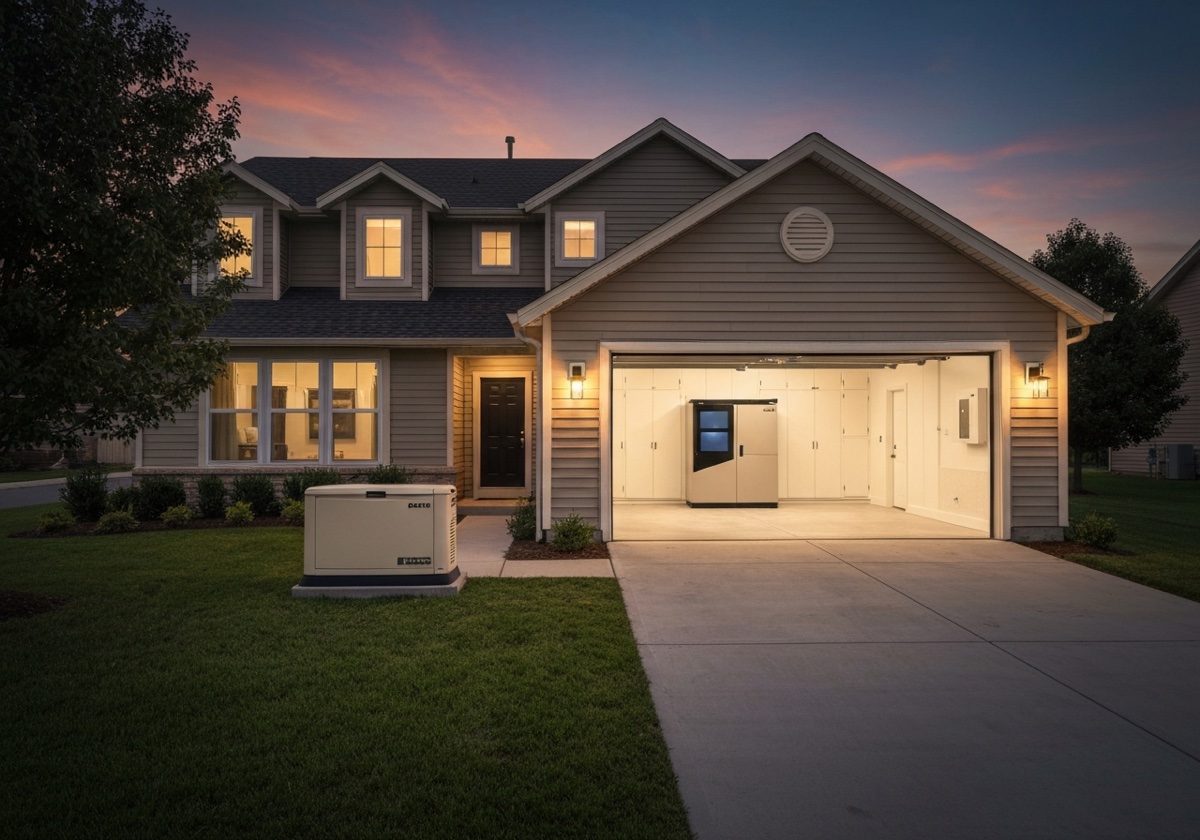
Every serious conversation about home backup power eventually narrows to three paths: a portable power station you can carry into the bedroom, a whole-house standby generator bolted to a concrete pad, or a home solar battery on the garage wall. They all keep the lights on, and that is roughly where the similarities end.
The price spread alone is enormous: a capable power station costs less than a nice television, while a solar battery installation can cost as much as a car. But the deeper differences (automation, runtime, noise, what happens on day three of an outage) matter more than the sticker, and people usually discover them only after spending the money.
This guide compares the three systems round by round, then matches each one to the household it fits. A renter, a homeowner in hurricane country, and someone with a CPAP on the nightstand each get a different answer.
Quick Answer: Power Station vs Generator vs Solar Battery
- Portable power station: Best for renters, short outages, and anyone who values silence and zero maintenance. Roughly $300 to $3,000. Limited capacity is the tradeoff.
- Whole-house standby generator: Best for long, frequent outages and homes with natural gas. Roughly $10,000 to $16,000 installed. Unlimited runtime, but loud and maintenance-hungry.
- Home solar battery: Best for solar owners and outage-prone areas with good sun. Roughly $12,000 to $20,000 before the 30 percent federal tax credit. Silent and automatic, but capacity is finite without panels.
- Dark horse: A power station plus a portable generator, roughly $1,500 to $2,500 combined, beats any single system for many households.
The Three Contenders in Plain Terms
A portable power station is a big lithium battery with AC outlets, USB ports, and usually solar input. No installation, no fuel, no exhaust. You charge it from the wall, and when the grid drops you plug things into it. Capacity runs from about 300Wh to 4,000Wh or more.
A whole-house standby generator is a permanently installed engine, typically 18 to 26kW, connected to a natural gas line or propane tank. An automatic transfer switch starts it within about 30 seconds of an outage, powering the entire panel, central air included, for as long as fuel flows.
A home solar battery is a wall-mounted lithium system (Tesla Powerwall 3, Enphase IQ Battery, Franklin Home Power) storing roughly 10 to 27kWh, wired into your panel. It switches over in milliseconds, runs silently, and, if paired with rooftop solar, recharges every day of the outage.
Round 1: Upfront Cost
The power station wins this round easily. A 1,000Wh unit costs roughly $600 to $900, and even a flagship 4,000Wh system with a transfer switch connection lands around $3,000 to $4,500. There is no installation bill because there is no installation.
Check the current price of the EcoFlow Delta Pro on Amazon.
A standby generator runs roughly $5,000 to $8,000 for the unit, but the finished project (pad, gas plumbing, transfer switch, permits) typically totals $10,000 to $16,000.
A solar battery installation typically runs $12,000 to $20,000 for a single 13.5kWh battery before incentives, and each additional unit adds roughly $8,000 to $10,000. The 30 percent federal Investment Tax Credit softens this considerably, covered in round eight.
Round 2: Running Cost
Here the order reverses. A power station costs pennies per recharge (roughly 15 to 40 cents of grid electricity for a 2,000Wh unit) and nothing from solar panels.
A solar battery costs essentially nothing to operate if panels feed it, and in many utility territories it earns money the rest of the year by charging when rates are low and discharging when they spike.
The standby generator is the expensive one to use. A 22kW unit under load burns roughly 2 to 3.5 gallons of propane per hour, or around $10 to $30 per day in natural gas for moderate loads. A week-long outage can cost several hundred dollars in fuel, and annual maintenance adds roughly $200 to $400 outage or not.
Round 3: Runtime
The generator dominates. Connected to natural gas, it runs for days or weeks, limited only by oil-change intervals (roughly every 100 to 200 hours). This round decides the match for anyone who has lived through a week-long outage.
A solar battery holds a fixed 10 to 27kWh, covering essential loads (fridge, lights, internet, furnace blower) for roughly one to three days. With rooftop solar and decent weather, runtime becomes indefinite for those essentials. In a January ice storm with snow on the panels, it becomes a countdown timer.
A power station is the same story at smaller scale: a 2,000Wh unit runs essentials for roughly half a day to a day, stretched further with rationing and a folding solar panel.
Round 4: Installation
The power station requires none. You take it out of the box and charge it. This makes it the only option of the three a renter can realistically own, and the only one that moves with you.
The standby generator is a genuine construction project: site prep, gas line work, electrical work, permits, and inspection, typically spread over several weeks. Most codes also require clearance from windows, doors, and property lines.
The solar battery sits in between: installers typically finish in one to two days, but permitting and utility interconnection approval often add weeks of lead time.
Round 5: Noise and Placement
The power station and the solar battery are effectively silent and both live indoors or in the garage. A power station can sit on the nightstand next to a CPAP, which no generator of any kind can ever do.
The standby generator produces roughly 60 to 70 decibels at close range, comparable to a central air conditioner, around the clock while running. It must live outdoors, your neighbors will know it is running, and its periodic self-test cycles announce themselves too.
One safety point belongs in every comparison: fuel-burning generators produce carbon monoxide and can never operate indoors, in a garage, or near open windows. Battery systems have no exhaust, so they win by default for anyone who needs power in the room where they sleep.
Round 6: Maintenance
The power station asks almost nothing: top up the charge every few months and store it away from extreme heat or cold. LiFePO4 models are typically rated for 3,000 or more cycles, roughly a decade of use.
The solar battery is similar: no moving parts, no fluids, firmware updates over Wi-Fi, and warranties commonly running 10 to 15 years.
The standby generator is a small engine, and it lives an engine’s life: oil and filter changes, spark plugs, starter battery replacement, and an annual service visit. Skipped maintenance is the leading reason standby generators fail to start when finally needed, which undercuts the entire reason they were purchased.
Round 7: Automation
The solar battery wins on pure speed: transfer in milliseconds, so fast that desktop computers never notice. The standby generator is also fully automatic but takes roughly 10 to 30 seconds to start and transfer, a gap that reboots electronics unless you add a small UPS.
The portable power station is manual by default. When the power fails, someone plugs things in. A few flagship systems paired with a transfer switch can automate selected circuits, but at that point their price approaches solar battery territory.
Automation sounds like a luxury until you frame it correctly: it is the only feature that protects your home when nobody is there. A full freezer, a sump pump during a storm, or a medical device user asleep at 3 a.m. does not care what your system can do, only what it does by itself.
Round 8: Resale Value and Incentives
Home solar batteries qualify for the federal 30 percent Investment Tax Credit, which turns a $16,000 installation into roughly $11,200 net, and several states and utilities stack additional rebates or grid-program payments on top. Installed batteries also convey with the house and are increasingly recognized in appraisals.
Standby generators receive no federal credit, but they tend to add modest resale value in outage-prone markets, where agents treat them as a genuine selling point.
Portable power stations receive no incentives and add nothing to home value, but they cost a tenth as much and move with you, which for a renter is the whole point.
Head-to-Head Comparison Table
| Power Station | Standby Generator | Solar Battery | |
|---|---|---|---|
| Typical cost | $300 to $4,500 | $10,000 to $16,000 installed | $12,000 to $20,000 before 30% credit |
| Runtime | Hours to 1 day (more with solar) | Days to weeks on fuel | 1 to 3 days (indefinite with solar) |
| Coverage | Selected devices | Whole house, including central AC | Essentials to whole house |
| Automatic | No (manual) | Yes, roughly 30 seconds | Yes, milliseconds |
| Noise | Silent | 60 to 70 dB while running | Silent |
| Indoor safe | Yes | Never | Yes (garage or wall mount) |
| Maintenance | Essentially none | $200 to $400 per year | Essentially none |
| Renter friendly | Yes | No | No |
| Incentives | None | None | 30% federal ITC plus state programs |
Which System Fits Your Situation?
Renters: the power station is the only real option, and fortunately it is a good one. A 1,000Wh unit covers the fridge intermittently, the router, and every device you own for a day, needs no landlord permission, and moves to your next address.
Homeowners with rare, short outages: a mid-size power station, roughly $500 to $900, is the rational choice. Five figures for automation you use twice a year is peace of mind at a steep markup.
Check the current price of the EcoFlow Delta 2 on Amazon.
Storm-prone regions (hurricanes, ice storms, week-long outages): this is standby generator country. Fuel-based runtime is the only technology that shrugs at day seven, and natural gas service means you never haul a fuel can. Without gas service, size a propane tank for at least a week of moderate use.
Households with medical needs: layer the solutions. A power station at the bedside provides instant, silent, indoor-safe power for a CPAP or oxygen concentrator, and an automatic system carries the longer outage. The bedside layer matters because it works in the first second, with no one awake to act.
Off-grid ambitions or existing rooftop solar: the solar battery is the obvious fit. It is the only option that turns backup equipment into an everyday asset, cycling daily against time-of-use rates and capturing the 30 percent credit. Adding the battery during a solar installation is meaningfully cheaper than retrofitting later.
Worked Example: One Family, Three Quotes
Picture a family in coastal North Carolina: owned home, natural gas service, a few outages a year, and one hurricane-driven outage every couple of years that runs three to five days. Critical loads (refrigerator, chest freezer, internet, lights, one window AC unit) total roughly 8 to 10kWh per day in summer.
Their three quotes: a 22kW standby generator installed for $13,500; two stacked solar batteries (27kWh) for $19,000, roughly $13,300 after the federal credit, no solar panels yet; or a 4,000Wh power station with a 400W solar panel for $3,800.
The battery quote worries them: 27kWh covers about three days of load, and hurricanes are exactly when rooftop solar underperforms. The generator covers everything indefinitely but adds fuel cost, noise, and annual service. The power station alone covers barely half a day.
They choose a hybrid: a 2,000Wh power station ($1,400) plus a 6,500-watt dual-fuel generator with an interlock kit installed ($1,700), roughly $3,100 total. In a multi-day outage the generator runs a few hours morning and evening to cool the fridge and freezer and recharge the power station, and the battery carries the quiet hours silently. It is not automatic, but it covers a five-day hurricane outage for a quarter of either five-figure quote, and either big system can be added later.
See current pricing for a Champion dual fuel generator on Amazon.
The Honest Recommendation: Hybrids Usually Win
The industry sells these systems as competitors, but they are really specialists. Batteries are instant, silent, and clean but finite. Generators are endless but loud, thirsty, and manual or expensive. Solar recharges everything but answers to the weather.
For a large share of American households, a mid-size power station plus a dual-fuel inverter generator, roughly $1,500 to $2,500 total, outperforms any single system: instant silent power the moment the grid drops, plus unlimited fuel-based runtime for the long haul. Homeowners with solar on the roof should lean battery. Homeowners facing week-long outages should lean standby generator. Everyone else should be suspicious of any answer that starts with five figures.
Frequently Asked Questions
Can a portable power station replace a whole-house generator?
Not for whole-house loads or multi-day outages. Even a flagship 4,000Wh system stores less energy than a standby generator produces in two hours. What it can do is cover essentials (fridge, internet, lights, CPAP) for a day or so, silently and with zero installation, which is all many households need.
Does a solar battery work during a power outage without solar panels?
Yes, as long as it was installed with backup capability (some grid-services-only configurations do not island). Without panels, it runs until the stored 10 to 27kWh is gone, typically one to three days of essential loads. Panels convert it from a big battery into an indefinite power source.
Which option is cheapest over ten years?
For occasional short outages, the power station wins easily: roughly $600 to $900 once, with near-zero operating cost. For frequent long outages, the math tightens. A standby generator’s install plus $2,000 to $4,000 of decade-long maintenance and fuel competes against a solar battery’s similar net cost after the 30 percent credit but near-zero running cost. In sunny regions with time-of-use billing, the battery often comes out ahead by year ten.
Is the 30 percent tax credit available for generators or power stations?
No. The federal Investment Tax Credit applies to home battery storage of 3kWh or more (installed systems like Powerwall qualify), but fuel generators and portable power stations do not. Some states and utilities run separate rebate programs, so check local offerings before you buy.
Costs and incentive details in this article reflect typical U.S. figures at the time of writing and vary by region, installer, and tax situation. Consult a licensed electrician for installation questions and a tax professional regarding credit eligibility.