
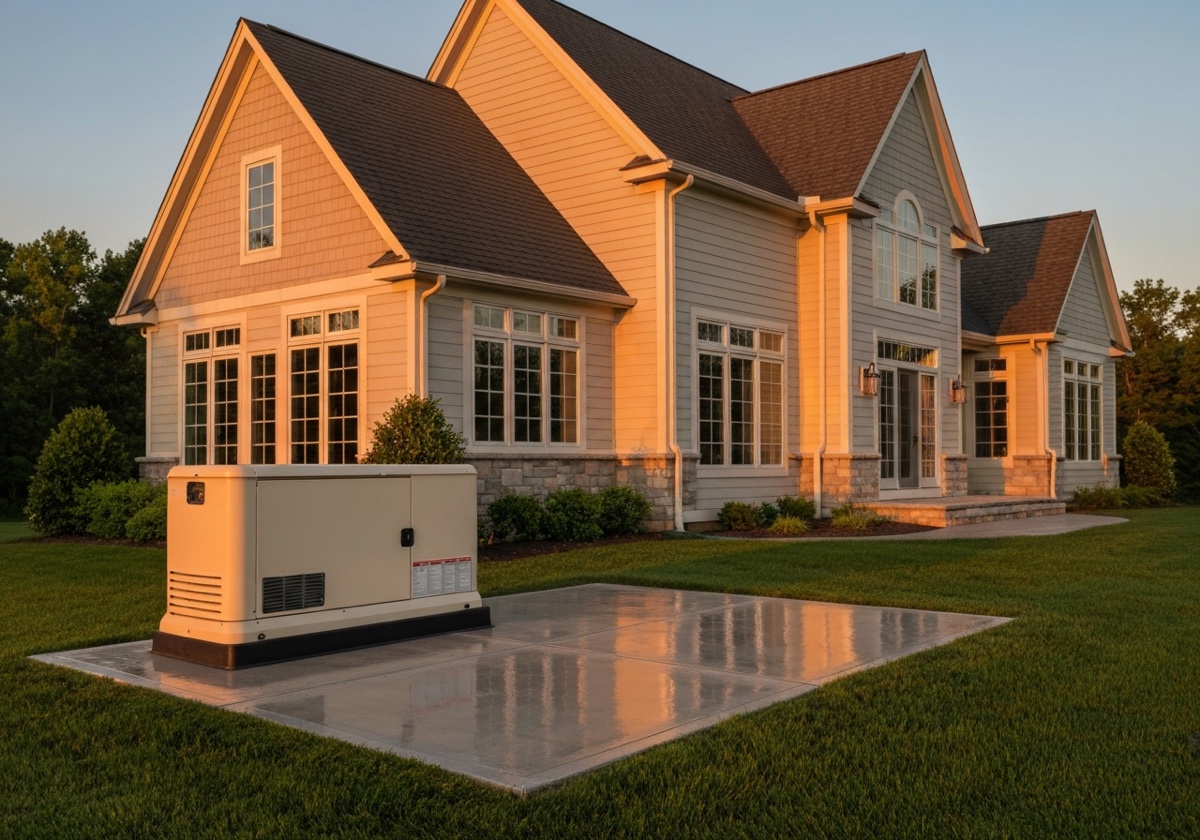
The pitch for a whole house generator is seductive: the power goes out, you barely notice, and life continues exactly as before. The lights stay on, the AC keeps humming, the freezer never warms up. For a certain kind of household, that promise is worth every penny.
But here is what the glossy brochures skip. A whole house generator is not a $6,000 purchase. It is a $12,000 to $18,000 installed project with ongoing fuel, maintenance, and repair costs that continue for the 15 to 20 years the unit sits beside your house. For millions of homeowners, the honest math says a much cheaper solution covers 95% of the same benefit.
So is a whole house generator worth it? It depends on numbers most sales conversations never mention. Here are the seven things nobody tells you before you sign the contract, followed by a straight answer on who should buy one and who should walk away.
Quick Answer: Is a Whole House Generator Worth It?
- Worth it if: you lose power several times a year for multiple days, someone in the home has medical equipment, you work from home with no flexibility, or a well pump and sump pump protect your house from real damage.
- Probably not worth it if: you see one or two short outages a year. A portable generator or a $1,000–$2,000 power station covers those for a fraction of the cost.
- Real installed cost: roughly $12,000–$18,000 for a full-home setup, not the $4,000–$7,000 sticker price on the unit itself.
- Ongoing cost: roughly $300–$500 per year in maintenance, plus $50–$150 per day in fuel when it actually runs.
- Middle path: an essential-circuits (partial home) setup delivers most of the comfort at roughly half the price.
1. The Installed Cost Is Roughly Double the Sticker Price
The number you see advertised, say $5,500 for a 22kW standby generator, is just the machine. Getting it running beside your house involves a concrete or composite pad, an automatic transfer switch, licensed electrical work, a gas line sized for the generator’s demand, permits, and inspections.
In practice, installation typically adds 80% to 120% on top of the equipment price. A $6,000 unit routinely becomes a $12,000 to $18,000 project once everything is in and inspected. Homes that need a gas meter upgrade or a long trenched gas run can go higher still.
The line item that surprises people most is the gas work: it alone can run $1,000 to $3,000, because a 20kW+ generator at full load demands more natural gas than a furnace and water heater combined, and many existing meters and lines cannot supply it.
When you compare quotes, ask for the full turnkey number in writing. A low equipment price with vague installation language is how a $10,000 budget becomes a $16,000 invoice.
2. Fuel Costs During a Long Outage Are Not Trivial
A whole house generator does not sip fuel. A 20–24kW unit running a typical home burns roughly 2 to 3.5 gallons of propane per hour, or around 200 to 300 cubic feet of natural gas per hour, depending on load.
On natural gas, that works out to roughly $50 to $100 per day of continuous running at average U.S. utility rates. On propane, expect roughly $100 to $150 per day, and a standard 500-gallon tank (which only fills to about 400 gallons) can be drained in four to six days of heavy use.
For a two-day outage, that is a manageable $100 to $300. But the same multi-day ice storms and hurricanes that justify a standby generator are exactly the events that produce $500 to $1,000 fuel bills. Propane users also face a quieter risk: delivery trucks may not reach you during the same disaster that knocked out your power, so the tank you start with is the tank you get.
Load management helps. Running the generator on essential loads and letting the AC rest can cut fuel burn nearly in half. But budget for fuel as a real operating cost, not a rounding error.
3. Maintenance Is Mandatory, Not Optional
A standby generator is a small engine that lives outdoors year-round and must start flawlessly after months of sitting idle. That only happens with maintenance.
Manufacturers require annual (or every 100–200 running hours) service: oil and filter changes, spark plugs, air filter, valve adjustments on some models, and battery checks. A professional maintenance plan typically costs roughly $300 to $500 per year. Doing the basics yourself cuts that down, but skipping service voids most warranties, and warranty claims on standby generators are frequently denied for exactly that reason.
There is also the battery. Like a car, the generator uses a starting battery that dies every three to five years, usually around $100 to $150 to replace, and usually discovered dead at the worst moment if nobody checks it.
Over a 15-year life, plan on roughly $5,000 to $7,500 in maintenance alone, plus at least one meaningful repair (controllers, voltage regulators, and starters are the usual suspects).
4. The Home Value Bump Is Real, but Smaller Than Advertised
You will see claims that a standby generator adds enormous resale value. The honest version: appraisal and real estate industry estimates generally put the value bump around 3% to 5% of home value in markets where outages are common, and considerably less where they are not.
On a $400,000 home in hurricane country, 3% to 5% is $12,000 to $20,000, which can genuinely recover most of the installation cost. On the same home in a suburb with reliable power, buyers may treat it as a nice-to-have worth a few thousand dollars, not a premium feature.
Also remember that value fades with age. A 12-year-old generator near the end of its service life is closer to a disclosure item than a selling point. If resale value is a major part of your justification, you are probably stretching the math.
5. Insurance Discounts Exist, but They Are Small
Some insurers offer a discount for a permanently installed, automatically starting generator, on the logic that it prevents frozen pipes, sump pump failures, and food spoilage claims. The typical discount is around 5% or less on the relevant portion of your premium, often translating to roughly $50 to $100 per year.
That is real money, but over 15 years it might total $1,000 to $1,500 against a $15,000 investment. Take the discount if your insurer offers it, ask before you buy so you can document the installation properly, but do not let anyone sell you the generator on insurance savings.
The more meaningful insurance angle is loss prevention itself: a single burst-pipe claim from a winter outage can easily exceed $10,000 in damage and years of higher premiums. For homes with genuine freeze or flooding exposure, avoided losses matter far more than the discount.
6. A Partial-Home Setup Costs Roughly Half as Much
Here is the option many dealers mention last, because it halves the invoice. Instead of a 20–26kW unit backing up every circuit, a 10–14kW generator feeding an essential-circuits panel covers the things that actually matter: refrigerator, freezer, furnace or a portion of HVAC, well pump, sump pump, some lights, internet, and a handful of outlets.
A partial-home installation typically lands around $6,000 to $10,000 installed, versus $12,000 to $18,000 for full coverage. The smaller engine also burns meaningfully less fuel, often 30% to 50% less per day.
What do you give up? Usually central air conditioning for the whole house, the electric range, and the dryer during an outage. Many households discover they can live comfortably without those for a few days, especially since a load-managed system can often run one AC unit part-time anyway. If the full-home quote makes you wince, price the essential-circuits version before walking away from standby power entirely.
7. For Short, Rare Outages, a $2,000 Power Station Wins
This is the comparison the standby generator industry would rather you not run. If your outages are typically a few hours and happen once or twice a year, a large portable power station, roughly $1,500 to $2,500 for 2,000 to 4,000 watt-hours with a 2,000W+ output, handles the refrigerator, internet, phones, lights, a fan or space heater, and a TV with zero installation, zero fuel, zero noise, and zero maintenance.
It sits in a closet, charges from a wall outlet, and works instantly. Add a couple of solar panels and it can recharge itself through a longer event. Pair it with a $700 to $1,000 dual-fuel portable generator for the rare extended outage, and you have a layered backup plan for under $3,500 total, roughly a fifth the cost of a whole house system.
What it will not do: run central air, a well pump on a hard-start compressor, or your whole panel automatically while you are away. That is the honest dividing line. If those loads are essential and your outages are frequent, keep reading. If not, the small solution probably wins.
The Math: Cost per Outage for Two Very Different Families
Assume a full-home standby system at $15,000 installed, $400 per year in maintenance, and a 15-year service life. Ignoring fuel for a moment, that is $21,000 over 15 years, or $1,400 per year of ownership.
Family A: two short outages per year. Over 15 years, that is 30 outages, mostly a few hours each. Their cost works out to roughly $700 per outage, to avoid inconveniences a $2,000 power station would have covered. For Family A, the whole house generator is a luxury purchase, and there is nothing wrong with luxury, as long as it is named honestly.
Family B: ten outages per year, several lasting one to three days. Think rural property with a well pump, or a hurricane-prone coastal area. Over 15 years that is 150 outages, roughly $140 per outage. Each multi-day event without backup would cost them spoiled food (roughly $300 to $700), possible frozen pipes or a flooded basement (potentially thousands), lost work-from-home income, and two or three miserable nights. For Family B, the generator likely pays for itself in avoided losses alone, before counting comfort.
Run your own version of this math with your actual outage history. Your utility’s app or your own memory of the last five years is more useful than any sales projection.
Who a Whole House Generator IS Worth It For
- Frequent multi-day outages. If your area sees extended outages several times a year from hurricanes, ice storms, wildfires, or fragile rural lines, automatic standby power moves from luxury to sensible infrastructure.
- Medical needs. Oxygen concentrators, home dialysis, CPAP with no tolerance for gaps, or refrigerated medication justify power that starts itself even when nobody is home or awake.
- Non-negotiable work from home. If a day offline is a day of lost income or a professional problem, the generator is partly a business expense.
- Well pump and sump pump households. No power means no water, and possibly a flooded basement. These homes get the most concrete financial protection per dollar.
- Frequent travelers and second homes. Automatic start protects a house nobody is in when the storm hits.
Who Should Skip It
- One or two brief outages a year. A power station, or nothing at all, is the rational answer.
- Tight budgets. A $700 dual-fuel portable with a manual transfer switch (roughly $500 to $1,000 installed) delivers 80% of the function for under $2,000 total.
- Short-horizon homeowners. If you may move within three to five years, you will pay full cost and recover only part of it at sale.
- Homes without natural gas and without room for a propane tank. Fuel logistics can quietly break the whole plan. In that case, a whole house battery backup is often the smarter route.
Frequently Asked Questions
How long does a whole house generator last?
Well-maintained air-cooled standby units typically last 10 to 20 years, or roughly 2,000 to 3,000 running hours. Since most homes only accumulate 50 to 150 hours per year (including weekly self-tests), age and weather exposure usually retire the unit before the engine wears out.
Can a whole house generator run continuously for days?
Yes, with caveats. Most manufacturers recommend a brief shutdown to check oil roughly every 24 to 100 hours of continuous running, depending on the model. Natural gas units can run as long as the utility supplies gas; propane units run until the tank is empty.
Is a portable generator with a transfer switch a reasonable middle ground?
For many homes, yes. A 9,000 to 13,000 watt dual-fuel portable feeding a manual transfer switch covers essentials, and often a small AC unit, for roughly $1,500 to $2,500 all-in. The trade-offs are manual start, refueling every 8 to 12 hours, and no protection when you are away from home. For specific model picks, see our guide to the best portable generators for home outages.
Do whole house generators qualify for tax credits?
Generally no. Federal clean-energy credits cover battery storage systems, not fossil-fuel generators. Some states offer sales tax holidays or small incentives in disaster-prone regions, so it is worth a quick check of your state’s programs, but do not build the budget around it.
Prices and figures in this article are typical U.S. ranges as of 2026 and will vary by region, installer, and fuel market. Always get multiple written turnkey quotes before committing to an installation.